How to Prepare for Social Security Disability Hearing starts with the Social Security Administration (SSA) decision letter and the full record. It also requires honest answers about medical history, work, and daily function. Sympathy won’t decide the claim.
Evidence and credible testimony will.
A request for an Administrative Law Judge (ALJ) hearing generally must be filed within 60 days after SSA mailed the applicable appealable decision, although the notice controls and late requests can be complicated. As of 2026, confirm the exact deadline, the benefits involved, and every stated reason for denial. That groundwork keeps the hearing focused on the issues the ALJ must decide.

Quick Answer
How to Prepare for a Social Security Disability Hearing starts with your record. Review the denial, request missing evidence, and organize a clear timeline. Prepare specific answers about symptoms, daily activities, and work.
Practice with a representative without memorizing a script. Bring organized exhibits and report all work accurately.
What preparation method works best?
The best method combines a denial-focused evidence review with truthful, specific testimony.
- Read the decision closely. Record each finding SSA says failed to meet its definition of disability.
- Build the full record. Confirm that treatment, work, and functional evidence is present and current.
- Connect evidence to daily life. Explain how symptoms changed specific activities, not just how much they hurt.
- Practice the likely questions. Rehearse treatment, work duties, bad days, and functional limits without memorizing answers.
Start with paper before you rehearse testimony. Place the decision letter, a short chronology, medical records, work evidence, and a daily-function summary in one review folder. Mark every passage that supports or conflicts with SSA’s findings.
Next, separate legal issues from medical details. A diagnosis matters, but the ALJ also needs to know how the condition limits work-related abilities. The Social Security Administration provides the current forms, benefit rules, and hearing instructions that should control your preparation.
Use a one-page listening guide. It should contain the hearing date, contact details, key dates, disputed issues, and a short list of functional examples. Keep it factual.
A long written script can make testimony sound memorized and less credible.
Never exaggerate, minimize, or invent a symptom to strengthen the claim. Knowingly false statements to a federal agency can lead to civil or criminal consequences under 18 U.S.C. § 1001. Preparation should improve your memory and organization, not change the facts.
How SSA Evaluates Disability at an ALJ Hearing
An ALJ decides whether the evidence supports disability under SSA’s rules. The hearing lets you explain errors in the record, answer questions, and respond to SSA’s findings. It is not a fresh medical examination.
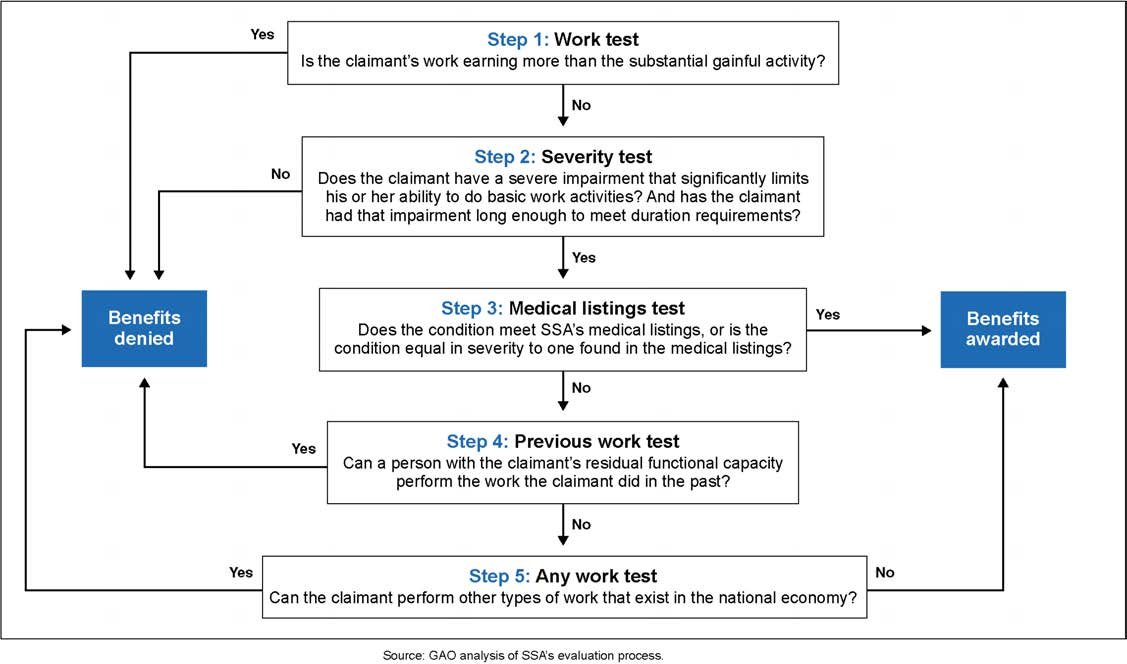
Image source: Wikimedia Commons / U.S. Government Accountability Office from Washington, DC, United States
How does SSA’s sequential evaluation work?
SSA generally uses five steps, although a case can end earlier if the evidence satisfies an earlier step.
| Step | Main question | Evidence that matters |
|---|---|---|
| 1 | Are you disabled under SSA’s legal definition? | Diagnoses, symptoms, limitations, and treatment |
| 2 | Is the impairment or combination of impairments severe? | Medical findings and functional restrictions |
| 3 | Has the severe condition lasted or is expected to last enough time? | Treatment history, prognosis, and expected duration |
| 4 | Can you still perform past relevant work? | Job duties and residual functional capacity |
| 5 | Can you perform other work that exists in significant numbers? | Age, education, work experience, and RFC |
A medical condition does not automatically meet SSA’s definition of legal disability. Severity alone may not be enough if the condition does not meet a listed impairment’s duration requirement. The analysis then moves to your ability to work.
Residual functional capacity, or RFC, is the work-related ability that remains after considering the effects of disability. Your testimony should explain physical tasks, mental tasks, duration, frequency, and the assistance you need. A person may stand for 30 minutes but walk less than a block.
Another may complete a simple task slowly but lose focus after several hours.
Medical findings and symptom reports work together. SSA considers objective evidence, treatment, daily function, symptom duration, frequency, intensity, and any resulting limitations. A treatment gap or earlier improvement does not automatically defeat a claim, but you should explain it honestly.
SSA may use a Medical Expert to interpret the medical evidence and a Vocational Expert to analyze work. Their assumptions must match the record. A VA rating can provide useful evidence, and the VA benefit coordination rules explain why one agency’s decision does not bind the other.
Similar care is needed for developmental disability programs and SSI treatment of child support.
The date of disability also matters. The alleged onset date is when symptoms became disabling. The last insured day applies to SSDI work credits.
Timely SSDI filings can sometimes receive up to six months of retroactive benefits, but that rule is limited. SSI generally has no retroactive payment period. Separate financial rules may also affect SSI, even when both claims reach the same hearing.
Start With the Decision Letter, Denial Reasons, and Administrative Record
The most important preparation comes from matching your evidence to the exact findings in SSA’s decision. If the denial concerns medical severity, focus there. If it concerns past work, earnings, onset date, or insured status, gather evidence for that issue too.
What deadlines and records matter first?
The hearing request generally has a 60-day deadline under 20 CFR Part 404, Subpart J. Read your notice because the decision type and mailing date control. Don’t assume a late request will be accepted.
The hearing notice should also list your contact information, hearing format, and evidence deadline. SSA ordinarily schedules a hearing at least 75 days after the request under 20 CFR 404.922. That scheduling period is not extra time to ignore the evidence deadline.
Submit records as early as practical.
Read the decision for six key details:
- Whether the claim covers SSDI, SSI, or both
- Each diagnosis or issue SSA considered
- The medical findings SSA relied on
- The reasons past work or other work was or wasn’t possible
- The disability onset date or last insured date
- The stated appeal rights and response deadline
The administrative record is the evidence SSA considered before and during the claim. It should contain your applications, medical records, work information, appeal forms, and agency findings. Missing evidence does not automatically become part of the record because SSA could have requested it.
If you missed the reconsideration stage, review the standard appeal process before contacting SSA. You can also check online case tracking to confirm that your appeal was received. Processing problems are common, so understand the possible causes of claim delays.
Create a records request list immediately. Include recent treatment notes, test results, imaging, medication changes, employer records, and outside evaluations. If the hearing notice does not list the records you plan to submit, ask SSA or your representative about the proper submission method.
Use the current hearing regulations to check the rule for your claim type. Regulations matter, but they don’t replace the exact instructions attached to your hearing.
Build a Case Chronology and Organize the Hearing Packet
A one-page chronology gives you and the ALJ a shared map of the case. It shows when treatment started, when symptoms changed, and why the evidence matters. It also reduces the need to search large files during testimony.
How do you create a useful chronology?
Start with the earliest event that affects eligibility and end with the most recent treatment or work attempt.
| Date | Event | Functional effect | Supporting record |
|---|---|---|---|
| Initial symptoms | Pain or cognitive symptoms began | Cleaning and shopping became harder | Primary care notes |
| Treatment change | Medication or dosage changed | Sleep and walking improved briefly | Medication list |
| Work attempt | Job ended after several weeks | Standing and concentration became difficult | Payroll and employer records |
| Latest treatment | New symptoms or restrictions appeared | Assistance was needed at home | Recent clinical note |
Leave blank dates blank. Don’t guess at an exact month or event. You can use “spring 2025” or “before March 2026” when that level of accuracy is reasonable.
Organize the packet into four simple groups:
| Packet section | Contents |
|---|---|
| Core documents | Decision letter, hearing notice, chronology, and exhibit list |
| Medical evidence | Treatment records, test results, clinical notes, and source opinions |
| Work evidence | Job descriptions, payroll records, tax forms, and work-attempt details |
| Function evidence | Function reports, third-party statements, and relevant daily-activity records |
Give each group clear tabs and consecutive page numbers. Keep one copy of every document and one spare paper copy if permitted. Your representative or the hearing office may control how electronic exhibits are handled, so confirm the process before the hearing.
Accurately complete any Function Report or Third-Party Statement. These forms can show how long tasks take, how often symptoms occur, and what help you need. A lay witness should describe only what they personally observed.
They shouldn’t guess at a diagnosis or medical restriction.
Ask each medical source for their own opinion about diagnosis, symptoms, prognosis, and work limitations. If appropriate, request an SSA Form SSA-1696. Never draft or change a clinician’s answers.
The value comes from the source’s independent judgment.
If a record is missing, make reasonable written requests before the hearing. Identify the provider, dates of service, and type of record you need. If ordinary requests fail, tell the ALJ or your representative well before the hearing.
A subpoena is a possible next step, not the first one. Ask the ALJ to issue one when relevant evidence cannot reasonably be obtained and your requests have failed. Provide the correct name, address, and a specific description of the records needed.
Don’t use a subpoena to send repeated demands to a doctor or employer.
Finally, reconcile every job and money source. Include self-employment, cash work, volunteer work, and unsuccessful work attempts. Accurate reporting helps you explain the work evidence and avoids surprises about benefit eligibility or overpayments.
Prepare Your Testimony for Questions, Memory, and Cross-Examination
Prepared testimony answers clear questions with specific facts from the record. It should sound natural when you speak, not like a speech delivered from memory.
Image source: Openverse / DickClarkMises
How should you answer the ALJ’s questions?
Answer the question asked, then add the detail needed to explain the functional effect.
A useful four-part structure works for many questions:
- State the task or symptom.
- Give its duration and frequency.
- Explain the effect on your body or mind.
- Connect it to treatment, work, or daily life.
For example, if asked about lifting at work, “I can’t do anything” may sound inaccurate. A more useful answer explains what you could lift, for how long, how often, and what happened afterward. Use real facts from your life, not invented details designed to sound severe.
Prepare a short opening statement if the ALJ allows one. It can follow four beats: when your condition began, how it changed your work, how it affects daily life, and why you believe SSA’s decision is wrong. Keep it brief so the real testimony receives most of the hearing time.
Practice common question areas:
- What treatment are you receiving now?
- Which symptoms limit standing, walking, lifting, or concentrating?
- How often do your limitations change?
- What happened during each work attempt?
- Why did a doctor increase, decrease, or stop a treatment?
- What help do you need at home?
- What could you still do during a good day?
During questioning, listen until the question ends. Answer in your own words, and ask the ALJ to repeat or clarify anything you didn’t understand. Correct a mistaken assumption as soon as you notice it.
You shouldn’t volunteer a long answer when a short one will do.
Differences in the record deserve a calm explanation. Symptoms can vary with sleep, stress, medication cycles, weather, or disease flares. Missed appointments may reflect cost, transportation, forgetting, or another barrier.
State what happened without blaming or guessing.
Good days don’t automatically disprove a claim. Likewise, bad days should be described accurately rather than used to describe every moment. Explain the pattern, frequency, duration, and triggers that produce the change.
If fatigue, anxiety, hearing trouble, or memory problems affect you, tell your representative before the hearing. Ask for clarification, repeat the question when needed, or request a short break. You remain responsible for giving truthful answers, but you shouldn’t have to guess at words you didn’t hear.
Your goal is accuracy, consistency, and understanding. The best preparation makes those qualities easier to demonstrate under pressure.
Choose Witnesses, Experts, and Representation Wisely
A witness can support the record, but no one can testify for you. You must answer questions, and every witness must speak from personal knowledge. Choose people who add accurate evidence, not extra volume.
Who should appear as a lay witness?
A lay witness should be someone who regularly saw or heard your daily limitations and can describe them from firsthand observation. A spouse, adult child, neighbor, caregiver, or former coworker may be useful if that person knows the tasks you struggled with. A person who only knows your diagnosis usually adds little.
Before the hearing, ask the witness to recall dates, activities, frequency, and help you needed. Don’t feed them a story or ask them to guess at medical restrictions. Their value comes from clear memory and honest observations.
Prepare them for narrow questions. The ALJ may ask whether you climbed stairs, carried groceries, forgot appointments, or needed help bathing. A clear example is stronger than a broad statement that you were unable to function.
When is a Medical Expert useful?
A Medical Expert is useful when medical records are complex, conflicting, or central to the disputed findings. The expert interprets the medical evidence and may testify about diagnosis, prognosis, symptoms, and functional limitations. The expert does not replace your treating providers or provide ongoing care.
The ALJ decides whether to call a Medical Expert. Give the expert the full packet and identify the disputed findings, but don’t ask for a preferred conclusion. A treating source’s own opinion, such as an SSA-1696, may support the same issues.
A consultative examination is different. It is an SSA-requested examination used to resolve medical questions, not a replacement for your hearing testimony.
When is a Vocational Expert useful?
A Vocational Expert is useful when the case turns on past relevant work, remaining work abilities, or other jobs. The expert analyzes how a person’s abilities and limitations match real jobs. A Vocational Expert cannot decide whether a medical diagnosis is true.
At the hearing, the ALJ may give a hypothetical set of abilities and ask what work a person with those abilities could do. If the hypothetical conflicts with the evidence, state the conflict clearly and cite the relevant record page. Never argue about the person’s name or workplace instead of the actual limitation.
Ask the ALJ to clarify any unclear assumption. A 20-pound lifting limit is very different from a 50-pound limit, even if both sound physically demanding.
How do you choose representation?
Choose an attorney when the case involves complex medical issues, disputed work, earnings, multiple programs, or a possible court appeal. An eligible accredited non-attorney representative can help with evidence and hearing preparation. Self-representation can work when the record is manageable and you can explain the evidence clearly.
| Situation | Useful choice | Main benefit |
|---|---|---|
| Several medical or work issues | Attorney | Broader legal strategy and hearing experience |
| Straightforward record | Self-representation | Direct control and lower legal costs |
| Help with forms and evidence | Accredited representative | Support without attorney fees |
SSA does not appoint a lawyer for claimants. Ask any representative for a written fee agreement, expense policy, and explanation of who pays experts, copies, and travel. No representative can guarantee approval.
Handle Deadlines, Costs, Evidence Rules, and Work-Related Risks
A missed date can hurt a claim more than one imperfect exhibit. Put every deadline in one calendar. Confirm dates with the decision letter, hearing notice, and current SSA instructions.
What deadlines matter after a hearing request?
Track each date separately, because a deadline for one appeal does not replace another.
| Event | General rule | Practical action |
|---|---|---|
| Hearing request | Usually 60 calendar days after SSA mailed the appealable decision | File before the stated deadline |
| Hearing scheduling | A hearing generally is not scheduled within 75 days of the request | Treat this as a planning period, not a guarantee |
| Evidence cutoff | The date shown on the hearing notice | Submit earlier whenever possible |
| Appeals Council review | Usually 5 calendar days after the ALJ decision | Calendar the decision date immediately |
| Federal court filing | Generally 60 days after the final administrative decision | Confirm the date in the decision notice |
| Expedited appeal | Usually 180 days after the ALJ decision, if eligible | Check the special requirements |
The hearing notice controls the evidence cutoff. Don’t wait for the hearing date to send records. If a deadline has passed, contact SSA or your representative immediately and ask about available options.
An expedited appeal is not an ordinary second hearing. It follows separate rules and is available only in qualifying situations. Read the notice before assuming you qualify.
What can a hearing cost?
There is no filing fee for an SSA ALJ hearing. Private attorney and representative fees vary by experience, location, case complexity, and the agreement you sign.
In qualifying cases, the Equal Access to Justice Act may allow fees to be paid from past-due benefits. Ask how that arrangement works before signing a fee agreement. Experts, copies, travel, transcripts, and medical records may create separate expenses.
Get the cost terms in writing. Ask who pays each expert, whether the representative receives a percentage or hourly fee, and whether expenses are refundable if benefits are denied. Don’t agree to a large fee without understanding the payment trigger.
What should you do about work while waiting?
Report every work attempt and keep accurate records. The annual substantial gainful activity amount changes, and SSDI trial-work rules do not always match SSI rules. A work attempt can affect payments even if it lasts only a short time.
| Work detail | Record to keep |
|---|---|
| Start and stop dates | Calendar entries and employer records |
| Hours and earnings | Pay stubs, payroll records, and tax forms |
| Duties | Job descriptions and supervisor statements |
| Expenses and support | Receipts and records of transportation or equipment |
A trial work period may allow benefits to continue temporarily, but it doesn’t protect every work attempt. Ask SSA how a planned job could affect benefits and whether notice is required. If employer coverage ends, check coverage assistance before treatment becomes unaffordable.
What legal and privacy warnings apply?
Use the release forms SSA requests, along with a HIPAA authorization when your provider requires one. Submit only records relevant to the claim, and use a secure method for medical information.
Never sign or submit a false statement, altered record, or invented work history. A subpoena is not automatic. The ALJ must decide whether the evidence is relevant and cannot reasonably be obtained another way.
SSA hearings are administrative proceedings, not ordinary court trials. Ask your representative about burden, deadlines, subpoenas, and evidence rules before the hearing.
Mistakes That Can Hurt Credibility or Your Claim
The strongest hearing preparation doesn’t guarantee approval. It gives you a fair chance to explain the record accurately. Most avoidable mistakes involve poor preparation, overstated testimony, or missed evidence.
Which mistakes most often weaken a claim?
The most common mistakes are:
- Waiting until the hearing to request missing records.
- Relying on a diagnosis without explaining daily function.
- Saying every task is impossible when the evidence shows partial ability.
- Ignoring earlier improvement, treatment gaps, or changes over time.
- Failing to list self-employment, cash work, or unsuccessful attempts.
- Sending a large evidence bundle without an exhibit list.
- Arguing with the ALJ instead of answering the question.
- Using a witness who has not confirmed the facts they plan to discuss.
Each mistake has a practical fix. Request records early, describe limits with examples, and explain changes with dates. Keep the hearing packet focused on the issues SSA actually decided.
How do you handle a contradiction?
A contradiction in the record doesn’t automatically defeat a claim. Acknowledge it, explain the context, and point to the evidence that supports your account.
For example, an older note may say you could walk 30 minutes, while a later Function Report says 10 minutes. Treatment, medication, pain, or a bad-day pattern may explain the change. Say what you remember without inventing a better version.
If you don’t know why two records differ, say so. The ALJ can assess the gap. A calm explanation is more useful than a rehearsed theory that the evidence doesn’t support.
What if you cannot remember?
Answer honestly by saying that you don’t remember the exact detail. Then explain what you do remember, including the approximate date, location, task, or people involved. Check your notes or packet if permitted, but don’t guess.
A wrong date is usually less damaging than a confident invention. If memory or concentration worsens during the hearing, ask for the question to be repeated or clarified. You can also request a short break through your representative or the ALJ.
How do you recover from a mistake during testimony?
Correct yourself as soon as you notice the error. Say, “I misspoke,” then give the accurate fact. Don’t argue with the person who asked the question or add more confusion.
For example, if you said you stopped working in 2024 but meant 2025, correct the year and explain the work attempt. If you realize the problem later, tell your representative before the appeal deadline. The recovery plan is simple: acknowledge it, document it, and address it in the next permitted filing.
Review the ALJ’s Decision and Protect Your Next Legal Step
The hearing is over, but your claim may not be. Read the decision carefully, separate favorable findings from unresolved issues, and calendar every appeal date before doing anything else.
What should you do when the ALJ decision arrives?
Read the entire decision, including the action taken and the findings on every disputed issue. Compare each finding with the evidence you submitted and the issue you requested the hearing to decide.
A favorable decision may still limit the onset date, amount of benefits, or other issue. A denial may explain that a different date or work finding was used. Download or request a copy of the decision and save every attachment.
Create a two-column list. Put the favorable findings in one column and the adverse findings in the other. Then mark each error, missing fact, or unclear explanation for review.
How do you request Appeals Council review?
A request for Appeals Council review is generally due within 5 calendar days after the ALJ decision. Submit the request through the method stated in the decision notice, and identify the findings you believe are wrong.
The Appeals Council usually reviews the existing record. It does not normally hold a new evidentiary hearing. It can deny the appeal, issue a different decision, or send the case back for further proceedings.
Attach a short explanation of the error. Point to specific records and explain why the ALJ misread them. Don’t add a new argument that your representative could have raised earlier without checking the case.
When is a supplemental claim or federal court review available?
Use a supplemental claim only when new evidence about an existing condition could change the decision, and confirm the current filing rules first. A later medical record does not automatically create a new claim or reopen a hearing.
Federal judicial review generally requires a final administrative decision. A civil action is commonly due within 60 days after the Appeals Council decision, or after the ALJ decision when review is not requested. The court usually reviews the administrative record, so legal help can be valuable.
What should you preserve after the hearing?
Keep the hearing notice, evidence packet, exhibit list, submission receipts, decision, and every appeal filing. Save the dates and names of people who handled the case.
Keep work records, pay stubs, benefit statements, medical reports, and correspondence about coverage. If SSA provides a recording or transcript, save that copy too. A single benefits calendar should include the hearing date, evidence deadline, decision date, and every appeal deadline.
Frequently Asked Questions About Social Security Disability Hearing Preparation
How long does it take to prepare for an SSDI hearing?
There is no fixed SSA preparation period. A simple, well-documented claim may need a few focused sessions, while a complex claim can take several weeks or longer. Start after the decision arrives, request the record, gather missing evidence, and practice testimony before the hearing notice deadline.
Treat these as planning estimates, not SSA guarantees.
Can I prepare without a lawyer or representative?
Yes. You can appear without a lawyer or accredited representative, and SSA does not appoint one for you. You remain responsible for knowing the record, presenting evidence, and answering questions.
Representation is most useful when several impairments, work issues, earnings, or a possible court appeal complicate the case.
What if my medical records are missing or incomplete?
Missing records can hurt a claim, but they do not automatically decide it. Request the records in writing, ask SSA to add them to the file, and submit them before the notice deadline. If ordinary requests fail, tell the ALJ or your representative promptly and ask whether a subpoena is appropriate.
Should I work while waiting for the hearing?
Work while the claim is pending can affect benefits, so report it and keep accurate records. The annual substantial gainful activity limit changes, and SSDI trial-work rules do not always match SSI rules. Ask SSA how a planned attempt may affect payments, Medicare, Medicaid, and any later overpayment.
What happens if I disagree with the ALJ’s decision?
You usually have a short period to challenge an ALJ decision. A request for Appeals Council review is generally due within five calendar days, while a federal court filing is generally due within 60 days after the final administrative decision. Read the decision notice, calendar every date, and get legal help quickly if you want to continue.