
SSI and Child Support Income Rules Explained can feel contradictory when a family receives a payment through one program while another program affects the same money. The key issue isn’t simply whether the words “child support” appear on a deposit. You need to know who receives it, who pays it, and which agency controls the benefit.
A parent on SSI may have support withheld under a court order, yet that withholding doesn’t automatically change the federal SSI income calculation.
Those separate rules create problems when families count one payment twice or assume every state program follows the Social Security Administration. As of 2026, the maximum federal monthly SSI payment is $994 for one eligible person and $1,491 for an eligible couple, before any state supplement. The SSA SSI program provides the federal baseline, but state Medicaid, TANF, General Assistance, and SNAP rules may differ.
Start with the quick answer, then work through each program..
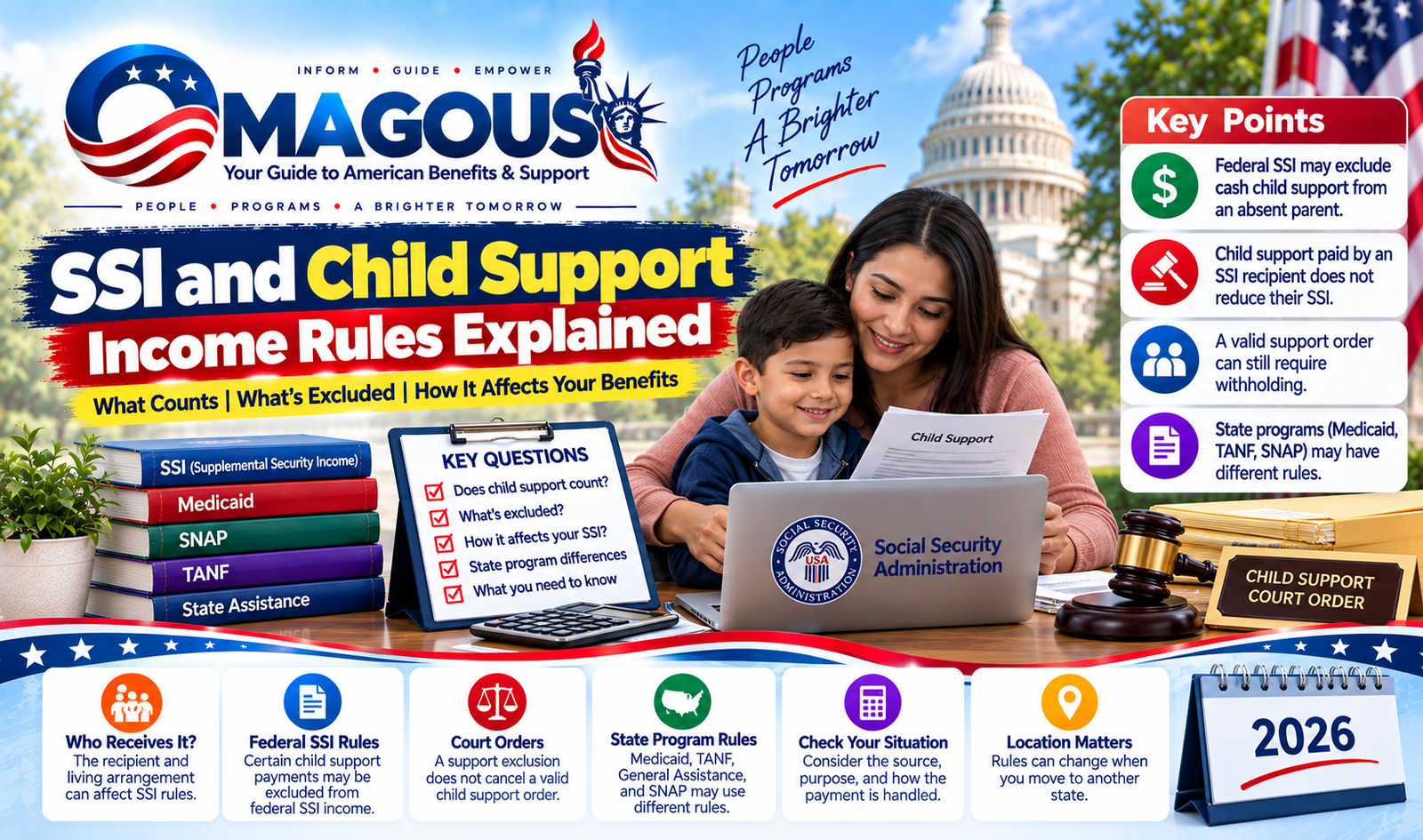
SSI and Child Support Income Rules Explained
Quick Answer
SSI and Child Support Income Rules Explained: does support received count?
Federal SSI can exclude cash child support from an absent parent.
Support paid by a recipient doesn’t reduce that recipient’s SSI.
Income exclusion doesn’t block a valid support order.
State programs may apply different rules.

Image source: Wikimedia Commons / Becker, S.D.
Does receiving child support always change SSI?
No. Federal SSI uses specific exclusions for qualifying cash support paid by an absent parent. The payment’s source, purpose, recipient, and living arrangement all matter.
| Payment situation | Federal SSI starting point |
|---|---|
| Cash support from an absent parent for a child outside the recipient’s home | Generally excluded from federal SSI income |
| Support paid for a child who receives SSI | A special SSA rule may apply |
| Rent, food, or other support provided directly | The cash-support exclusion may not apply |
| Support paid by an SSI recipient | Not income received by that recipient |
| Support collected by a state agency | Assignment and pass-through rules control |
A support exclusion answers an income question. It doesn’t cancel a court order, prevent lawful withholding, or automatically protect the money from state-program rules.
Why SSI and Child Support Rules Can Change Your Benefits
We keep coming back to one point. A federal SSI exclusion doesn’t rewrite a state support order or another benefit program’s rules. Each system has its own definition of income, resources, ownership, and enforcement.
Why the three rules diverge
SSI asks whether money is countable under federal income and resource rules. A child-support case asks who owes support, how much is due, and whether an order must change. Medicaid, TANF, General Assistance, and SNAP each use their own eligibility and counting rules.
| Decision | Controlling authority | Main consequence |
|---|---|---|
| Countable SSI income | Federal SSA regulations | Changes the monthly federal SSI amount |
| Child-support amount and arrears | State law and the support order | Creates or changes a payment obligation |
| Support withholding | Federal limits and the legal order | Reduces or redirects the benefit actually received |
| Medicaid or cash assistance | Federal and state program rules | May affect eligibility or payment amount |
| State SSI supplement | State rules | May use different treatment from federal SSI |
A mistake can therefore create more than one problem. Reporting exempt support as countable income may lead to an SSI overpayment. Ignoring a support order can lead to enforcement action.
Assuming support can’t be withheld can leave a family surprised by a smaller deposit.
Why location matters
Federal SSI continues when you move, but the state supplement can change. Medicaid, TANF, General Assistance, SNAP, and child-support administration also vary. Our guide to moving between states explains the parts that commonly change after a move.
Always identify the agency issuing the payment. A note from a state child-support office doesn’t necessarily change a federal SSI award. A state supplement notice also doesn’t replace the SSA decision.
Federal SSI Rules: Countable Income, Excluded Income, and Resources
Federal SSI rules distinguish income from resources. Income is money received during a month, while resources are cash and property a person owns. A payment can be excluded as income without becoming money the recipient is free to spend.
What does federal SSI treat as countable income?
Countable income is income left after SSA applies all applicable exclusions. Wages, Social Security benefits, SSDI, and many other payments can affect SSI. Child support is different only when it meets the applicable exclusion.
For an eligible individual, the maximum federal SSI payment is $994 a month in 2026. The maximum is $1,491 for an eligible couple. Those amounts don’t include every state supplement, and countable income can reduce the federal benefit.
Which child support payments are excluded?
Federal SSI generally excludes cash support from an absent parent for a child who isn’t living in the recipient’s household. SSA also has provisions that apply when support is paid for a child who is an SSI recipient.
Past-due support can generally be excluded when it represents support for earlier months and meets SSA’s requirements. A regular payment still doesn’t become an arrears payment merely because the state sends it as one lump sum.
The exclusion has limits:
- It generally concerns cash support, not rent, food, or other in-kind support.
- It usually concerns support from an absent parent.
- The child and payment purpose must match SSA’s rules.
- A transfer from a parent living in the household can receive different treatment.
- Other programs can treat the same payment differently.
The basic 2026 SSI reduction formula starts with a $20 general income exclusion. It then allows a $65 earnings exclusion, followed by a 50% reduction of remaining countable income. Child support must be treated correctly before you apply that formula.
How does the SSI income formula work?
The formula doesn’t always reduce SSI by the same amount as the countable income. That’s why a $100 reduction in income doesn’t always produce a $100 reduction in benefits.
Spousal or parental “deemed income” rules may apply. Deemed income means a portion of another person’s income is considered available under SSI rules. The result depends on living arrangements and program rules, as our household-based SSI guide explains.
Are child support payments resources?
Money that properly belongs to a child or adult child generally isn’t the SSI recipient’s personal property. Support collected and held for a child also needs to be separated from the parent’s own income and resources.
The basic federal resource limits are $2,000 for one person and $3,000 for a couple. Certain resources receive special treatment. A vehicle usually isn’t counted if the person doesn’t use it for transportation, though SSI vehicle rules explain the exclusions.
Use the official SSI income and resource limits as a starting point. Your award notice controls if your personal situation produces a different result.
What happens on a disabled child’s SSI application?
Parental income can be deemed on a child’s application even when the child receives child support. One-parent and two-parent living-arrangement rules then become relevant. Don’t assume that an exclusion available to the parent also resolves the child’s application.
Report who receives the support and who controls it. State agencies often want that information during a separate IV-D child-support review.
When an SSI Recipient Has a Child-Support Order
Receiving SSI doesn’t erase an existing support duty. If you’re a noncustodial parent on SSI, a court order or state agency may still require current support and arrearsand arrears. Your inability to work may support a request for a lower order, but it doesn’t erase the order by itself.
Can SSI be withheld for current support?
Yes. Federal law places limits on withholding from SSI, and a state agency can take support through an income-withholding order. A valid order may allow the agency to withhold part of each payment until the current obligation is met.
The limits aren’t the same for current support and arrears. A state must use the correct calculation and send any notice required by state and federal law. Ask the agency for the amount withheld, the balance remaining, and the law used to calculate it.
If you think the withholding is wrong, benefit garnishment basics can help you identify the next question. Don’t simply stop payments yourself. That can create arrears or enforcement trouble.
Does paying support reduce your SSI?
No, not merely because you pay it. Money you pay is money leaving your control, not new income received. The payment could still change your circumstances, such as your ability to pay rent or buy food.
If support comes from wages or another ongoing source, the state may recalculate the order. SSI may also affect income available for support under state rules. Ask the child-support agency to show its calculation before assuming the order is accurate.
Should the order be modified?
Consider modification if your work, benefits, disability, custody, or income has changed materially. Gather your award letter, medical evidence, support order, payment history, and current budget.
Send the request through the issuing court or child-support agency. Keep paying until an official decision changes the order.
SSI and Other Benefits: Why Each Program Has Different Rules
A federal SSI exclusion doesn’t control every public program. Each agency decides whether the payment is income, whose money it is, and which deductions apply.
| Program | Main caution |
|---|---|
| Federal SSI | Follow SSA’s child-support income and resource rules |
| State SSI supplement | Check the state supplement rules |
| Medicaid | Review the eligibility pathway and state income treatment |
| TANF or General Assistance | Ask how the state counts support and assigned payments |
| SNAP | The federal household rule and state eligibility method matter |
Why Medicaid may look different
SSI can qualify you for Medicaid in many states. Someone applying through another Medicaid pathway can face different income rules. Our guide to Medicare Extra Help can help with a related low-income benefit, but it doesn’t replace state Medicaid guidance.
Why SNAP and cash assistance don’t always match SSI
SNAP and state cash assistance may consider support as household income. Exclusions for federal SSI don’t automatically carry over. A state can also apply different disregard rules.
The SSA Red Book is an official federal reference for SSI. For state programs, use your state agency’s rules and ask which eligibility pathway applies.
A Step-by-Step Decision Guide for Your Situation
Start with the payment, not the program name attached to it. A single deposit can affect several agencies, but each agency applies its own rules.
List every source of money. Record SSI, Social Security or SSDI, a state supplement, regular support, arrears, and any cash assistance. Include the payer, recipient, amount, frequency, and payment dates.
Identify the legal owner. An obligor owes support. An obligee or child is entitled to receive it. A representative payee manages the child’s benefits. A state agency may hold assigned rights.
Classify the payment. Ask whether it came from an absent parent. Confirm that it was cash, rather than rent, food, or other in-kind support. Check whether the child lived outside the adult recipient’s home.
Separate current support from arrears. A one-time payment isn’t automatically arrears. Match it to earlier unpaid months and confirm the balance on the state payment ledger.
Check the income rule and enforcement rule. Determine whether the payment is excluded from federal SSI income. Then review whether a lawful order permits withholding or another collection method.
Apply each program’s rules. Use SSA rules for federal SSI. Use state rules for Medicaid, TANF, General Assistance, SNAP, and any state supplement. Apply the support order and state law to enforcement.
Build an evidence packet. Keep award letters, orders, assignment notices, payment ledgers, deposit records, and correspondence. Request a written determination when the agencies give different answers.
If the facts remain unclear, ask SSA, the state child-support agency, and the relevant benefits office to identify the exact rule they applied. Don’t assume one agency’s answer controls another.
Real Situations: How the Rules Apply in Practice
An adult receives $300 each month for a child elsewhere
The child lives outside the adult’s home, and an absent parent pays $300 monthly in cash. Federal SSI may exclude that support from the adult’s countable income.
The family still needs separate answers for Medicaid, TANF, General Assistance, or SNAP. Those programs can use different income definitions and household rules. Keep the order and payment ledger available.
A disabled child’s $200 payment goes through a representative payee
The child receives SSI, and a representative payee manages both benefits and qualifying support. A federal child-support exclusion may apply to the child’s SSI calculation.
The representative payee doesn’t become the owner of the money. The payee must account for the payment and use it according to the child’s needs and applicable program rules. A state assignment can add further payment requirements.
A noncustodial parent on SSI has a $150 monthly order
The parent remains responsible for support unless an agency or court changes the order. Paying $150 doesn’t create $150 of new income for that parent.
A state agency may use an income-withholding order to collect the payment. Ask which part covers current support and which part covers arrears. Also ask for the calculation used to determine the amount withheld from SSI.
A $1,200 payment arrives as “back support”
The payment isn’t qualifying arrears merely because it combines several months. A state ledger should show the original due dates, prior payments, and remaining balance.
If it represents qualifying past-due support, the federal SSI exclusion may still apply. State Medicaid or cash assistance rules can produce another result. Use the legal description, not the deposit label, to classify it.
Support is assigned to a state agency
Some families assign child-support rights when a child receives certain public services. Federal IV-D rules protect the child’s entitlement through state pass-through procedures.
Assignment doesn’t mean the state keeps every dollar. It changes who receives the payment and how it is accounted for. Ask the state agency about the child’s benefit, the assignment amount, and any remaining amount passed through.
Mistakes That Can Cause an SSI Overpayment or Support-Order Trouble
The most common errors come from treating every child-support payment the same. The table below shows the correction for frequent problems.
| Common mistake | Why it causes trouble | Safer approach |
|---|---|---|
| Counting all incoming support as income | The payment may meet a federal exclusion | Check the payer, child, home, and payment type |
| Counting support paid by the recipient | Money paid out isn’t income received | Record it as a support expense or withheld amount |
| Using one ledger for the parent and child | It can assign the same money twice | Keep separate ownership and case records |
| Calling one lump sum “arrears” | The payment may cover current support | Match it to unpaid months on the state ledger |
| Assuming SSI rules control Medicaid or SNAP | State programs can count it differently | Ask each agency about its own rule |
| Treating a representative payee as the owner | The payment belongs to the child | Account for it as the child’s money |
| Paying a new person without approval | It can create arrears or legal trouble | Follow the order and state payment instructions |
| Stopping payments during a dispute | Unapproved nonpayment can trigger enforcement | Seek clarification while complying with the current order |
An overpayment notice or unexpected withholding shouldn’t be ignored. Check the figures, compare them with the legal documents, and request a correction through the proper agency.
Never move a child’s support into an unrelated personal account. A temporary mix-up can become a custody, accounting, or child-support enforcement issue. Keep the payment traceable and used for the legally permitted purpose.
Deadlines may run while you’re gathering records. An SSA appeal usually has a 60-day filing period from the notice. Child-support deadlines vary by state and action, so check them immediately.
State Rules, Legal Limits, and When to Get Help
Which state controls each decision?
Federal SSI follows SSA rules nationwide. State benefit agencies usually use the rules for the applicant’s current residence. A support order is controlled by its issuing court, state law, and applicable choice-of-law rules.
Moving doesn’t automatically end or transfer a support order. Contact the state central registry or family court to confirm where you must file a change. Separately, notify the agencies administering Medicaid, TANF, General Assistance, SNAP, or a state supplement.
What are the federal SSI withholding limits?
Under section 408(b) of the Social Security Act, federal withholding from SSI is generally capped at 10% of the monthly payment for current support. The limit is generally 20% for child-support arrears.
The percentages aren’t automatic collection amounts. The agency must identify a valid legal basis and apply the rule that fits the order. Don’t add current-support and arrears percentages together yourself.
Ask for the exact calculation and supporting notice.
A support exclusion answers an SSI income question. It doesn’t prevent a lawful collection under the correct authority. An agency that withholds more than the applicable legal rule allows should provide its calculation and formal appeal rights.
Which agency can change the support amount?
Usually, the issuing court or the state child-support agency decides the support amount. SSA decides SSI eligibility and payment. It doesn’t decide how much support a parent owes.
If your income, disability, work status, custody, or payment changed, submit records through the child-support case. An SSA appeal normally won’t resolve a disagreement about the support order itself.
When should you seek legal help?
Get legal aid or family-law advice if an agency threatens enforcement, the order appears inconsistent with state law, or a payment is assigned. Also seek help if child funds are unaccounted for or a withholding exceeds the claimed legal limit.
Ask SSA for a reconsideration through the notice’s stated process. Ask the child-support agency for its administrative hearing options. State deadlines can be short, and some hearings don’t pause withholding unless the law says they do.
Bring organized records to every meeting. Separate SSA, Medicaid, SNAP, and support questions so each agency answers the issue it actually controls.
Frequently Asked Questions
Does child support reduce federal SSI?
No. Qualifying cash support from an absent parent is generally excluded from federal SSI countable income when received for a child outside the recipient’s custody. That exclusion doesn’t cancel a support order, and state Medicaid, TANF, General Assistance, or SNAP rules may treat the payment differently.
Is child support excluded on a disabled child’s SSI application?
Often, yes. Federal SSI has an exclusion for qualifying child support received on behalf of a disabled child, including support administered through a representative payee or assigned state system. The money remains the child’s.
Keep the order, assignment notice, and payment ledger to establish ownership.
Can a parent use child support received for a child?
Only as the order, assignment, and applicable law allow. Money belonging to a child should be used for the child’s benefit under any representative-payee or state pass-through requirements. A parent shouldn’t treat it as unrestricted household income without checking the controlling rules.
Can SSI be garnished for current support or arrears?
Yes. A valid court order or other federal authority can permit withholding even when support is excluded from SSI income. Federal rules generally cap withholding at 10% of monthly SSI for current support and 20% for arrears.
Ask the agency for its statutory calculation and notice.
Does receiving SSI change a child-support order?
Not automatically. State agencies may consider SSI when calculating income available for support, public assistance, or ability to pay. A disability or work change can support a modification request, but the order remains controlling until an authorized agency or court changes it.
What if SSA and my state treat the payment differently?
They can treat it differently because SSA and state agencies use different statutes and purposes. Don’t assume either agency is wrong. Keep the order, assignment notice, payment ledger, and correspondence, then request a written decision from each agency.