How to request a waiver for an SSI overpayment starts with reading the notice SSA sent you. An SSI overpayment means benefits were paid above the amount you were entitled to receive. The notice should show the debt, covered months, recovery method, and filing deadlines.
Don’t assume a waiver erases a bill you believe is wrong.
Most SSI overpayment notices give you 60 days to appeal the debt and 30 days to request a waiver of recovery. You may need both routes if you dispute part of the debt and still want relief on the rest. That makes the first question a simple one: which request fits your situation?
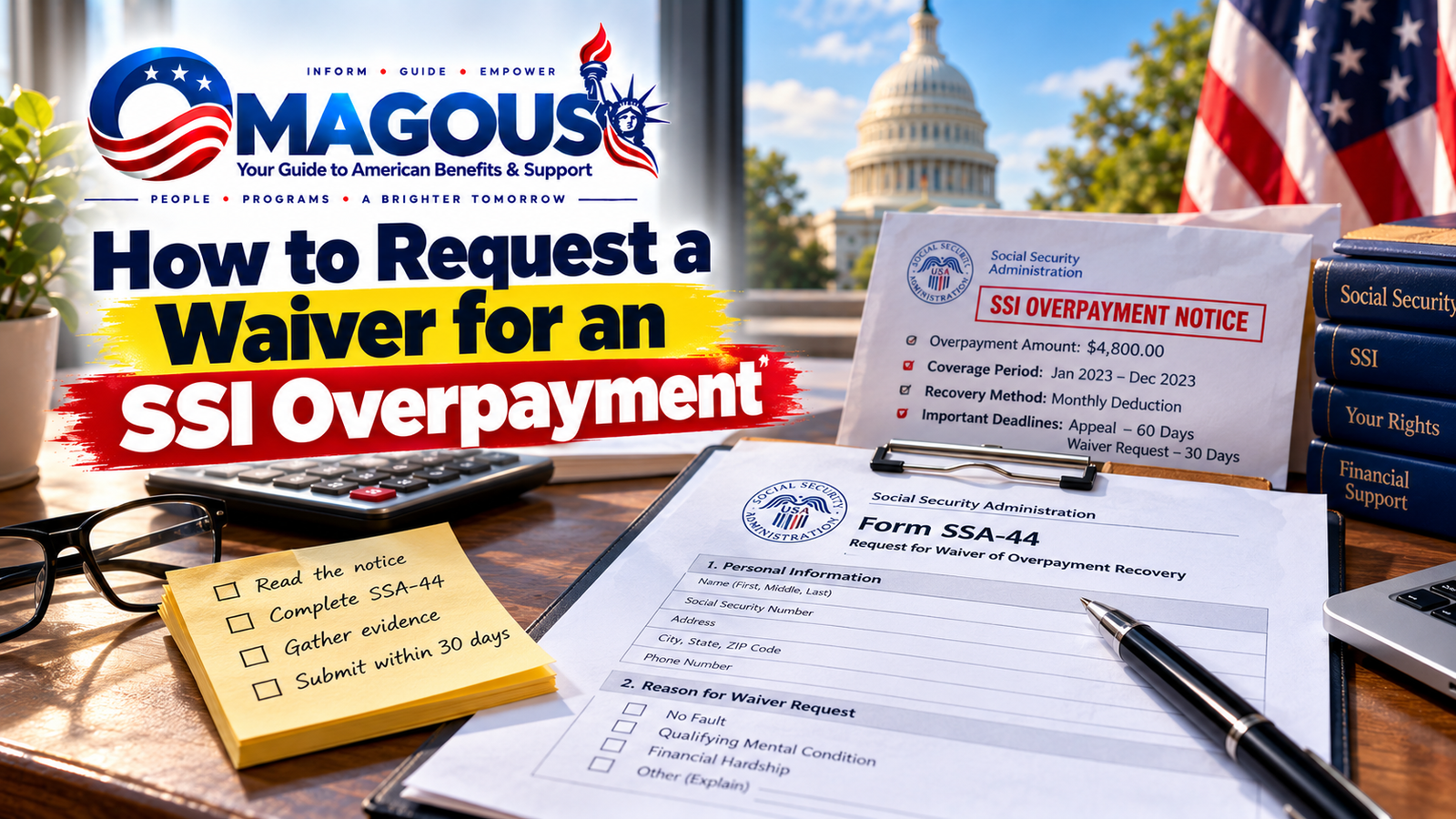
How to Request a Waiver for an SSI Overpayment
Quick Answer
How to request a waiver for an SSI overpayment: submit official Form SSA-44. Send it to SSA within the notice’s 30-day waiver deadline. Show no fault, a qualifying condition, or financial hardship.
Attach evidence and keep a complete copy. Filing it does not protect a separate 60-day appeal.
Why Accuracy Matters When Asking SSA to Waive an SSI Overpayment
SSI overpayment recovery can affect your monthly benefit, a past lump-sum payment, or both. A vague request can delay review, miss a deadline, or leave a valid debt in place. If the overpayment itself is wrong, asking only for a waiver may not solve the problem.
What can go wrong when the request is vague?
A vague request can create three serious problems:
- Recovery continues. You may keep losing part of each SSI payment while SSA waits for information.
- Your strongest ground gets buried. A genuine medical condition or SSA error may receive less attention than it deserves.
- Your appeal rights may expire. A waiver request usually does not replace a separate appeal of the overpayment determination.
If SSA used the wrong income, payment, or resource figure, ask for the underlying calculation and consider requesting a corrected benefit calculation. If you have already appealed, tracking a pending appeal helps confirm that SSA received the right filing.
Don’t stop paying or assume deductions have ended until SSA confirms the recovery status in writing.
The strongest request answers four questions clearly. What happened? Why did the overpayment occur?
What evidence supports the waiver ground? What outcome are you asking SSA to review?
How SSA Evaluates Fault, Mental Condition, and Financial Hardship
As of 2026, SSA generally evaluates an SSI overpayment waiver under three grounds. You normally need one solid ground, not all three. The governing federal rule appears in 20 C.F.R. § 416.582.
| Waiver ground | What you generally show | Possible result |
|---|---|---|
| No fault | An SSA error and no reason to know the payment was improper | Full or partial forgiveness |
| Qualifying mental condition | A condition and a direct connection to the overpayment | Full or partial forgiveness |
| Financial hardship | Recovery would be against equity and good conscience | Full or partial forgiveness |
What does “no fault” mean?
No fault means SSA did not make the payment error and you lacked reason to know the payment was improper. For a direct payment to you, SSA may consider whether you knew or reasonably should have known that the payment was not yours.
The same issue can arise when SSA used incorrect information from an employer or pension plan. A good no-fault case connects the agency’s records with your reporting history. It shows what you reported, what documents you sent, and how SSA’s calculation differed from the facts.
Can a mental condition qualify for a waiver?
Yes, a qualifying mental condition can support a waiver if it caused you to fail to realize that the payment was improper. The condition doesn’t automatically qualify, and it doesn’t need to be permanent.
SSA needs evidence of the condition and a causal connection to the payment. That link may involve memory loss, impaired judgment, difficulty understanding notices, or an inability to manage reporting duties. A diagnosis by itself rarely tells SSA how the condition affected your decisions.
What makes a financial hardship claim persuasive?
A persuasive hardship claim shows the complete financial picture and explains why repayment would be against equity and good conscience. SSA can consider income, resources, age, ability to work, necessary expenses, and other personal circumstances.
Countable income rules still matter, so use the current SSI income rules as a starting point. Your budget should also show any food support you receive through SNAP income and eligibility rules.
Include unavoidable costs that affect your available money. For example, document eligible prescription cost assistance, medical bills, housing costs, and transportation needs. SSA wants to see what you can realistically pay, not simply the word “hardship.”
Appeal, Waiver, or Reconsideration: Choose the Correct Route
An appeal asks whether the overpayment is correct. A waiver asks SSA not to recover an overpayment that you generally accept is valid. Reconsideration comes later if SSA denies the initial request.
| Route | Best used when | Main purpose |
|---|---|---|
| Appeal | The debt, amount, or covered months are wrong | Change or reverse the overpayment decision |
| Waiver | The debt is correct, but recovery should be reduced or stopped | Seek forgiveness under the waiver rules |
| Reconsideration | SSA denied an appeal or waiver request | Ask SSA to review and correct the decision |
When should you appeal instead of asking for a waiver?
Appeal when you dispute the existence or amount of the overpayment. Examples include incorrect wages, duplicated payments, wrong covered months, or resources that were not actually available to you.
State the exact error and the relief you want. “The overpayment is wrong” gives SSA little to investigate. “The May calculation counted $800 in wages I never received” gives it a specific fact to verify.
Can you appeal and request a waiver at the same time?
Yes, you may need both requests when only part of the overpayment is disputed. File the appeal by its deadline and submit Form SSA-44 by the separate waiver deadline.
For example, suppose SSA calculates a $2,400 overpayment. You may accept $1,200 but believe the other $1,200 came from an incorrect wage report. The appeal addresses the disputed amount.
The waiver request addresses recovery of the amount you acknowledge.
What if SSA denies the request?
A denial should identify the issue SSA found and the evidence it considered. Review the notice before deciding whether to seek reconsideration, a hearing, or further benefits review.
A payee problem requires its own analysis. If money was paid to the wrong representative, use the formal payee change process when appropriate. That doesn’t replace an overpayment appeal or waiver request.
Evidence for a No-Fault or Mental-Condition Waiver
The best evidence is dated, specific, and tied to the overpayment period. A general statement can explain your position, but supporting records give SSA something it can verify.
What evidence supports a no-fault waiver?
Strong no-fault evidence usually includes SSA notices, payment records, calculation sheets, and your original reporting documents. It should also show what action you took after receiving a notice or asking SSA for help.
Useful evidence may include:
- Bank statements or payment records that contradict the overpayment calculation
- Pay stubs, tax forms, or pension statements showing the correct amount
- Copies of income, resource, or change reports sent to SSA
- Proof that SSA received an earlier correction or supporting document
- Wage or pension reports that were duplicated or recorded incorrectly
- A written explanation of what you believed the payment meant at the time
Suppose the notice says you had a $3,500 bank balance in May. If you reported $700 and sent a statement showing $350, include all three documents. Also include SSA’s calculation.
This example supports a calculation error and may support a no-fault position, but it does not automatically prove financial hardship.
What records help with a mental-condition waiver?
The strongest records connect a diagnosed condition to the specific actions or omissions that created the overpayment. Medical history alone may not show that connection.
Look for evidence describing memory, judgment, communication, and daily functioning. A focused clinician statement can explain how the condition affected your ability to understand letters, track income, manage money, or remember reporting requirements.
A dementia diagnosis, for example, should be paired with relevant treatment notes. Add evidence of missed appointments, confusion about SSA letters, difficulty balancing accounts, or a caregiver’s contemporaneous observations. Explain how those symptoms existed during the overpayment period.
How should you package the evidence?
Package the evidence in chronological order and label each exhibit by topic. A short index helps the reviewer connect each document to your argument.
Include these items:
- The overpayment notice
- A completed Form SSA-44
- A concise supporting statement
- Medical records or a focused clinician statement
- Financial records, if requesting a hardship waiver
- Proof of mailing, delivery, or any appeal you filed separately
Don’t alter original documents. You may use copies, sticky notes, or highlighters to point out relevant dates and figures. Redact information that SSA does not need, but keep enough identifying information to connect each exhibit to your claim.
Evidence for a Financial-Hardship Waiver
A hardship case asks SSA to find that collecting all or part of the overpayment would be against equity and good conscience. The evidence must show your real ability to repay, not just the fact that money would be difficult to find.
SSA can consider age, ability to work, fault, financial resources, and special circumstances. It can waive some or all of a debt. Do not assume that being eligible for SSI proves you cannot afford any repayment.
What should your financial hardship evidence show?
Your evidence should show four things: available income, accessible resources, necessary expenses, and a realistic payment you can afford.
| Evidence category | Useful records | What to explain |
|---|---|---|
| Income | SSI, SSDI, wages, pensions | How much money is available now and when the overpayment occurred |
| Resources | Bank accounts, investments, property | Which assets you own, owe money on, or cannot quickly sell |
| Expenses | Rent, utilities, food, medicine, transportation | Which costs are necessary and unusually high |
| Proposed payment | Installment amount | Why that amount is realistic without leaving you unable to meet basic needs |
Include both your current finances and the period when you received the overpayment. SSA may consider the circumstances that existed when recovery was proposed.
What records strengthen a hardship request?
Gather recent bank statements, pay stubs, benefit award letters, rent records, utility bills, and medical invoices. Include debt statements if you owe money that affects your ability to pay SSA.
You can add a plain monthly budget. Keep categories simple, such as housing, food, utilities, transportation, health care, debt payments, and proposed SSA recovery. Show the math clearly, especially when several people share housing or expenses.
How do you show that full repayment isn’t affordable?
Show the amount left after essential expenses, then compare it with the repayment SSA proposes. A large lump sum often matters less than the ongoing effect of benefit deductions.
For example, suppose your available money is $240 each month after basic costs. You could propose a $100 monthly payment rather than demanding immediate relief from the entire $4,800 balance. This is an illustration, not an expected result.
It shows why a partial waiver may be realistic.
What if your expenses were higher last year?
Explain the higher costs and attach dated proof. Medical emergencies, temporary housing, home repairs, or loss of a household member may be relevant. A receipt without context shows an expense, but your statement should explain why it mattered.
How to Request the Waiver: Step-by-Step With Form SSA-44
The strongest submission is organized, documented, and easy to match with SSA’s waiver standards. Follow the notice attached to your case. It controls the filing address, deadlines, and any program-specific instructions.
1. What should I do before filling out the form?
Read the entire overpayment notice before completing anything. Record the balance, covered months, recovery method, notice date, field office, and both deadlines.
Then separate any dispute about the debt. If SSA used incorrect wages, resources, or payment dates, request the relevant calculations and file the appeal separately.
2. What records should you request from SSA?
Ask for the records and calculations that produced the overpayment. This may include payment history, income reports, resource records, and benefit recalculations.
If an employer’s wage record caused the problem, gather your own pay records too. A guide to finding missing Social Security work records can help you identify gaps before writing your response.
3. How should you frame the waiver request?
Choose the strongest grounds supported by evidence. Address no fault, a qualifying mental condition, or financial hardship in separate labeled paragraphs.
A useful supporting statement follows this order:
- Identify the overpayment amount and covered months.
- Explain the events in chronological order.
- State the waiver ground you rely on.
- Connect each fact to an exhibit.
- State the outcome you request.
Avoid unsupported claims about fault or capacity. The record should support every conclusion.
4. What should the completed package contain?
Your package should contain Form SSA-44, the supporting statement, relevant evidence, and proof that you sent everything.
Use clear exhibit labels. For example, “Exhibit 3 shows the bank statement provided to SSA in March 2025.” Call out dates, amounts, and reported income directly on your document index.
5. Where should you send the request?
Send the package through the method and address stated on the notice or form instructions. Don’t assume the nearest office can handle a case assigned elsewhere.
Sign and date the form. Make complete copies before mailing anything. Keep the tracking receipt, fax confirmation, delivery receipt, or a dated note explaining how and when you submitted it.
6. What happens after you file?
Ask SSA to confirm receipt and identify any missing evidence. Give reviewers a reasonable time to respond, but follow up if the stated date passes without confirmation.
If deductions continue, ask whether they are provisional or final. Recovery can change during review, so don’t treat a temporary reduction as approval of the waiver.
Common Mistakes That Delay or Weaken a Waiver Request
Most weak requests fail because they mix legal routes, miss evidence, or fail to prove a required fact. Fixing these problems before filing can prevent a second request and preserve more time.
| Common mistake | Why it causes trouble | Better approach |
|---|---|---|
| Filing only an appeal | This disputes the debt but doesn’t request forgiveness | Add Form SSA-44 if recovery should be waived |
| Filing only Form SSA-44 | This asks for relief but may not challenge an incorrect amount | File a separate appeal for the disputed portion |
| Waiting for perfect records | The notice deadline may pass | File on time and explain when more evidence will arrive |
| Assuming deductions stopped | Collection may continue while SSA reviews the request | Ask SSA for the recovery status in writing |
| Writing “I can’t pay” | It doesn’t show income, resources, or expenses | Submit a budget and proposed affordable payment |
| Sending a diagnosis alone | It doesn’t explain the connection to the payment | Add functional evidence and a focused clinical statement |
| Using conflicting figures | Inconsistent amounts weaken the whole case | Reconcile the numbers before attaching records |
| Mailing originals | Records can be difficult to replace | Send copies unless SSA specifically requests originals |
| Missing SSA’s follow-up letter | An incomplete file may remain inactive | Respond by the stated deadline with every requested item |
Don’t exaggerate or invent facts
Never claim a condition, expense, payment, or SSA error without evidence. Inconsistent statements can delay a decision and may trigger additional review.
If you don’t remember a date, say so and identify the records that may clarify it. A careful explanation is more credible than a confident statement that later proves wrong.
Don’t bury the request under attachments
A large stack of records isn’t a stronger case when SSA cannot tell what each item proves. Include a short index and a one-page statement when possible.
Group medical records separately from financial records. Within each group, arrange documents by date and mark the pages that matter most.
Don’t treat a filing receipt as approval
A mailing receipt proves delivery, not acceptance. It also doesn’t prove that the request was timely or complete.
After filing, make a simple tracking sheet. Record the submission date, documents sent, SSA contact information, promised response date, deductions, and every request for more information.
Deadlines, Recovery, Privacy, and Legal Help
The most important filing dates usually appear near the end of the overpayment notice. Read the whole letter because recovery rights are separate from the right to challenge the debt.
| Action | Common deadline stated on notices | What happens |
|---|---|---|
| Appeal the overpayment determination | 60 days | SSA reviews whether the debt is correct |
| Request a waiver with Form SSA-44 | 30 days | SSA reviews whether recovery should be reduced or stopped |
| Explain a late filing | As soon as possible | Ask SSA to consider good cause for the delay |
Does the exact deadline vary?
Yes, the notice’s dates and instructions control. Weekend, holiday, mail, and other special rules may apply, so don’t wait until the final day.
A late request should still be submitted as soon as possible. Explain the cause, provide supporting records, and request consideration under SSA’s good-cause process. Acceptance isn’t guaranteed.
What recovery methods might SSA use?
SSA may seek an initial payment, deduct part of ongoing benefits, recover a past lump sum, or use another authorized method. A waiver request does not guarantee an immediate pause.
If a bank reversed a direct deposit, collect the bank’s trace or return record. A guide to tracing a reversed benefit payment can help preserve evidence about whether you actually received specific SSI payments.
How should you protect medical and financial records?
Send only the information needed to evaluate the request. Keep required names, dates, case numbers, and figures on SSA-44 itself.
On copies, you may hide unrelated account numbers or medical details. Don’t remove information SSA needs to connect the records to your claim. Use a secure delivery method and keep the unredacted originals.
When should you get help?
Contact the SSA field office for notice details, calculation records, and submission status. Seek legal help sooner if a large sum is at stake, deadlines are close, or you cannot clearly separate an appeal from a waiver.
Legal-aid organizations, disability advocates, attorneys, guardians, and recognized representatives may help organize evidence. Verify the person’s authority before allowing them to sign or submit documents for you.
Final Decision Guide and FAQs
You should appeal if the overpayment itself is wrong, request a waiver if the valid debt should not be recovered, and consider both if only part of the balance is disputed.
| Your situation | Recommended action |
|---|---|
| Wrong wages, resources, months, or payment amount | File an appeal within 60 days |
| Correct debt, but SSA made the error | Request a no-fault waiver |
| Correct debt, and a qualifying condition caused the error | Request a mental-condition waiver |
| Correct debt, but repayment would cause serious hardship | Submit a financial-hardship waiver |
| The filing date has passed | File immediately and explain good cause |
Does filing Form SSA-44 stop deductions right away?
Not automatically. A timely request may prevent or pause certain recovery while SSA reviews it, but the result depends on your notice and the stage of the case. Ask SSA in writing to confirm whether deductions or other collection activity are suspended.
Don’t assume recovery has ended until the agency confirms it.
Can a parent, guardian, attorney, or other representative request it?
Yes, a legally authorized representative can usually submit the request with proper authority. Parents, guardians, and attorneys may need different supporting documents. The representative should identify their role, sign where authorized, and attach proof of authority.
Confirm the requirements with the SSA field office before filing.
Can SSA waive only part of an SSI overpayment?
Yes. Federal SSI rules allow SSA to waive an overpayment in whole or in part. The outcome depends on the facts and evidence tied to each period or amount.
State exactly which part you dispute and which part you acknowledge. A documented request for a partial waiver or affordable repayment method is more useful than an unsupported demand for complete forgiveness.
What if I disagree with the amount and still want a waiver?
File an appeal for the disputed amount and request a waiver for the amount you accept. These are separate actions with different deadlines. The appeal asks whether SSA owes you benefits.
Form SSA-44 asks whether recovery of the valid overpayment should be waived or reduced.
What if I missed the deadline?
Submit the request immediately and explain the reason for the delay. Include dates, records, and any steps you took to correct the issue. Ask SSA to consider good cause for a late filing.
Keep pursuing the appeal separately if you also dispute the debt, because a late waiver request may not protect appeal rights.