How to Request a Reconsideration After Disability Denial starts with the notice you received. Read it closely, protect the deadline, and answer each stated reason for denial. A strong request connects medical facts, daily limitations, and work history to the rules used by the program making the decision.
For a U.S. Social Security Disability Insurance (SSDI) or Supplemental Security Income (SSI) claim, you generally have 60 calendar days from the notice date to request reconsideration. The exact route differs for a state Disability Determination Services (DDS) claim, a private insurer, the Department of Veterans Affairs (VA), or the UK Department for Work and Pensions (DWP).
As of 2026, filing options can change, so your notice and current official instructions control.
Quick Answer
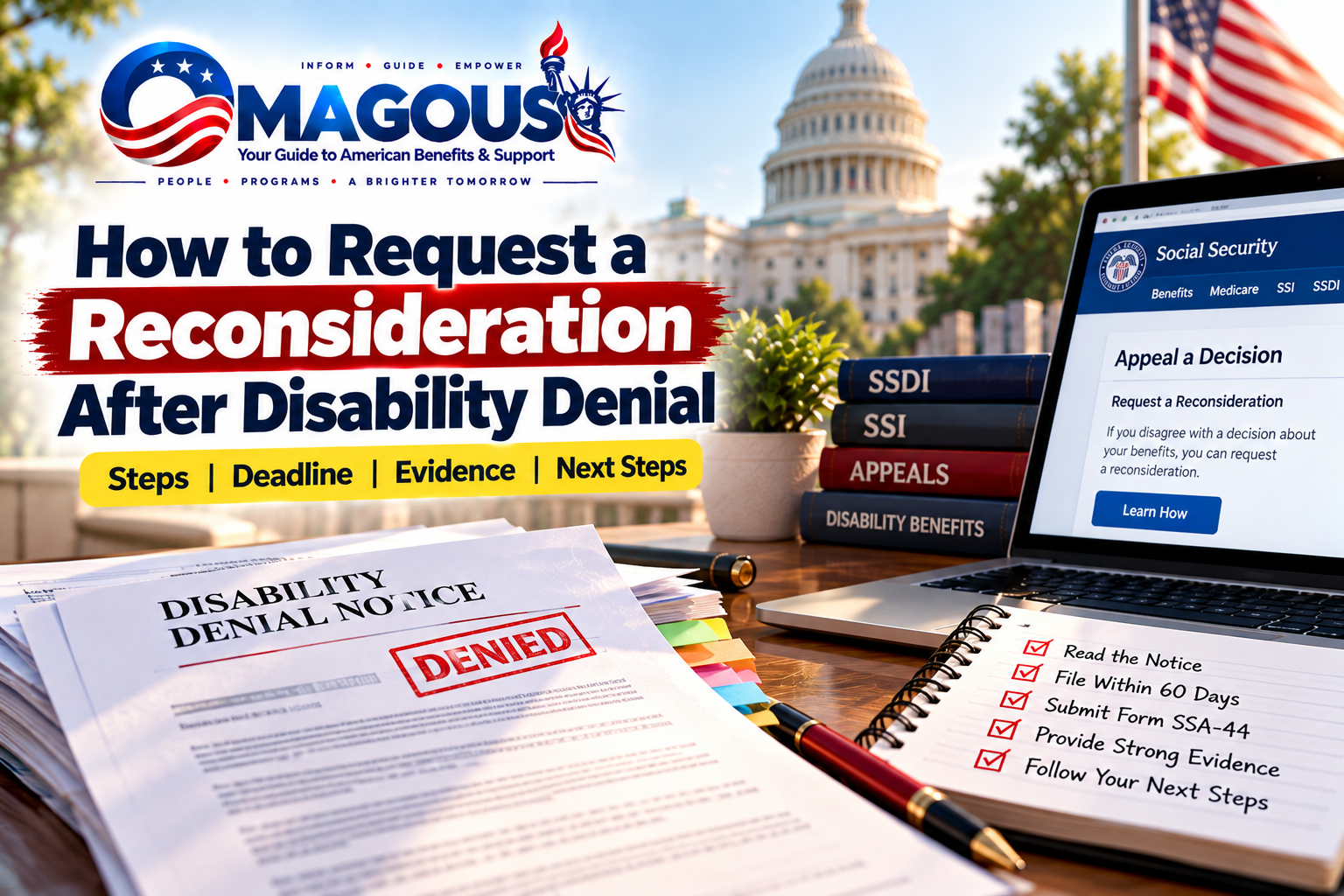
How to Request a Reconsideration After Disability Denial starts with the notice. Use Form SSA-44 for most U.S. SSDI and SSI claims.
File within 60 calendar days of the notice date. Attach evidence that answers every denial reason. A late request may be accepted for good cause.
Which Review Process Applies: SSA, State DDS, Private Plan, VA, or UK DWP?
Start with the agency or plan named on the denial notice. “Reconsideration” is an administrative review, but the procedure differs across benefits systems.
| Decision source | What reconsideration usually means | Where to start |
|---|---|---|
| SSA | First appeal of an initial SSDI or SSI determination | Form SSA-44 and the filing instructions on the notice |
| State DDS | A state review that may occur before a federal hearing | State office and deadline listed on the decision |
| Private insurer or employer plan | Internal claim appeal or redetermination | Policy, plan document, and claim notice |
| Department of Veterans Affairs | A review under a VA appeal pathway | VA decision letter and current VA form |
| UK DWP | Mandatory Reconsideration | GOV.UK filing instructions and DWP decision |
What if the notice names SSDI or SSI?
A reconsideration asks SSA to review the denial again. It does not include a hearing before an administrative law judge.
Complete Form SSA-44, usually called the Request for Reconsideration. Add a short statement that responds to every adverse finding. Then submit the request through the channel listed on the notice.
Check the Social Security Administration for current forms and filing guidance. A combined SSDI and SSI claim may include separate decisions with separate deadlines.
What if another agency or insurer made the decision?
If DDS made an initial determination, follow its reconsideration instructions first. Some claimants then proceed to an SSA hearing.
For veterans, don’t use Form SSA-44. The VA offers different routes, including a Decision Review Officer, Higher-Level Review, or Board of Veterans’ Appeals review. People claiming both programs can review Social Security and VA benefits to understand how the systems operate separately.
A private insurer or employer plan may require an internal appeal before other review. A U.S. Department of Labor rule may also apply to some employer-sponsored plans.
Read the plan’s claims procedure instead of assuming SSA rules apply.
In the UK, the usual first step is Mandatory Reconsideration. The standard filing period is normally one month from the DWP decision date.
If the process is unclear, contact the office named on the notice before the deadline. Ask which form, address, and review stage apply. Don’t wait for an informal answer if filing instructions are available.
Read the Denial Notice and Turn It Into an Action Plan
Your request must match the decision being challenged. The notice tells you the filing route, deadline, evidence considered, and exact reasons for denial.
Check these five items first
- Decision type: Determine whether this is an initial denial, redetermination, termination, or continuing disability review.
- Decision date: Find the date printed on the notice. For SSA reconsideration, the usual deadline is 60 calendar days from that date.
- Denial reasons: Separate medical, functional, work, and financial findings from one another.
- Evidence reviewed: Note the medical sources, forms, statements, and jobs listed in the decision.
- Filing method: Confirm the required form, office, address, fax number, or online process.
A correctable error doesn’t replace an appeal. If your date of birth is wrong, use the process for correcting SSA records as well. File your reconsideration by the deadline.
Build an issue matrix
A denial often contains several findings. Treat each one as a separate problem.
| Stated finding | Evidence to review |
|---|---|
| The condition was not medically severe | Clinical findings, treatment, test results, and functional restrictions |
| The condition was not expected to last long enough | Onset, treatment history, prognosis, and continuing symptoms |
| You could return to past work | Actual job duties and physical or mental demands |
| Other work was available | Functional abilities, work skills, education, and work experience |
| You were not insured for SSDI | Earnings record and missing work credits |
| Income or resources affected SSI | Income sources, resources, exclusions, and supporting records |
This matrix keeps you from writing a general complaint about the decision. It also shows you where the evidence is thin.
Separate medical and financial issues
SSA may find that you meet the medical definition of disability while denying SSDI because you lack insured status. The same claimant may also be denied SSI because countable income is too high.
Handle each finding under the rule that caused it. A favorable medical decision does not automatically resolve work history or benefit formula issues. For SSI, review how child support income is counted when that income appears in the record.
Preserve proof and your next deadline
Keep a copy of the notice, request, forms, attachments, and delivery confirmation. Don’t assume an upload was successful until you receive confirmation.
After filing, use SSA’s status tools to check your appeal status. If the reconsideration remains unfavorable, read the next deadline immediately. Waiting to understand the decision could eliminate options later.
Build a Complete Evidence File Before You Request Review
Start with the evidence used in the denial, then add records that fill clear gaps. Quality matters more than the number of pages.
Get the claim file
Ask SSA or the responsible agency for the evidence used to make the decision. The file may contain medical reports, application answers, medical source statements, prior decisions, and administrative notes.
Review it for:
- Missing treatment records
- Incorrect dates
- Misunderstood job duties
- Unanswered questions
- Findings that conflict with other evidence
- Medical information that was never requested
This review can show whether the denial came from a factual error, incomplete evidence, or a disputed interpretation.
Create a medical and functional chronology
A chronology turns scattered records into a clear history. List events in date order.
| Period | Document |
|---|---|
| Initial symptoms | Medical visits, symptom reports, or early records |
| Diagnosis and testing | Lab results, imaging, specialist findings, and diagnosis |
| Treatment | Medication, therapy, procedures, surgeries, and hospital care |
| Functional change | New limits, absences, missed tasks, or worsening symptoms |
| Work impact | Reduced hours, removal of duties, leave, or job loss |
| Current status | Ongoing treatment, prognosis, and present abilities |
Include gaps. If treatment stopped because of cost, lack of access, insurance, or another barrier, explain that fact when supported by records.
Collect several types of evidence
- Medical records: Request complete records from hospitals, primary care offices, specialists, therapists, mental health providers, laboratories, imaging centers, pharmacies, and surgeons.
- Medical source statements: Ask appropriate clinicians to complete Form SSA-4268 when a formal opinion about findings and function would help.
- Claimant evidence: Use Form SSA-4827 or a personal statement to explain symptoms, daily activities, and work impact.
- Functional evidence: Document standing, walking, lifting, concentration, memory, communication, attendance, and task completion.
- Work evidence: Include job descriptions, actual duties, attendance records, performance reviews, earnings, and work-stop details.
- Financial evidence: Supply income and resource records when SSI eligibility is at issue.
A diagnosis identifies a condition. It does not by itself show how severe that condition is or whether it prevents substantial gainful activity.
Add new evidence without waiting for a perfect file
Updated medical records can help explain treatment started after the denial. Explain why the evidence is relevant and connect it to the condition already in the record.
Don’t miss the filing deadline while waiting for an appointment. File the available request on time, then follow the agency’s instructions for additional evidence. Ask the office how later records should be sent.
Organize and protect the file
Number the documents and prepare a short evidence index. State the date and purpose of each item. Keep the original files unchanged and send only what is relevant and necessary.
Use an approved submission channel. Don’t send a Social Security number or medical records through ordinary email unless you’ve verified that the agency’s system is secure. A current Form SSA-3441 controls what information SSA may receive from medical sources.
Turn the Evidence Into a Clear Disability Case
A strong case connects every denial finding to dated evidence. It explains what the condition is, how it limits daily function, and why those limits matter under the program’s rules.
Use SSA’s four-part disability framework
For SSDI and SSI, SSA generally considers whether:
- The medical condition is severe enough to significantly limit basic work-related activity.
- The condition is expected to last at least 12 months or result in earlier death.
- The evidence prevents engagement in Substantial Gainful Activity, or SGA.
- The claimant meets the program’s additional work, insured-status, income, or resource rules.
This is often called the severe and prolonged impairment standard. A condition can be severe without being prolonged. A condition can also be prolonged without meeting SGA rules.
Make every limitation concrete
Vague statements such as “I cannot work” give the decision maker little to evaluate. Add the activity, duration, frequency, and cause.
For example, don’t write only “I cannot stand.” Explain whether you can stand for 15 minutes, need to sit immediately, can manage only with a cane, or have good days and severe days. A clear example might describe standing limits at home, in a store, and during a work shift.
Do the same for mental health conditions. Describe difficulty staying on task, following instructions, remembering details, handling stress, or communicating with coworkers. Strong evidence connects those symptoms to actual work demands.
Connect treatment to function
Medical records should show more than a list of visits. They should help explain symptoms, treatment response, prognosis, and present abilities.
SSA may also consider a clinician’s opinion about your work-related abilities. That opinion is important, but it doesn’t replace the full record. A personal statement can explain the lived impact of a condition in a way that medical terms may not capture.
Residual Functional Capacity, or RFC, is SSA’s assessment of what you can still do despite your limitations. Treat it as one part of the case. Your records, symptoms, work history, education, and skills still matter.
Match the evidence to the denial reason
Suppose the decision says you can perform your past job as a cashier. Don’t answer with a general statement that the job is impossible. Compare the actual duties with your restrictions.
Show the standing time, lifting requirement, pace, customer demands, concentration needs, and tolerance for standing. Then address the finding directly.
If the decision says other work exists, explain your education, transferable skills, work history, and ability to perform available jobs. If you tried work, provide dates, duties, hours, performance issues, and why it ended.
Keep the account accurate and consistent
Explain honest differences between records instead of hiding them. A later improvement, a temporary flare, or a changed treatment plan may be perfectly valid. Label the date and context.
Don’t describe every limitation as total if the evidence shows partial ability. Don’t copy wording from someone else. Don’t ask a medical provider to use conclusions they haven’t given.
The best request is specific, measured, and supported. It tells the reviewer what the records show, where the decision may be wrong, and what outcome you’re requesting.
Complete Form SSA-44 and Write a Focused Request
Form SSA-44 is the Social Security Administration’s request for reconsideration of an SSDI or SSI determination. Use it for an SSA decision. A state DDS, VA, private insurer, or UK DWP decision may require a different form.
Start with the current official SSA forms page. The form asks for personal information, the type of claim, the decision date, contact details, and the reason you disagree.
What information should the form contain?
Check these sections carefully:
- Your full name and Social Security number
- The decision date and office handling the claim
- Whether the decision concerns SSDI, SSI, or both
- Your current address and contact information
- The name of any authorized representative
- A short explanation of why the decision should be changed
- Your signature and the filing date
A missing signature or incomplete claim number can delay processing. Don’t guess at information. Contact the office if the notice and your records don’t match.
Which supporting forms may help?
Form SSA-4268 is a Medical Source Statement. It asks a medical professional for clinical findings, treatment, prognosis, and work-related abilities.
Form SSA-4827 is the Disability Report. It helps explain symptoms, daily activities, medical treatment, and functional limitations. You can use a symptom interview guide to prepare a clear account.
Form SSA-3441 controls what information SSA may request from medical sources. Don’t sign a broad release without checking which records you actually need.
Use a four-part statement
A focused statement usually works better than a long complaint. It should identify the decision, summarize the evidence, explain the error, and state the remedy you want.
- Identify the exact finding you disagree with.
- Cite the records that support your version.
- Explain how the evidence affects work or daily function.
- Ask SSA to review the claim and issue a favorable decision.
For example, if the decision says you can stand for two hours, compare that finding with your treatment records. State your actual standing limit, the reason for it, and how it affects a cashier or warehouse job. Don’t simply write, “I cannot work.”
Attach evidence in a usable format
Number your records and include a short index. Give each document a date, provider, and purpose. This helps the reviewer connect a treatment note with the issue it supports.
Send relevant records, not an unlabeled stack of duplicates. If the file is large, ask the office how it prefers additional evidence. Don’t alter, backdate, or create records.
False statements can damage the claim and trigger benefit recovery or fraud consequences.
Submit the Request Correctly and Protect Your Deadline
Submit the request using the method printed on the decision notice. The notice controls because filing options and office instructions can change. As of 2026, SSA may offer electronic, mail, and fax options, depending on the claim.
Run a final filing check
Before sending anything, confirm these points:
- The request is due to the correct office
- The correct form and claim type are selected
- Every page is included
- The signature and date are present
- The evidence is organized and legible
- The filing method is available to you
Don’t rely on a phone call or an informal email as your only filing. If an office accepts a request by phone, ask how that request is confirmed and recorded.
Keep proof of every delivery method
For an online filing, save the confirmation page and a copy of the submitted packet. For mail, keep the complete copy, envelope, and delivery receipt. Don’t assume a postmark alone resolves a deadline dispute.
If you fax the request, verify the number on the notice. Keep the transmission confirmation and a copy of every page. The receipt proves delivery, but it may not prove that the packet was complete.
If the deadline is close, contact SSA promptly. Ask whether a specific office accepts electronic filing and how later evidence should be submitted.
Send later evidence without losing track of it
New medical records can arrive after you file. Label the packet with your name, claim type, and issue. State the dates covered and explain what the records add.
Use the agency’s approved channel. Don’t send an entire medical history through ordinary email. A short cover note plus the relevant records is usually more manageable than an unlabelled full file.
After filing, use a reliable reminder to check the claim and track the appeal status. Respond promptly if SSA asks for a missing form or clarification.
What if the deadline has passed?
File the request immediately and include a clear explanation for the delay. State when you received the notice, why you couldn’t file sooner, and what action you took as soon as you learned of the problem.
A late request may be considered for good cause. Examples can include a serious hospitalization, a documented failure to receive the notice, or an agency error. Good cause is not automatic, and disability by itself doesn’t prove every delay.
If you never received a notice, document your calls and letters. Don’t wait for SSA to locate you. File what you can and ask for filing instructions.
Common Mistakes That Can Delay or Undermine a Reconsideration
The most serious errors usually involve a missed deadline, the wrong filing route, or evidence that doesn’t answer the stated reasons for denial. A careful review can catch them before submission.
The most common mistakes
- Missing the deadline: File within 60 calendar days for a standard SSA reconsideration request. A late filing needs a good-cause explanation.
- Using the wrong form: Form SSA-44 applies to SSA claims. A VA, private-plan, or DWP notice may require another process.
- Writing a generic complaint: A letter that says the decision is unfair doesn’t address the medical, work, or financial findings.
- Submitting only a diagnosis: The decision maker needs evidence about symptoms, treatment, prognosis, and daily function.
- Ignoring separate notices: SSDI and SSI decisions may have different reasons and different deadlines.
- Sending contradictory statements: Explain changes honestly. Don’t hide a prior answer that differs from your current account.
- Overstating abilities or limits: Extreme claims can conflict with treatment notes and harm credibility.
- Forgetting proof of filing: Keep copies, receipts, upload confirmations, and transmission reports.
- Waiting for a perfect packet: Submit the request by the deadline, then follow instructions for additional evidence.
- Sending irrelevant records: Organize the evidence and explain its connection to the denied issue.
Which edge case needs special handling?
If the notice concerns termination or a continuing disability review, follow that notice’s procedure. A standard initial reconsideration request may not be the right form.
If you never filed an application, you normally need an initial claim. Reconsideration reviews an existing decision. If the problem is a calculation error rather than a disability finding, a separate benefit recalculation request may be more suitable.
For an employer plan, check the plan document and claims procedure. For a private insurer, don’t assume the policy uses SSA’s medical standard.
What should you check before submitting?
Ask yourself these questions:
- Does every paragraph address a stated denial reason?
- Can a reviewer understand the timeline?
- Are the records complete enough to support the statements?
- Are signatures, dates, and authorizations included?
- Have I preserved proof of delivery?
Never fabricate, alter, or backdate medical evidence. A claim can lose benefits and face repayment consequences if the evidence is misleading.
If Reconsideration Is Denied: Next Steps, Ongoing Benefits, and When to Get Help
An unfavorable reconsideration doesn’t necessarily end your options. For an SSA claim, the usual next step is a hearing before an administrative law judge.
What comes after an SSA reconsideration?
The usual sequence is:
- Reconsideration denial: Request an SSA hearing within 60 calendar days of the reconsideration notice.
- Missed hearing deadline: SSA lists a possible 90-day route in some situations. Read the notice and confirm the current rule.
- Hearing decision: Request Appeals Council review within 60 calendar days of the ALJ decision.
- Appeals Council decision: A federal court appeal may be available within 60 calendar days after the notice.
These deadlines are separate. Don’t treat the reconsideration deadline as a hearing deadline. State and non-SSA claims follow different procedures, so check the original decision carefully.
At an SSA hearing, you can attend, testify, submit evidence, and respond to the issues in the denial. Bring a clear timeline and copies of the records you want the ALJ to consider.
Could benefits continue during the appeal?
Sometimes, but not automatically. A favorable ALJ decision can allow benefits to be paid while the claim awaits Appeals Council or federal court review. The effective date depends on the decision and program rules.
A successful claim may also include retroactive benefits. SSDI may cover qualifying months before the protected application date, commonly up to six months. SSI may cover up to three qualifying months before the protected filing date.
Eligibility and payment timing still matter.
If benefits were paid and later recovered, you may receive a separate overpayment notice. Respond to that notice on its own deadline. Report work, income, and other changes while the appeal is pending.
When should you get help?
Seek help if the denial involves complex medical records, conflicting medical opinions, work-history analysis, or a rapidly ending benefit. A State Disability Specialist can explain SSA’s process at no cost. An attorney or eligible non-attorney representative can prepare and present the case.
If the issue is only a benefit calculation, a benefit calculation request may be more appropriate than a disability appeal. If the issue is a private plan, VA claim, or DWP decision, use that system’s own review route.
Frequently Asked Questions
How long do I have to request an SSA reconsideration?
You generally have 60 calendar days from the date on the SSA notice to request reconsideration of an SSDI or SSI determination. File by the deadline even if you’re still gathering records. A late request may be considered for good cause, but approval isn’t automatic.
The notice and current SSA instructions control.
Can I submit medical records after I file?
Yes. You can submit relevant medical records after filing, including treatment notes, test results, and medical source statements. Label the records, explain what each one adds, and send them through the method SSA specifies.
Keep proof of submission. New evidence doesn’t guarantee a favorable decision, and it must still be timely submitted.
Does it cost anything to request reconsideration?
An SSA reconsideration has no filing fee. You can request it yourself. A representative’s fees, if any, follow separate SSA rules.
Private plans, VA claims, and UK benefits have their own cost and representation rules. Ask the issuing program about charges before hiring someone.
Can someone else request it for me?
Yes. A properly authorized representative can submit it for you. An attorney or eligible non-attorney representative must follow SSA registration rules, and you must sign or authorize required forms.
Family can help organize records, but shouldn’t sign for you without permission. Confirm representation before sending private medical information.
Will benefits continue while I appeal?
Sometimes, but not automatically. A favorable SSA hearing decision can allow benefits to be paid while a later Appeals Council or court review is pending. The start date depends on the decision and program rules.
Report work, income, and other changes. If benefits were paid and later recovered, you may face a separate overpayment.
What if I never filed an application?
A reconsideration normally reviews an existing SSA determination, so it isn’t the right filing for someone who never applied. File the initial SSDI or SSI application instead. If you applied but never received a decision notice, contact SSA or DDS for the claim status and correct instructions.
Don’t assume a new appeal preserves every deadline.