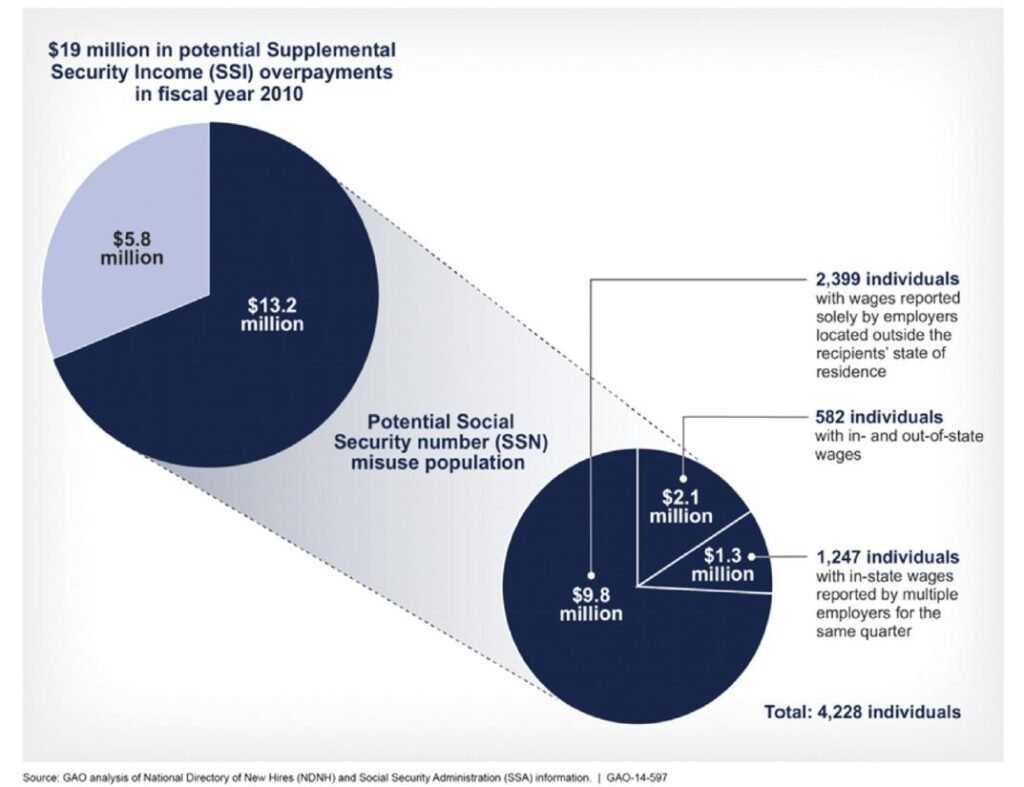
Yes, you can own 2 cars on SSI, but owning two vehicles can affect your Supplemental Security Income eligibility. Under current Social Security rules, one vehicle per household can generally be excluded from the SSI resource calculation when it is used for transportation. A second vehicle may count as a resource unless another exclusion applies.
The key issue is not simply how many cars you own. Social Security looks at whether a vehicle is excluded and, for a non-excluded vehicle, how much equity value it has. See the current SSA automobile rules for how multiple vehicles are treated.

Can You Own 2 Cars on SSI?
Yes. SSI does not set a simple two-car ownership limit. The issue is whether the second vehicle is a countable resource and whether your total countable resources stay within the applicable SSI limit.
The SSA automobile rules explain that one automobile per household can be excluded regardless of its value when the recipient, spouse, or a household member uses it for transportation. When there is more than one vehicle, any automobile that is not excluded can become a countable resource.
That means owning two cars and keeping SSI are not automatically incompatible. What matters is how Social Security treats each vehicle under its resource rules.
How Many Cars Can You Have on SSI?
There is no simple numerical ownership limit that automatically ends SSI eligibility. However, additional vehicles can affect your countable resources.
In 2026, the federal countable resource limit is $2,000 for an individual and $3,000 for a couple. Some property does not count toward that limit because it is excluded under SSI rules. See the 2026 SSI resource limits published by Social Security.
The SSA resource rules identify one vehicle per household used for transportation as an excluded resource. A second vehicle is not automatically protected by the same exclusion.
So the practical question is not, “Can I have two cars?” It is, “How much of my second car counts toward the SSI resource limit?”
How Does SSI Treat a Second Car?
A second car can count as a countable resource if it does not qualify for another exclusion.
When a recipient owns more than one automobile, SSA applies the automobile exclusion according to its rules. If more than one vehicle is used for transportation, the vehicle with the greatest equity value is generally the one that receives the full exclusion. A different exclusion, such as property essential to self-support, may apply to another vehicle in certain circumstances. See the SSA policy for multiple automobiles.
For a vehicle that is not excluded, SSA considers its equity value, which is generally its current market value minus applicable encumbrances.
Does One Car Per Household Count as Exempt on SSI?
Yes. One vehicle per household can generally be excluded regardless of value when it is used for transportation.
This is a household rule rather than a rule that gives each person a separate vehicle exclusion. The SSI resource rules state that one vehicle is excluded when you or a member of your household uses it for transportation.
If more than one vehicle is used for transportation, SSA generally applies the full exclusion to the automobile with the greatest equity value. Other exclusions may apply to another vehicle in specific circumstances.
What Happens to the Second Car’s Value?
The second car can become a countable SSI resource.
For a non-excluded vehicle, SSA generally considers its equity value when determining countable resources. That amount is considered along with your other countable resources when Social Security determines whether you remain within the applicable SSI resource limit.
Equity is not necessarily the same as the vehicle’s listed sale price. Under the SSA automobile policy, equity value is based on the vehicle’s current market value minus applicable encumbrances.
That means a financed second car may have a lower countable value than a fully paid-off vehicle with the same market value.
What Is the SSI Resource Limit in 2026?
For 2026, the SSI countable resource limit remains $2,000 for an individual and $3,000 for a couple. Social Security’s 2026 COLA fact sheet confirms these limits.
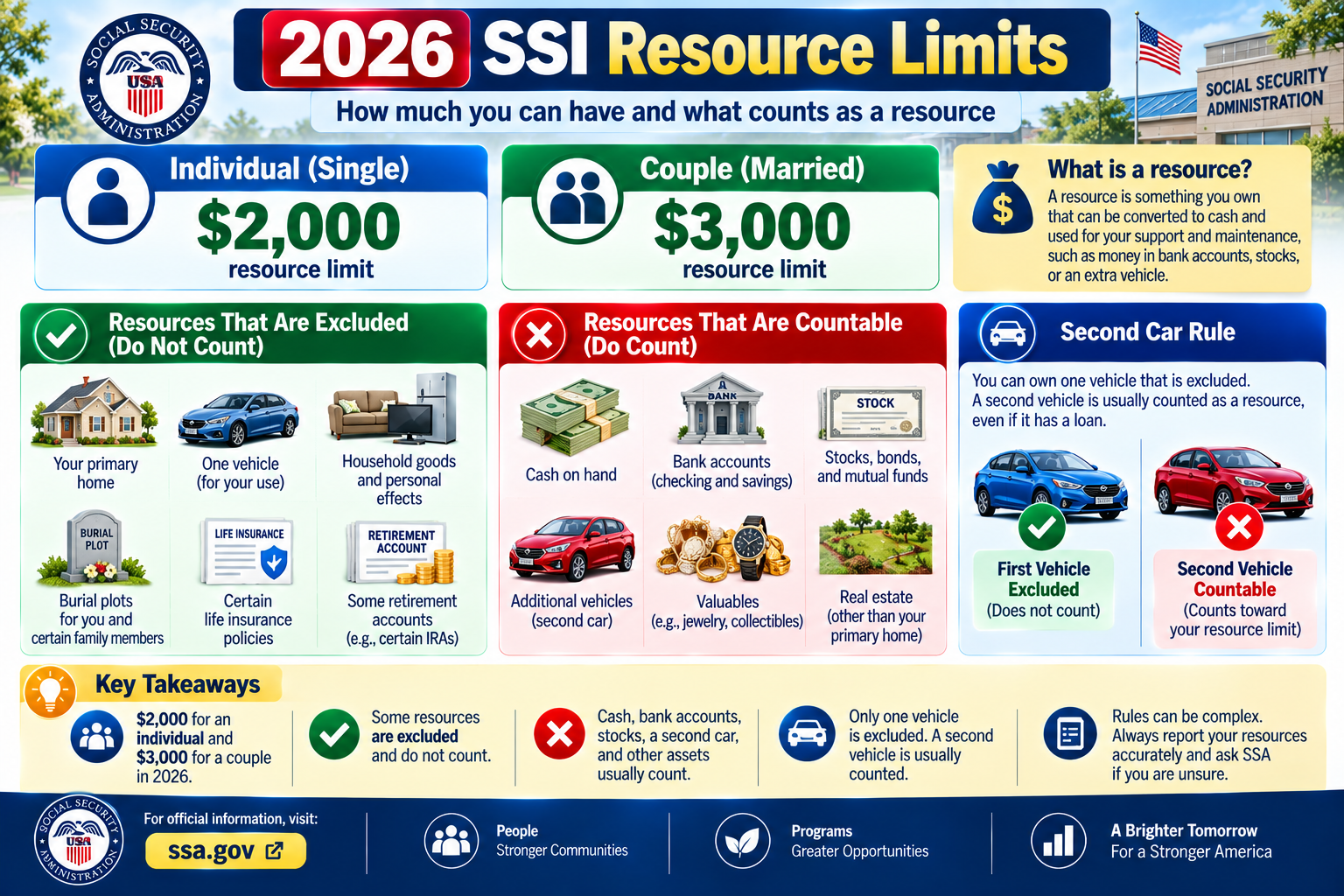
| SSI household | 2026 countable resource limit |
|---|---|
| Individual | $2,000 |
| Couple | $3,000 |
The limit applies to countable resources, not everything you own. Certain property is excluded under SSI rules, including the home you live in and one vehicle used for transportation. See the SSA resource guidance.
[Internal Link: SSI Resource Limits in 2026 | Insert Existing URL]
Can a Second Car Make You Lose SSI?
Yes, a second car can affect SSI eligibility if its countable equity value causes your total countable resources to exceed the applicable limit.
Social Security’s SSI eligibility rules state that the resource limit is $2,000 for an individual and $3,000 for a couple. The second car is only one part of that calculation.
Social Security may also consider countable money in bank accounts, stocks, bonds, and other assets. The effect of a second car therefore depends on its treatment under the automobile rules and your other countable resources.
If Both Cars Are Used for Transportation, Which One Is Excluded?
If both cars are used for transportation, Social Security generally excludes the vehicle with the greatest equity value.
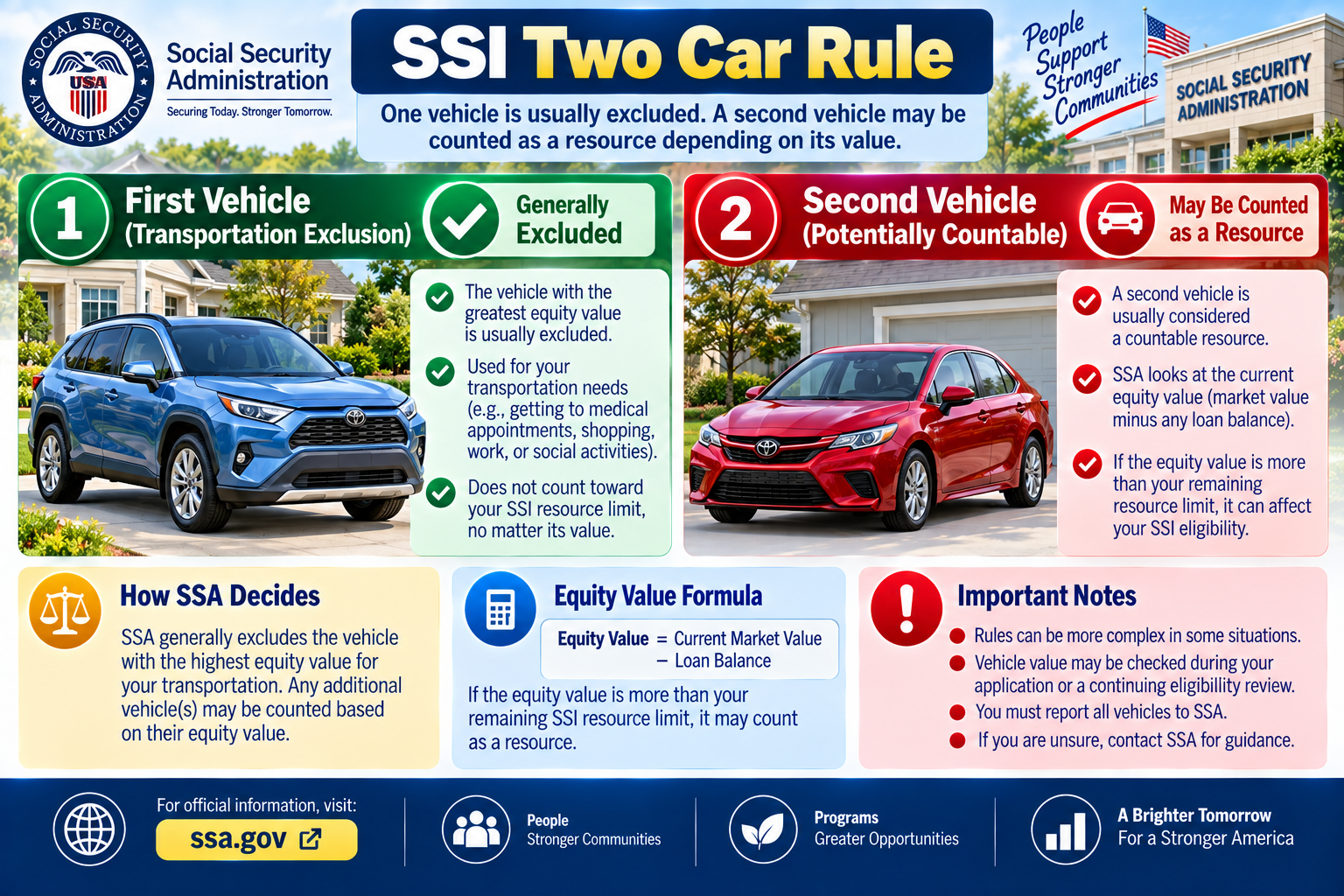
The current SSA automobile policy states that when more than one automobile is used for transportation, the exclusion is applied to the automobile with the greatest equity value.
The other vehicle may then be counted as a resource unless it qualifies under another exclusion or conditional benefits apply.
What If the Second Car Is Used for Work?
A second vehicle connected to work may receive different treatment in some circumstances.
SSI has separate resource exclusions for certain property that is essential to self-support. The SSA automobile policy instructs workers to consider those provisions when a vehicle cannot be fully excluded under the transportation rule.
Because this treatment depends on the specific facts and the applicable exclusion, owning a second car for work does not automatically mean that the vehicle is excluded.
[Internal Link: SSI Rules for Work and Self-Support | Insert Existing URL]
What If the Second Car Is Financed?
A financed second car can still be a resource, but Social Security generally looks at its equity value, not simply the vehicle’s full market value.
SSA defines equity value as the vehicle’s market value minus applicable encumbrances. See the SSA definition of automobile equity value.
For that reason, the amount still owed on a vehicle can affect how much of the second car is counted. The vehicle’s condition, market value, and remaining debt can all matter when its equity is determined.
What If the Second Car Is Broken or Not Working?
A temporarily broken vehicle is not automatically treated as if it does not exist.
SSA says that a vehicle that is temporarily broken down but normally used for transportation can still meet the definition of an automobile. Under its current procedures, a temporarily inoperable vehicle that will be used for transportation within the applicable period can continue to receive the automobile exclusion. See the SSA rules for temporarily broken vehicles.
A vehicle that is permanently unusable or falls outside the automobile definition may be treated differently. SSA distinguishes temporarily broken-down automobiles from vehicles that have been junked.
Does a Paid-Off Second Car Count Against SSI?
It can. A paid-off second vehicle may have substantial equity because there is no remaining loan balance to reduce the vehicle’s value.
The important calculation is the countable equity value of the non-excluded vehicle. If that amount, combined with your other countable resources, puts you over the SSI resource limit, your eligibility can be affected.
A paid-off vehicle is therefore not automatically disqualifying, but it deserves attention during an SSI resource review.
Do You Have to Report a Second Car to Social Security?
You should report changes in vehicle ownership as required by Social Security.
SSA relies on recipients to report vehicle ownership, and its policies require workers to determine how multiple vehicles should be valued and counted. The SSA automobile policy provides the procedures used when recipients own more than one automobile.
A September 24, 2026 audit from the SSA Office of the Inspector General also examined whether SSI recipients accurately reported vehicle ownership and whether SSA properly valued multiple vehicles.
If you buy, sell, transfer, or otherwise change ownership of a vehicle, make sure the information reported to Social Security remains accurate.
What If You Have More Than Two Cars?
The same general resource principle applies when you own three or more vehicles.
One qualifying automobile can receive the full transportation exclusion. Other automobiles may be countable resources unless another exclusion applies. If more than one automobile is used for transportation, SSA generally excludes the automobile with the greatest equity value.
The more non-excluded vehicles you own, the more important the total equity value becomes when Social Security reviews your countable resources.
Can You Keep SSI While Selling a Second Car?
Possibly. SSA has a process for certain recipients who have excess resources and are making reasonable efforts to sell a countable resource.
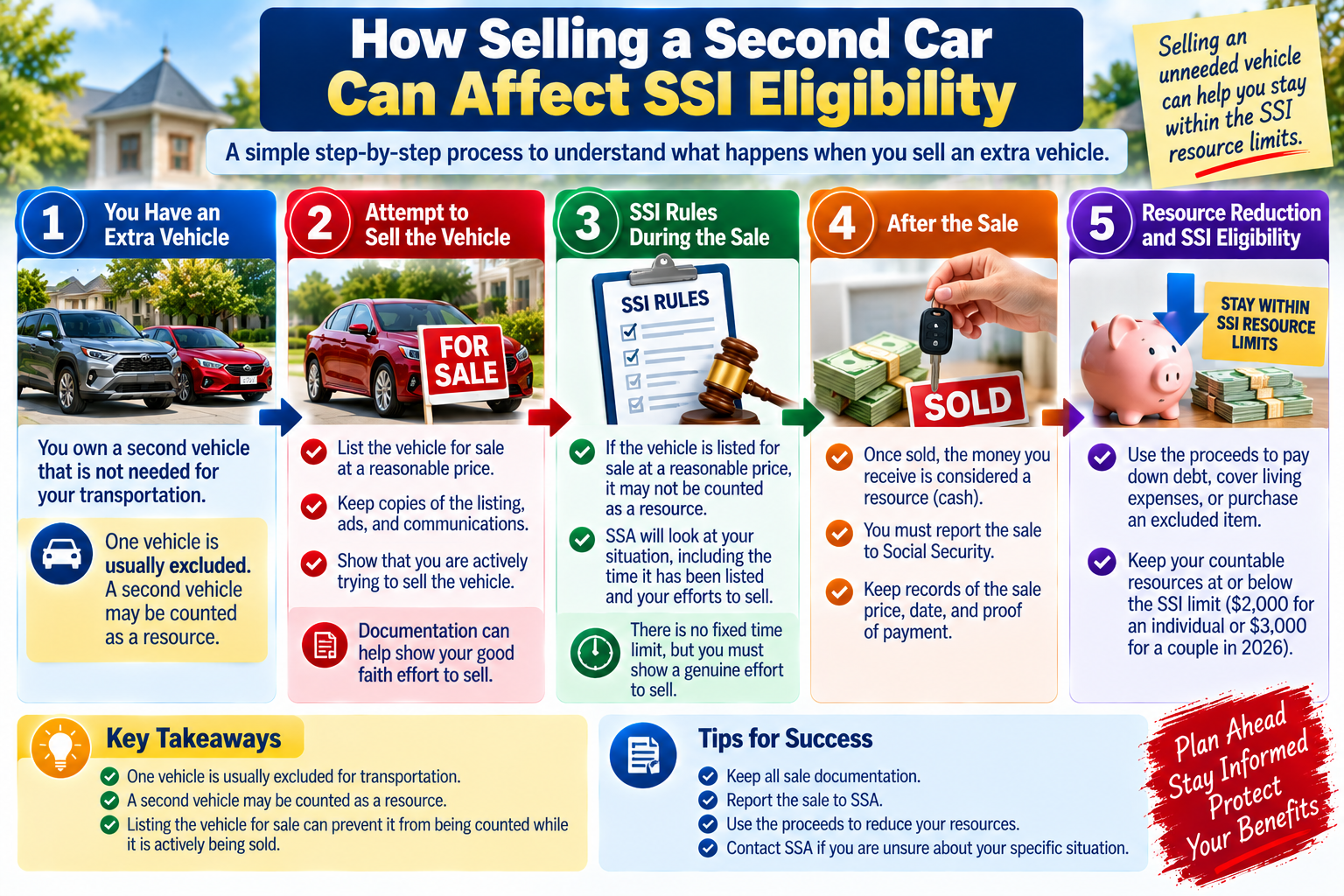
The SSA conditional-benefit rules state that a non-excluded vehicle, including a second car, can be a personal property resource that may be sold under the conditional benefits provisions.
While you are trying to sell the excess resource, you may receive conditional SSI payments for a limited period if the applicable conditions are met. Those conditional payments must be repaid when the resource is sold.
The conditions and time limits for this process are specific, so a person with excess resources should not assume that simply listing the car for sale will automatically preserve SSI eligibility.
What Should You Do Before Buying a Second Car on SSI?
Before buying another vehicle, consider how the purchase will affect your countable resources.
SSI resource rules are based on what you own and what counts toward the applicable resource limit. A second automobile may become a countable resource, while certain other assets and one transportation vehicle may be excluded.
Keep records showing the vehicle’s ownership, value, and any amount owed. If the purchase could change your SSI eligibility, review the situation with Social Security before assuming the second vehicle is excluded.
Frequently Asked Questions
Can you own 2 cars on SSI?
Yes. You can own two cars while receiving SSI, but the second vehicle may count as a resource. One vehicle per household can generally be excluded when used for transportation. The equity value of a non-excluded vehicle can count toward the $2,000 individual or $3,000 couple resource limit.
Does SSI allow a second car?
SSI does not prohibit a second car. The issue is whether the second vehicle is a countable resource. If it is not excluded under another rule, Social Security generally considers its equity value when determining your total countable resources.
Is one car automatically excluded from SSI?
One vehicle can generally be excluded regardless of value when the recipient or a household member uses it for transportation. The exclusion applies to one vehicle per household, not one vehicle for every person in the household.
Can two cars both be excluded if both are used for transportation?
Not under the standard one-vehicle transportation exclusion. When more than one automobile is used for transportation, SSA generally applies the full exclusion to the vehicle with the greatest equity value. The other vehicle may count as a resource unless another exclusion applies.
Can a second car make me lose SSI?
It can if the second car’s countable equity value, combined with your other countable resources, puts you above the SSI resource limit. In 2026, that limit is $2,000 for an individual and $3,000 for a couple.
Does a car loan reduce the amount counted for SSI?
It can. For a non-excluded automobile, SSA uses equity value, which is generally the vehicle’s current market value minus applicable encumbrances. A remaining loan balance can therefore affect the amount counted as a resource.
What happens if my second car is not working?
A temporarily broken vehicle can still meet SSA’s definition of an automobile if it is normally used for transportation. SSA has specific rules for temporarily inoperable vehicles, so a broken car is not automatically ignored for SSI purposes.
Can I sell my second car if I have too many resources?
Potentially. SSA has conditional-benefit rules that may allow certain SSI recipients to receive benefits while trying to sell an excess resource, including a non-excluded second car. The applicable rules include specific conditions and time limits, and conditional payments must be repaid when the resource is sold.
Key Takeaways
You can own 2 cars on SSI, but the second car may count toward your SSI resource limit.
- One vehicle per household can generally be excluded when it is used for transportation.
- A second vehicle may be a countable resource unless another exclusion applies.
- For a non-excluded vehicle, SSA generally considers equity value, not simply the vehicle’s full market value.
- In 2026, the SSI resource limit is $2,000 for an individual and $3,000 for a couple.
- When multiple cars are used for transportation, SSA generally excludes the vehicle with the greatest equity value.
Conclusion
So, can you own 2 cars on SSI? Yes. The number of vehicles itself does not automatically end SSI eligibility. The key issue is whether the second vehicle is a countable resource and how its equity value affects your total countable resources.
Under current SSA rules, one vehicle per household used for transportation can generally be excluded regardless of value. A second vehicle may count toward the resource limit unless another exclusion applies. In 2026, that federal limit is $2,000 for an individual and $3,000 for a couple.
Before buying, selling, or transferring a second vehicle, check how the change could affect your SSI resources. The safest source for an individual determination is Social Security, because the treatment can depend on the vehicle, its equity value, household circumstances, and other countable resources.