
Can you receive VA disability and SSI together? Yes, but the two checks don't simply add up the way most veterans expect. VA disability compensation counts as unearned income for SSI, so a new VA award usually shrinks your monthly SSI payment.
That one rule catches thousands of households off guard every year. Federal regulations at 20 CFR Part 416 spell out exactly how unearned income gets counted. The Social Security Administration applies those rules to every VA dollar you receive.
Here's how the offset actually works, and how to keep it from wrecking your budget.
Quick Answer
Can you receive VA disability and SSI together? Yes, if you meet both programs' rules. The SSA counts VA disability compensation as unearned income.
That income reduces your SSI payment dollar for dollar. A large enough award can end your SSI payments.
Why Getting This Right Matters: The Financial Stakes of VA Disability and SSI
Most veterans hear "tax-free" and assume VA disability money never touches other benefits. That's the mistake. Tax-free only describes federal income tax.
It says nothing about how the Social Security Administration treats those same dollars when it calculates SSI.
SSI is a needs-based program. It exists for people with very little income and almost no savings. Add a VA disability check on top, and the SSA recalculates everything.
Get the reporting wrong and you can end up owing money back.
What Actually Hangs in the Balance
SSI is rarely just a cash payment. In most states, SSI opens the door to Medicaid automatically. It can also unlock SNAP food benefits and rental help through HUD.
Lose SSI and those doors can close with it. That's the part people miss when they focus only on the monthly dollar figure.
| Benefit | Tied to SSI? | What Happens if SSI Stops |
|---|---|---|
| Medicaid | Yes, in most states | Coverage may end or change |
| SNAP | Often | Monthly food benefits drop |
| HUD rental help | Often | Your rent share can rise |
| State SSI supplement | Yes | The supplement stops |
The Overpayment Trap
Overpayments are the biggest risk here. The SSA pays you based on what it knows. If you don't tell them about a VA award, they keep paying the old amount month after month.
Months later, the letters arrive. Now you owe thousands, and the SSA can trim future checks to recover it. Our breakdown of an unexpected overpayment letter walks through the appeal and waiver options.
You can request a waiver if the overpayment wasn't your fault and repayment would cost you basic necessities. That's a real path, but you have to ask for it.
Why Speed Matters
Report a new VA award as soon as you get the decision letter. The SSA expects changes within about 10 days. Waiting until the back pay hits your bank account is too late.
How SSI Counts VA Disability Compensation as Unearned Income
The SSA splits income into two buckets: earned and unearned. Wages are earned. Almost everything else, including VA disability compensation, lands in the unearned bucket.
That label decides how much of your check survives each month.
Unearned income gets the harsher treatment. The SSA subtracts a $20 general exclusion, then counts the rest against your SSI payment. Beyond that $20, one dollar of VA money removes roughly one dollar of SSI.
The $20 Exclusion, Explained
Every SSI recipient gets a $20 general income exclusion per month. It applies to unearned income first, before any other exclusion. After that, VA disability compensation reduces SSI dollar for dollar.
So a $200 monthly VA payment cuts about $180 from SSI, not $200. Small comfort, but it's real money over a year.
Resource Limits Still Apply
SSI also caps what you can own. As of 2026, the individual limit is $2,000 and the couple limit is $3,000. A VA back pay deposit can push you over that line in a single afternoon.
Our breakdown of the household resource caps explains how couples get counted. There's also a nine-month grace period for some retroactive payments, so timing your deposit matters more than most people realize.
Living Arrangements Change the Math
If you live with family who cover your bills, the SSA may count in-kind support and maintenance. That can cut your SSI even further. Our piece on living with relatives covers how that rule actually plays out.
What Counts and What Doesn't
| Income Source | SSI Treatment |
|---|---|
| VA disability compensation | Unearned, countable |
| VA pension | Unearned, countable |
| SSDI | Unearned, countable |
| Wages | Earned, partially excluded |
| SNAP benefits | Not counted as income |
VA Disability Compensation vs. VA Pension: Which One Affects SSI?
People mix these up constantly. They're two different programs with two different rulebooks. VA disability compensation pays for a service-connected condition.
VA pension pays a low-income wartime veteran who has limited income and isn't rated at 100%.
Both count as unearned income for SSI. The real difference is how the VA itself treats them when other money comes in.
VA Disability Compensation
This is the payment most veterans mean when they say "VA benefits." It's tax-free, and the amount depends on your rating and how many dependents you have. It is not reduced by other income. You can hold a full-time job and still collect it.
VA Pension
VA pension is needs-based. The VA sets a maximum annual pension rate, called the MAPR. Every dollar of other income, including SSI, reduces your pension.
Hit the MAPR and the pension disappears entirely.
That's the key difference. VA pension and SSI can cancel each other out. VA disability compensation and SSI simply offset.
| Feature | VA Disability Compensation | VA Pension |
|---|---|---|
| Based on | Service-connected rating | Wartime service plus low income |
| Reduced by other income | No | Yes |
| Taxable | No | No |
| Counts for SSI | Yes, as unearned | Yes, as unearned |
Which One Should You Apply For?
If you have a service-connected condition, pursue compensation first. It isn't offset by SSI the way pension is, so the math usually favors it. If you served in wartime and have limited income but no rating, pension may be your only VA option.
You can read the official VA rules before you file. Compare both programs side by side so you're not leaving money on the table.
SSI vs. SSDI: Why the Difference Changes Your Benefits
This is the confusion that costs people the most. SSI and SSDI sound alike. They are not alike at all, and mixing them up leads to bad decisions.
SSDI is an insurance program. You pay into it through payroll taxes during your working years. There's no income limit and no resource cap.
SSI is a safety net funded by general taxes, and it is strictly means-tested.
Why It Matters for Veterans
A veteran can collect SSDI, VA disability compensation, and SSI at the same time. But the SSI piece only survives if total income stays low. SSDI counts as unearned income for SSI, exactly like VA compensation does.
So a large SSDI award can wipe out SSI on its own, even with no VA money in the picture.
The Resource Test Only Hits SSI
SSDI has no savings limit. You can have $50,000 in the bank and still collect. SSI stops at $2,000 for an individual.
That single difference changes who qualifies and who doesn't.
Our guide on children's auxiliary benefits shows how dependents fit into the SSDI picture.
Working While on Benefits
SSDI allows trial work periods and has a substantial gainful activity limit. SSI has its own earned income exclusions that treat wages more gently. If you're thinking about picking up part-time hours, the rules shift depending on which program pays you.
Medicaid vs. Medicare
SSI usually brings Medicaid with it. SSDI brings Medicare after a 24-month waiting period. Some people end up with both.
Our guide to health coverage rules explains how the overlap works in practice.
Quick Comparison
| Feature | SSI | SSDI |
|---|---|---|
| Funded by | General taxes | Payroll taxes |
| Resource limit | $2,000 / $3,000 | None |
| Work history needed | No | Yes |
| Health coverage | Medicaid | Medicare |
Which Program Fits Your Situation?
If you have a work history and a qualifying disability, SSDI is usually the stronger base. No resource cap, no income offset, and Medicare after the waiting period. SSI steps in when your work credits are thin or your income is very low.
Many veterans end up on both, with SSI topping up a small SSDI check.
Run your numbers before you assume. A benefit verification letter from the SSA spells out exactly what you receive. Our walkthrough on pulling that letter online makes it a two-minute job.
Common Mistakes That Trigger SSI Overpayments and Reductions
The single biggest mistake is silence. Veterans get a VA decision letter, celebrate, and never call the SSA. Months later, an overpayment notice lands in the mailbox with a number that makes their stomach drop.
The SSA doesn't wait for you to report. It matches records with the VA electronically. When the match catches up, every month you were overpaid becomes a debt.
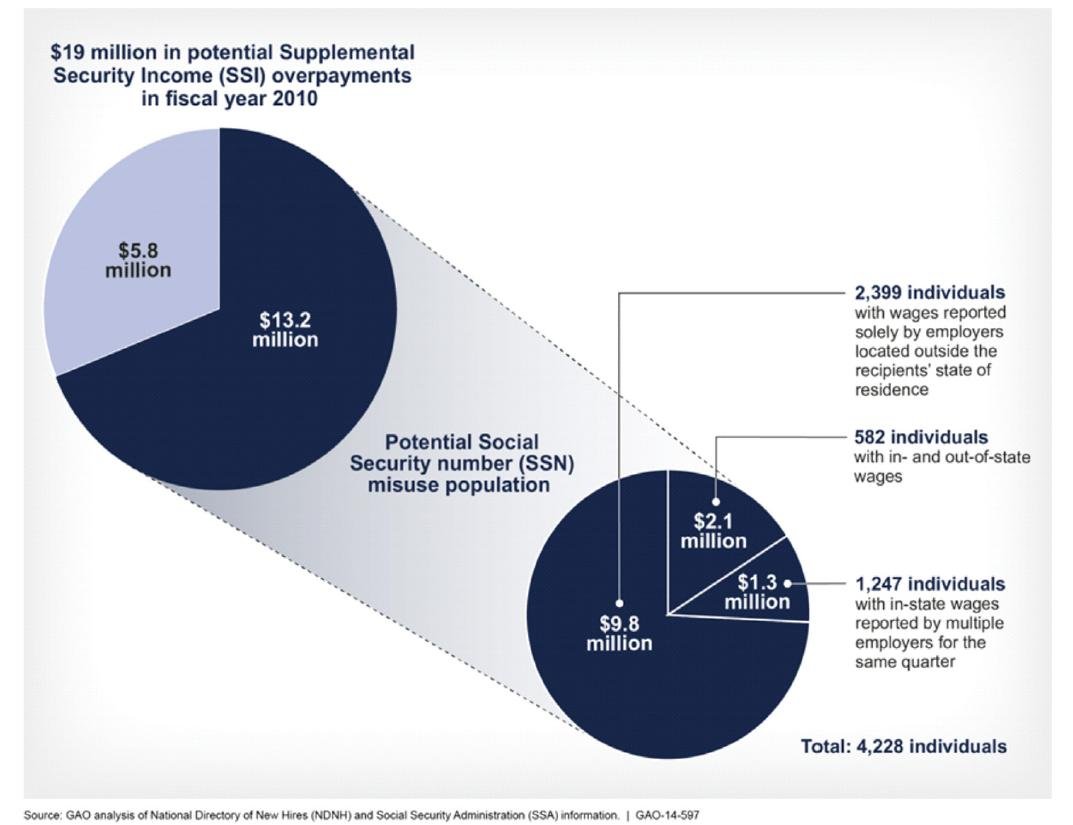
Image source: Wikimedia Commons / U.S. Government Accountability Office from Washington, DC, United States
Reporting Too Late
The SSA asks for changes within 10 days of the event. Most people report weeks or months later. That gap is where overpayments grow.
Forgetting the Back Pay Deposit
A retroactive VA lump sum can blow past the $2,000 resource limit overnight. If the money sits in your account past the grace period, SSI stops. Our post on back pay deposit timing explains how the SSA treats that lump sum.
Confusing Tax-Free With Count-Proof
Tax-free means the IRS ignores it. The SSA does not. This one mix-up drives a huge share of overpayment cases.
Not Reporting a Move or New Household Member
Living arrangements change your SSI amount. A new spouse, a roommate who pays rent, or a move into a family home all count. Skip the update and the SSA keeps paying the wrong figure.
Ignoring the First Notice
The first overpayment letter is not the final word. You can appeal it or request a waiver. Ignoring it lets the SSA start withholding from future checks.
Our guide on correcting benefit fraud concerns covers when a formal report is the right move.
Quick Fix Checklist
- Report every VA award within 10 days
- Keep VA back pay in a separate account if possible
- Tell the SSA about moves, marriages, and new household members
- Open every SSA letter the day it arrives
- File an appeal or waiver before the deadline on the notice
Safe Practices for Reporting VA Awards to the SSA
Reporting is not complicated, but it has to be done right and on time. You have three main channels: online, by phone, and in person. Each one leaves a different paper trail.
The safest habit is to report in writing and keep a copy. Phone calls work, but you have no proof of what was said. A dated letter or an online submission gives you a record if a dispute comes up later.
Use Your my Social Security Account
The SSA's online portal lets you report changes and view your current payment. Screenshot the confirmation. That timestamp is your proof.
Call the National Number, Not a Local Office
The national line at 1-800-772-1213 logs every call. Local offices are great for complex cases, but the national record is easier to retrieve. Note the date, time, and the name of the representative.
Put It in Writing
Send a short letter with your name, Social Security number, and the exact change. Include the VA award date and monthly amount. Mail it certified if the change is large.
Update Every Related Agency
SSI touches Medicaid, SNAP, and HUD. Each one needs the same information. Our guide on rent help for seniors explains why a delay in one program can raise your rent in another.
Keep a Benefits Folder
Store every VA letter, SSA notice, and payment stub in one place. When an overpayment notice shows up, you'll have the proof you need in minutes.
| Report Method | Proof You Get | Best For |
|---|---|---|
| Online portal | Screenshot / confirmation | Simple changes |
| Phone call | Reference number | Quick questions |
| Certified letter | Mailing receipt | Large changes, disputes |
What to Report Every Time
- New VA award or rating increase
- Change in living arrangement
- Marriage, divorce, or death of a spouse
- New bank account or direct deposit change
- Any lump sum over the resource limit
When to Get Expert Help: VSOs, Attorneys, and SSA Field Offices
You can handle most reporting yourself. But some situations need a trained hand. Overpayment disputes, denied claims, and complex household rules are where expert help pays for itself.
The good news is that most help for veterans is free. Veterans Service Organizations (VSOs) exist for exactly this reason. They know the VA system and the SSI rules that intersect with it.
What a VSO Can Do
VSOs help with VA claims, rating appeals, and benefit questions. Groups like the American Legion, VFW, and Disabled American Veterans staff trained officers at no cost. They can also point you toward SSI resources.
When to Hire an Attorney
For SSI appeals and overpayment waivers, a disability attorney can make the difference. Most work on contingency, meaning they only get paid if you win. Never pay an upfront fee for SSI help.
Visit an SSA Field Office
For complex cases, an in-person visit beats a phone call. Bring your VA decision letter, bank statements, and any SSA notices. Ask for a printed summary of the change before you leave.
Free Legal Aid and State Resources
Many states fund legal aid for benefits cases. Your state's long-term care ombudsman or bar association can point you to help. Our piece on documents for elderly assistance lists what to bring to any benefits appointment.
Red Flags That Mean Get Help Now
- An overpayment notice over $1,000
- A denied SSI application
- A reduction you don't understand
- Threats to cut Medicaid or SNAP
- Any letter mentioning fraud or an investigation
Verified Summary: Your Decision Guide for VA Disability and SSI
Yes, you can receive VA disability and SSI together. The catch is that VA disability compensation counts as unearned income, and it reduces your SSI payment dollar for dollar after a $20 exclusion. Large awards can zero out SSI entirely.
The rules don't change based on how you feel about them. They change based on your rating, your other income, your resources, and your living arrangement. Know those four numbers and you can predict your payment before the SSA does.
The Short Version
- VA disability compensation and SSI can be paid at the same time
- VA compensation counts as unearned income for SSI
- A $20 exclusion applies, then dollar-for-dollar offset
- Resource limits of $2,000 / $3,000 still apply
- Back pay can trigger an overpayment if you don't report it
- SSI often carries Medicaid, SNAP, and HUD with it
Your Next Steps
Report any new VA award within 10 days. Keep proof of every report. Watch your bank balance against the resource cap.
If a notice confuses you, call a VSO before the deadline passes.
When to Walk Away From DIY
If you're facing an overpayment over $1,000, a denial, or a fraud allegation, get help. Free VSOs and legal aid exist for a reason. Time limits on appeals are short and unforgiving.
Frequently Asked Questions
Can you receive VA disability and SSI together in 2026?
Yes. The SSA allows both at the same time. VA disability compensation counts as unearned income, so it reduces your SSI payment after a $20 exclusion.
If your VA check is large enough, SSI may drop to zero even though you still qualify.
Does VA disability back pay affect SSI?
It can. A retroactive lump sum counts as income in the month received and can push you over the $2,000 resource limit. The SSA offers a nine-month grace period for some retroactive payments.
Report the deposit right away to avoid an overpayment.
Is VA disability compensation counted as income for SSI?
Yes. The SSA treats VA disability compensation as unearned income. It gets the $20 general exclusion first.
After that, every dollar reduces your SSI payment by roughly one dollar.
What happens if I don't report my VA award to the SSA?
You'll likely get an overpayment notice. The SSA matches records with the VA electronically. Once the match catches up, you owe every month you were overpaid.
You can appeal or request a waiver, but the debt starts accruing immediately.
Can I get Medicaid if I receive VA disability and SSI together?
In most states, SSI brings automatic Medicaid eligibility. If your VA award reduces SSI to zero, Medicaid may still continue in some states under special rules. Check with your state Medicaid office before assuming coverage ends.
Does VA pension reduce SSI the same way as VA disability compensation?
Both count as unearned income for SSI, so both reduce your payment. The bigger issue is VA pension itself. It's needs-based and gets reduced by other income, including SSI.
In some cases the two cancel each other out entirely.
Real-World Scenarios: Three Veterans, Three Outcomes
Numbers tell the story better than rules do. Here are three examples built from how the offset math typically plays out. Names are changed, but the mechanics are real.
Scenario One: The 70% Rating That Cut SSI
A single veteran with no dependents was collecting $950 in SSI. He received a 70% VA disability rating and started getting about $1,750 monthly. The SSA applied the $20 exclusion, then counted the rest.
His SSI dropped to zero. He kept Medicaid in his state, but SNAP fell by roughly $200 a month. Had he reported within 10 days, he'd have avoided a $2,000 overpayment notice.
Scenario Two: The 30% Rating That Topped Up
A different veteran on SSI got a 30% rating worth around $550 monthly. After the $20 exclusion, roughly $530 counted against SSI. His $950 SSI check became about $420.
He still cleared both checks. Medicaid continued, SNAP barely moved, and his total monthly income rose by roughly $550. That's the best-case version of stacking benefits.
Scenario Three: The Back Pay Disaster
A veteran won an appeal and received $18,000 in retroactive VA compensation in one deposit. His bank balance blew past the $2,000 resource limit. SSI stopped the next month.
He didn't qualify for the nine-month grace period because the payment was for a rating increase, not an initial award. Our guide on getting a verification letter helps you prove your income when the SSA asks questions.
What All Three Share
Timing decided everything. The veteran who reported fast kept his benefits clean. The one who waited created a debt.
Speed is the whole game here.
The Numbers Side by Side: SSI Rates, VA Rates, and What You Keep
Understanding the offset means knowing both sides of the ledger. The SSA publishes its federal benefit rate every year. The VA publishes its compensation tables every December.
The gap between them is your real income.
How the Offset Math Works
Start with your SSI federal benefit rate. Subtract $20. Then subtract your countable VA compensation.
Whatever remains is your SSI payment.
If the result hits zero, SSI ends. You don't owe anything, but the cash stops.
The Two Sets of Limits
SSI uses an income test and a resource test. VA compensation only affects the income side. Your savings, vehicle, and home equity fall under the resource test.
| Item | SSI Individual | SSI Couple |
|---|---|---|
| Resource limit | $2,000 | $3,000 |
| General exclusion | $20/month | $20/month |
| Countable VA income | Dollar for dollar | Dollar for dollar |
Why the FBR Moves Every January
The SSA adjusts the federal benefit rate each year for cost-of-living increases. The VA does the same with its compensation tables. They rarely rise by the same percentage.
That mismatch means your offset shifts slightly every January. A veteran whose SSI sat just above zero in December can lose it entirely in February.
The State Supplement Wildcard
Some states add money on top of the federal SSI rate. California runs one of the largest supplements in the country. Others, like Texas, add nothing.
If you live in a supplement state, your SSI baseline is higher. That gives you more room before VA compensation wipes it out. Our post on benefit card problems applies once your payments are set.
State Differences That Change Your Bottom Line
Federal rules set the floor. States decide how much higher you go. Where you live can change your total monthly income by hundreds of dollars.
States With SSI Supplements
California, New York, Massachusetts, and a handful of others add a state supplement. The amounts vary by living arrangement and marital status. Some supplement states pay extra for people in assisted living.
States Without Supplements
Most states pay the federal rate only. Veterans in these states feel the VA offset more sharply. There's no state cushion to absorb the reduction.
Medicaid Expansion Matters Too
In expansion states, adults can qualify for Medicaid on income alone. That softens the blow when SSI ends because of VA compensation. In non-expansion states, losing SSI can mean losing coverage entirely.
Local Veteran Programs
Many counties run their own veterans assistance funds. They can help with rent, utilities, and emergency costs. These programs don't count as income for SSI in most cases.
How to Check Your State Rules
Call your state Medicaid office and your county veterans service officer. Ask two questions. Does my state add an SSI supplement?
What happens to my Medicaid if SSI stops?
Those two answers shape your entire plan. Get them before you file anything.
Long-Term Optimization: COLA, Redeterminations, and Reviews
Your benefit picture isn't static. The SSA reviews SSI cases on a schedule. The VA can change your rating.
Both events reset your math.
Annual COLA Adjustments
Every January, both agencies adjust payments for inflation. The SSA updates the federal benefit rate. The VA updates its compensation tables.
Check both figures each year. A small change on either side can push your SSI to zero or bring it back.
SSI Redeterminations
The SSA reviews SSI cases periodically, often every one to six years. You'll get a letter asking about income, resources, and living arrangements. Answer it fully and on time.
Miss the deadline and payments can stop. Our guide on fixing your earnings record shows how errors in SSA data cause problems down the line.
VA Rating Reviews
The VA can propose a rating reduction if it believes your condition improved. A lower rating means less compensation. That can actually raise your SSI payment back up.
Work Incentives Worth Knowing
SSI has earned income exclusions that treat wages gently. There's also the Plan to Achieve Self-Support and Impairment-Related Work Expenses. These let you keep more of your SSI while working toward independence.
Keep Your File Current
Update your address, bank account, and household details the moment they change. Small gaps in your record create big headaches during a review.
Alternatives and Overlaps: SNAP, HUD, and State Programs
SSI and VA disability aren't the only two programs in play. Several others stack on top, and each has its own income rules. Knowing how they interact keeps you from leaving money behind.
SNAP Food Benefits
SNAP counts VA disability compensation as income. A large award can cut your monthly food benefits. Report the change to your state SNAP office within the required window.
HUD Rental Assistance
HUD calculates your rent as a share of adjusted income. VA compensation raises that figure. Expect your rent portion to rise after a new award.
Medicaid and Medicare
SSI usually brings Medicaid. SSDI brings Medicare after a waiting period. Veterans with VA healthcare can hold all three at once.
State Veterans Benefits
Many states offer property tax breaks, tuition waivers, and annuity payments. Most don't count against SSI. Ask your state veterans affairs office for a full list.
| Program | Counts VA Income? | Who Runs It |
|---|---|---|
| SNAP | Yes | State / USDA |
| HUD housing | Yes | Local housing authority |
| Medicaid | Depends on state | State |
| State veterans annuity | Often no | State |
Where to Start
Call 211 or your county veterans service officer. They'll walk you through every program you might qualify for. Then report each new benefit to the SSA as it begins.