
You worked for years at low pay. Now you wonder what your Social Security check will look like. Retirement benefit calculation with low earnings can feel confusing.
But the math often works in your favor.
The Social Security Administration uses a progressive formula. It replaces a higher share of income for low earners. For example, the first bend point in 2026 replaces 90% of your average indexed monthly earnings.
That means small paychecks can still produce a meaningful benefit. Let's start with why your low earnings might not hurt as much as you fear.
Quick Answer
Retirement benefit calculation with low earnings uses a progressive formula. The SSA averages your 35 highest indexed years. Then it applies bend points.
Low earners get a higher replacement rate. You may also qualify for spousal or SSI top-ups. That protects you from a tiny check.
Why a Low-Earnings Retirement Benefit Is Often Bigger Than You Think
You might assume a lifetime of low pay means a tiny Social Security check. That's not how the system works. The formula is progressive by design.
It gives low earners a much higher replacement rate than high earners.
Think of it like a ladder. The first rung of your earnings gets the most support. In 2026, the first bend point still replaces 90% of your average indexed monthly earnings.
That number applies up to a threshold. After that, the replacement rate drops to 32% and then 15%. So your first dollars of lifetime earnings are the most valuable.
A worker who earned $20,000 a year for 35 years can still receive a benefit that replaces a large share of that income. The exact amount depends on your AIME and your claiming age. But the 90% rate on the first portion is a powerful floor.
Many low earners end up with a replacement rate above 50%.
Here's a simple comparison. A high earner might get 30% of their pre-retirement income. A low earner often gets 50% or more.
That's because of the bend points. The system is tilted toward you.
If your benefit is still very low, you might qualify for extra help for seniors with no savings. That includes SSI or state supplements. So don't assume you'll get nothing.
The system has layers. The Social Security Administration confirms the formula is progressive. You can check your own estimate through a My Social Security account.
So when you hear that Social Security is a safety net, this is what that means. It's not a flat percentage. It's a tiered formula that protects the bottom of your earnings record.
That said, the 35-year rule can still hurt you. If you have many low or zero years, your AIME drops. We'll cover that next.
How the SSA Calculates Your Retirement Benefit When Your Earnings Were Low
The Social Security Administration starts with your taxable earnings for each year. It adjusts those earnings for inflation. That gives you an indexed earnings figure for every year you worked.
Then it picks your 35 highest indexed years. If you have fewer than 35 years, it adds zeros. It adds them until you reach 35.
Next, the SSA adds up those 35 years. It divides the total by 420 months. That number is your Average Indexed Monthly Earnings, or AIME.
Then the SSA applies the bend points to your AIME. The result is your Primary Insurance Amount, or PIA. That PIA is your benefit at Full Retirement Age.
Here's a quick table of the steps.
| Step | What happens |
|---|---|
| 1 | Index each year of earnings for inflation |
| 2 | Select the 35 highest years |
| 3 | Add zero years if you have fewer than 35 |
| 4 | Divide total by 420 to get AIME |
| 5 | Apply bend points to get PIA |
Low earnings lower your AIME. But the bend points still give you 90% of the first portion. So the drop in your benefit is smaller than you might expect.
Self-employed workers report net earnings. That means your net profit counts, not gross revenue. If you had low net profit, your AIME reflects that.
For more on that, see how self-employed workers build benefits.
The SSA recalculates your AIME every year you work. So even a few low-earning years can nudge your benefit up. The key is to have 35 years of any earnings.
Zero years hurt more than low years. A low year still adds something to your average.
The 35-Year Rule: How Zero and Low Years Quietly Shrink Your AIME
The 35-year rule is simple but brutal. The SSA uses your 35 highest years of indexed earnings. If you have 40 years of work, the five lowest years get dropped.
That helps you. But if you have only 30 years, five zero years get added. Those zeros drag your average down.
Each zero year reduces your AIME. That reduces your PIA. The effect is permanent unless you replace that zero with a year of earnings.
So part-time work late in life can still help. Even a small paycheck adds to your average.
Low years are not as bad as zero years. A year with $5,000 of earnings still counts. It replaces a zero.
So if you have gaps from caregiving, disability, or unemployment, try to fill them. A single year of part-time work can raise your lifetime benefit.
If you spent years caregiving, you might have zero years. But you may still qualify for benefits as a caregiver. That can protect your record.
Check the rules for retirement benefits for caregivers.
What about low years that are not zero? They still count. But they pull your average down.
The only way to fix that is to work more years. Or earn more in future years. There's no shortcut.
The SSA does not let you exclude low years. It only drops the lowest of your 35 highest. So if you have 35 years, the lowest of those 35 still counts.
The best strategy for low earners is to work at least 35 years. Even at low pay. That eliminates zero years.
It also gives you more years to replace low years with slightly higher ones. Every extra year helps a little.
Work Credits, Special Minimum Benefit, and SSI: The Safety Nets for Low Lifetime Earnings
You need 40 work credits to get Social Security retirement benefits. You earn credits by working and paying Social Security taxes. In 2026, you get one credit for a certain amount of earnings.
You can earn up to four credits per year. Most low earners reach 40 credits after 10 years of work. But some do not.
If you have fewer than 40 credits, you cannot get retirement benefits. But you might qualify for SSI. Supplemental Security Income is a needs-based program.
It pays a small monthly check. It also gives you Medicaid in most states. SSI has strict income and resource limits.
But it is a safety net for very low earners.
There is also the special minimum benefit. This is a different way to compute your PIA. It helps people who worked for many years at very low wages.
The special minimum benefit can be higher than your regular PIA. But you must have at least 11 years of coverage. The more years you have, the higher the special minimum.
It maxes out at 30 years of coverage.
If you are an older immigrant with limited work history, SSI may be your main option. The rules for SSI for older immigrants are specific. You generally need to be a qualified alien.
You also need to meet the income and resource tests.
So even if your retirement benefit is tiny, you have options. Work credits get you in the door. The special minimum benefit can raise your floor.
SSI can fill the gap. None of these make you rich. But they keep you from falling through the cracks.
Spousal, Survivor, and Divorced-Spouse Benefits: The Top-Up Low Earners Miss
If you are married, you can get a spousal benefit. That benefit is up to 50% of your spouse's PIA. You get the higher of your own benefit or the spousal benefit.
So if your own benefit is low, the spousal top-up can raise your check. You must be at least 62 to claim it. And your spouse must have filed for their own benefit.
Survivor benefits work differently. If your spouse dies, you can get a survivor benefit. That can be up to 100% of what your spouse was receiving.
That includes any delayed retirement credits. So a low-earning survivor can step into a much higher benefit. This is often the biggest windfall for low earners.
Divorced spouses can also qualify. You must have been married for at least 10 years. You must be unmarried now.
And your ex-spouse must be entitled to benefits. Your own benefit must be lower than the spousal or survivor benefit. If you meet those rules, you can claim on your ex's record.
That does not reduce your ex's benefit. For more details, see the rules for surviving divorced spouses.
The key point is this. Your own low earnings do not lock you into a low benefit forever. If you have a higher-earning spouse or ex-spouse, you can top up.
Many low earners miss this. They assume their own record is all that matters. It's not.
Always check spousal and survivor options before you claim.
Claiming Age with a Low AIME: Early Reduction, Delayed Credits, and Break-Even
Your claiming age changes your benefit by a lot. Claim at 62 and your check drops permanently. Wait until 70 and it grows by 8% per year after Full Retirement Age.
For low earners, the dollar difference is smaller but still meaningful.
Early claiming reduces your PIA by 5/9 of 1% per month for the first 36 months. After that, the reduction is 5/12 of 1% per month. At 62 with an FRA of 67, that's a 30% cut.
Delayed retirement credits add 8% per year from FRA to 70. So waiting can boost a low benefit by 24% or more.
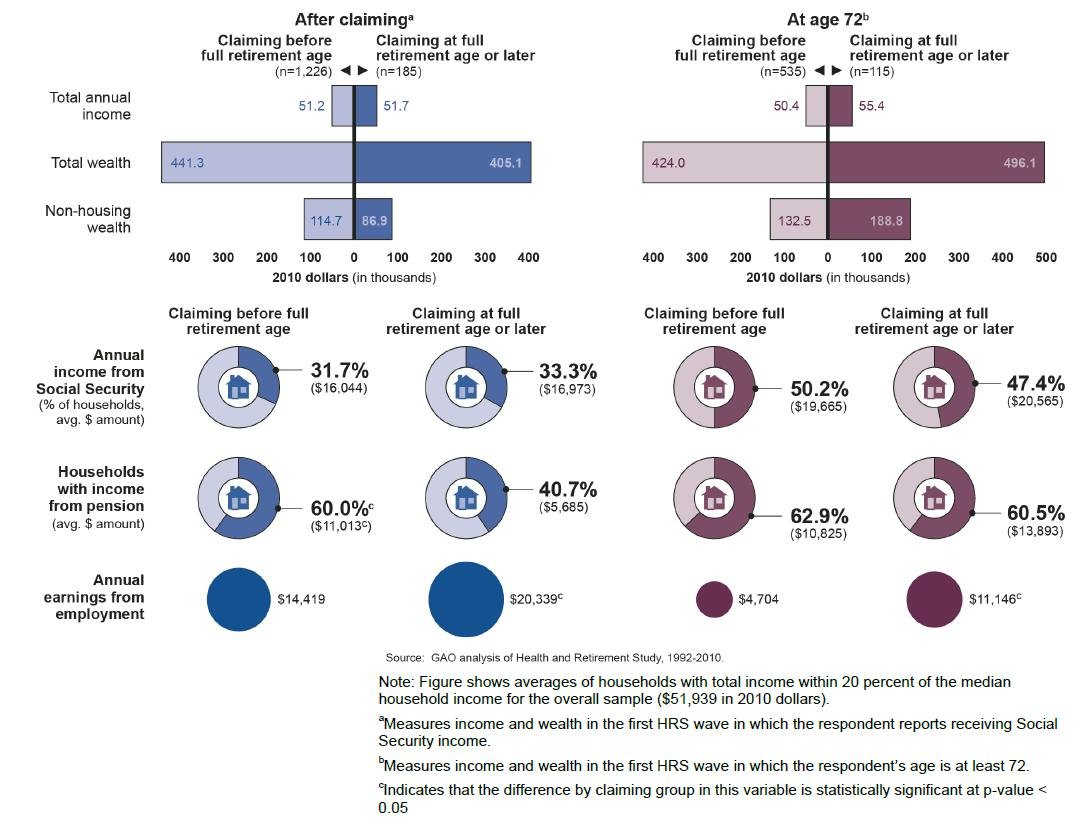
Image source: Wikimedia Commons / U.S. Government Accountability Office from Washington, DC, United States
Break-even age matters here. If you claim at 62 and live to 85, you'll collect more total dollars than someone who waited to 70 but died at 78. But the monthly check is smaller.
Low earners often need the money sooner, so early claiming is common.
Ask yourself one question. Do you have other income like a spousal benefit, pension, or SSI? If yes, waiting might pay off.
If Social Security is your only income, claiming early may be necessary. There's no wrong answer, just trade-offs.
Mistakes That Permanently Reduce a Low-Earnings Retirement Benefit
The biggest mistake is claiming before you check your earnings record. Errors happen. Employers report wrong amounts.
If you don't correct them, your AIME is lower forever. Fix errors as soon as you spot them.
Another mistake is ignoring zero years. If you have fewer than 35 years, each zero drags your average down. Part-time work late in life can fix that.
Even a few thousand dollars a year helps.
Assuming you don't qualify for spousal benefits is a third error. Many low earners never check their spouse's record. That leaves money on the table.
Always compare your own benefit to the spousal option.
Not reporting self-employment income is a fourth mistake. If you work gigs and don't file taxes, those earnings never count. You lose credits and AIME.
Report every dollar.
Finally, missing the appeal deadline for record errors hurts. You have limited time to challenge SSA decisions. If you get a denial, know the disability appeal deadline after denial.
Don't let the clock run out.
Step-by-Step: Check, Correct, and Estimate Your Own Low-Earnings Benefit
Here's how to take control of your calculation. Follow these steps in order.
Step 1: Create a My Social Security account. It's free and secure. You'll see your full earnings record.
Step 2: Review every year. Look for missing years or wrong amounts. If something looks off, gather your W-2s or tax returns.
Step 3: Correct errors. File Form SSA-7008 with proof of earnings. The SSA will update your record if your evidence is valid.
Step 4: Use the SSA's benefit calculators. The Social Security Administration offers a Retirement Estimator tool. It uses your real record to give a personalized estimate.
Step 5: Check work credits. You need 40 credits for retirement. SSI can fill the gap if you have fewer.
Step 6: Estimate spousal or survivor benefits. Compare your own benefit to what you'd get on a spouse's record.
Step 7: Decide on a claiming age. Use the break-even tool. Factor in health, other income, and expenses.
If you ever lose access to your account, there are steps to unlock an online benefits account. Keep your contact info updated so you don't miss notices.
Real Scenarios: Part-Time Workers, Caregivers, Gig Workers, and Public Employees
Numbers make this real. Here are four common cases.
Case 1: Part-time worker. Maria worked 25 years at $15,000 a year. She has 10 zero years.
Her AIME is around $900. Her PIA at FRA is roughly $800. If she claims at 62, she gets about $560.
If she works five more years part-time, her zero years shrink and her benefit rises.
Case 2: Caregiver. David took 12 years off to raise kids. He has 28 years of earnings.
Eight zero years drag his AIME down. He qualifies for caregiver credit rules. His spousal benefit is higher than his own, so he claims on his wife's record.
Case 3: Gig worker. Aisha drives for rideshare apps. She reports $18,000 net per year.
She has 15 years of credits. She needs 10 more years for 40 credits. Her AIME is low, but the 90% bend point helps.
She also qualifies for SSI if her benefit is below the federal rate.
Case 4: Public employee. Tom worked 20 years in a job that didn't pay Social Security taxes. He has 15 years of covered work.
His non-covered pension used to trigger the WEP. But the Social Security Fairness Act repealed WEP in 2025. So Tom now gets his full PIA.
He also qualifies for survivor benefits for parents of deceased workers through his late son's record.
Each case shows the same lesson. Low earnings don't mean a tiny check. Credits, spousal top-ups, and SSI all matter.
Frequently Asked Questions
Does a low-earning year hurt my Social Security benefit?
A low-earning year hurts less than a zero year. Both count in your 35-year average. But a year with any earnings replaces a zero.
Even $3,000 of income helps your AIME.
Can I get Social Security if I only worked 10 years?
Yes, if those 10 years gave you 40 work credits. That's the minimum for retirement benefits. If you have fewer credits, you may qualify for SSI instead.
Is the special minimum benefit better than my regular PIA?
It depends on your years of coverage. The special minimum benefit helps people with 11 to 30 years of very low earnings. Compare both figures.
The SSA pays the higher one.
What happens if I claim at 62 with a low benefit?
Your benefit drops by up to 30% compared to your Full Retirement Age amount. For a low earner, that's a smaller dollar cut. But it's permanent.
Consider waiting if you can.
Can I get SSI and Social Security at the same time?
Yes. If your Social Security benefit is below the SSI federal benefit rate, you can get both. The SSI payment is reduced by your Social Security income.
Do zero years always reduce my benefit?
Yes, if you have fewer than 35 years of earnings. Each zero year lowers your AIME. Working even one more year replaces a zero and raises your benefit.
Pingback: * Disability Benefits and Employer Health Insurance - OMAGOUS
Pingback: * Retirement Benefits After Working Overseas - OMAGOUS
Pingback: * Retirement Benefits After Bankruptcy - OMAGOUS