
If you have Medicare and a limited income, Medicare Extra Help can lower the cost of your prescription drug coverage. The program can help with Part D premiums, deductibles, coinsurance, and other covered drug costs. Some people qualify automatically, while others need to apply through Social Security. Medicare’s Extra Help program explains who may qualify and what the assistance covers.
How to Apply for Medicare Extra Help With Low Income?
If you do not qualify automatically, you can apply for Extra Help through Social Security. The application is available online, and Social Security also accepts applications by phone or through an appointment. You can start with the Social Security Extra Help application.
Before starting the application, check whether you already qualify automatically. People who receive SSI, have full Medicaid coverage, or receive help from a qualifying Medicare Savings Program can qualify automatically when they have Medicare. Medicare explains the automatic Extra Help eligibility rules.
What Is Medicare Extra Help?
Medicare Extra Help is a program that helps people with limited income and resources pay certain Medicare Part D prescription drug costs.
The assistance can cover or reduce costs such as Part D premiums, deductibles, coinsurance, and copayments. Extra Help also protects beneficiaries from the Part D late enrollment penalty while they receive the assistance. See the Medicare Extra Help details for the current program rules.
Extra Help is also known as the Low-Income Subsidy (LIS). It is tied to Medicare prescription drug coverage, so it does not replace Medicare itself or function as a general monthly cash payment.
Who Automatically Qualifies for Medicare Extra Help?
You generally do not need to file a separate Extra Help application if you receive SSI and have Medicare.
Medicare also says you automatically qualify if you have full-benefit Medicaid or receive state help paying your Part B premiums through a Medicare Savings Program. Medicare sends a notice explaining your Extra Help status. You can review the automatic qualification information for more details.
| Situation | Do you need to apply for Extra Help? |
|---|---|
| You receive SSI and have Medicare | No |
| You have full-benefit Medicaid and Medicare | No |
| You receive qualifying Medicare Savings Program assistance | No |
| You do not qualify automatically but meet the income and resource requirements | Yes |
The Medicare Savings Programs that can provide automatic Extra Help include QMB, SLMB, and QI. Medicare’s 2026 Medicare handbook identifies these programs as qualifying programs for automatic Extra Help.
What Are the Medicare Extra Help Income and Resource Limits for 2026?
For 2026, Medicare lists an annual income limit of $23,940 for an individual and $32,460 for a married couple living together. The resource limits are $18,090 for an individual and $36,100 for a married couple. You can check the 2026 Extra Help limits on Medicare’s official website.
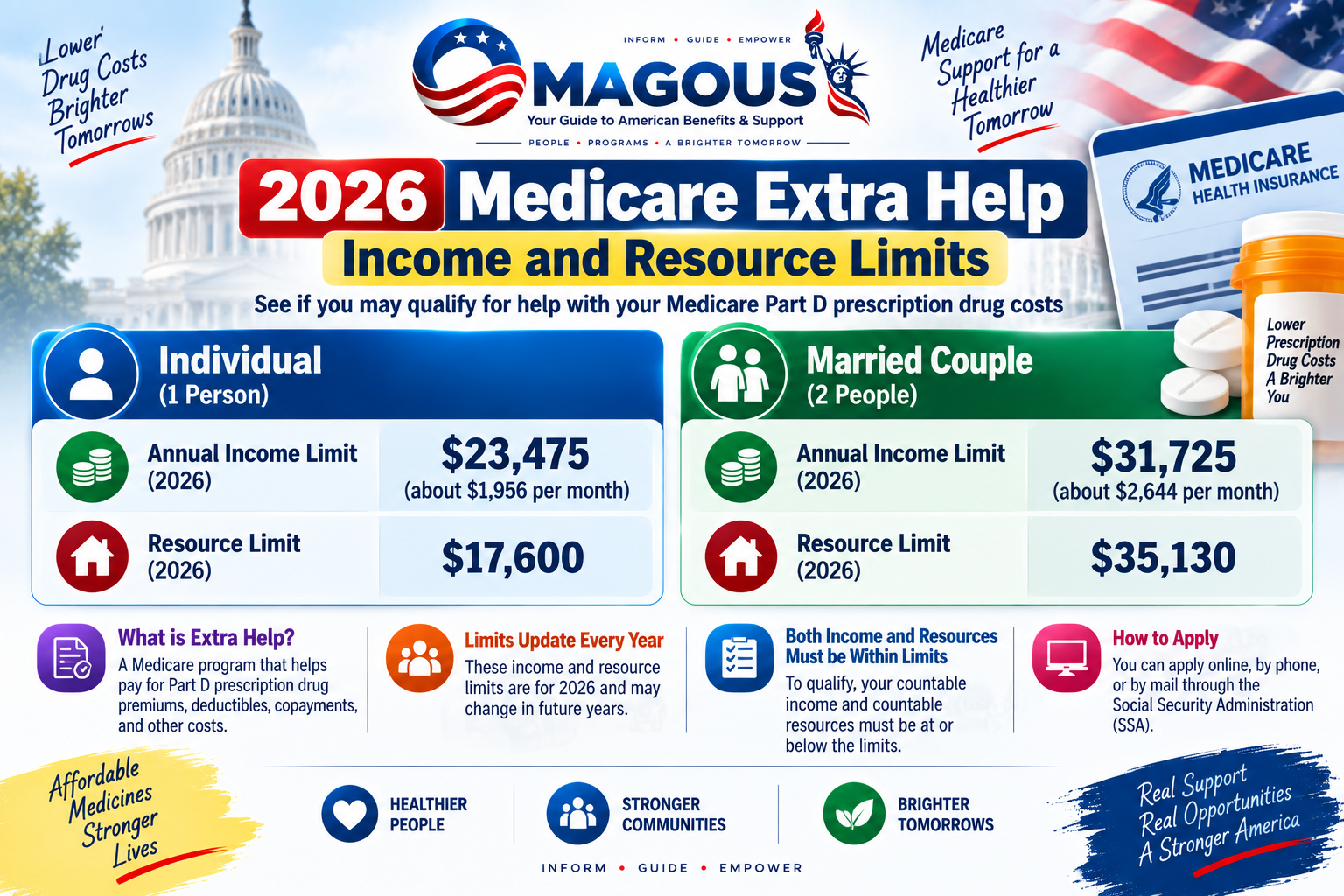
| Household situation | 2026 annual income limit | 2026 resource limit |
|---|---|---|
| Individual | $23,940 | $18,090 |
| Married couple living together | $32,460 | $36,100 |
These are the standard federal 2026 figures. They should not be treated as a simple yes-or-no calculator because the program has specific rules about which income and resources count.
For example, Medicare’s 2026 materials explain that resources include money in checking, savings, or retirement accounts, stocks, and bonds. Certain items, including your home, personal items, one car, burial plots, and qualifying burial funds, are excluded under the program rules. Review the 2026 Extra Help publication for the resource rules.
What Counts as Income for Extra Help?
Extra Help considers your income and resources when determining eligibility.
Income can include Social Security benefits, pensions, and other countable sources of income. The application asks for financial information so Social Security can determine whether you meet the program’s requirements. The Social Security Extra Help application explains the information applicants may need to provide.
Some payments are treated differently under the program. SSA’s Extra Help income guidance identifies certain assistance, including SNAP, housing assistance, and home energy assistance, as items that are generally not counted as income for Extra Help.
What Counts as Resources for Extra Help?
Resources generally include money and financial assets that you own and could use to pay expenses.
Examples include:
- Checking and savings accounts
- Stocks and bonds
- Mutual funds
- Individual Retirement Accounts
- Cash
- Certain real estate other than your primary residence
Medicare’s 2026 materials state that your home, personal belongings, one car, burial plots, and certain burial funds are not counted as resources. The official Extra Help publication provides the applicable exclusions.
The application asks about these resources because Social Security uses the information to determine your eligibility.
How Do You Apply for Medicare Extra Help If You Are Not Automatically Eligible?
If you do not qualify automatically, you can submit the SSA-1020 application for Extra Help.
Social Security provides an online application and also allows you to apply by phone or arrange an appointment. You can call 1-800-772-1213 or 1-800-325-0778 for TTY assistance. Start with the official Extra Help application page.
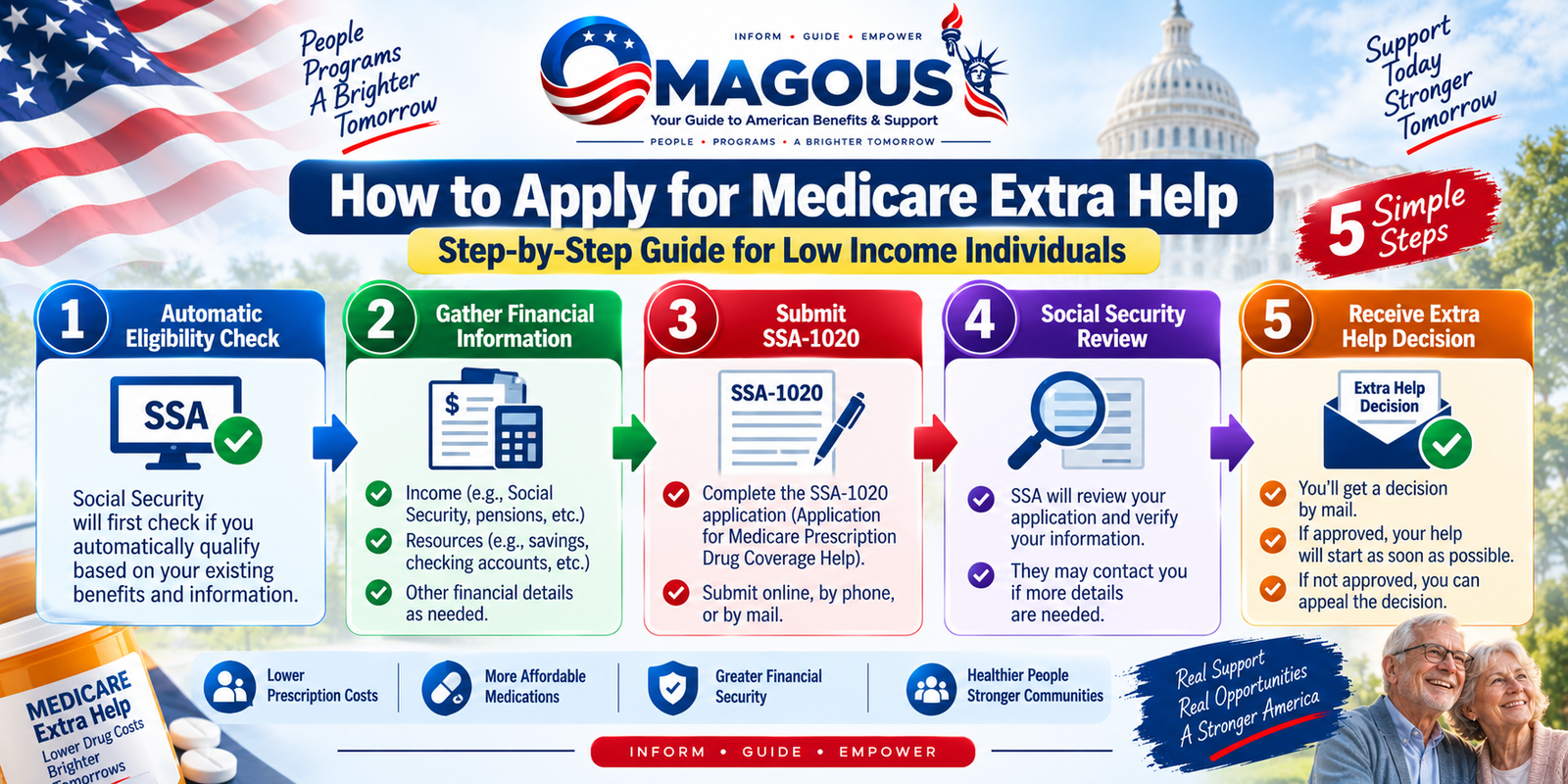
The application is used to determine Extra Help eligibility. It does not by itself enroll you in a Medicare prescription drug plan. To use Extra Help, you need Medicare drug coverage. The SSA-1020 application information explains the purpose of the application.
What Documents Do You Need to Apply?
You will need financial information about yourself and, when applicable, your spouse.
Social Security lists documents such as bank statements, tax returns, IRA or 401(k) balances, pension statements, Veterans’ benefits, annuity information, and Railroad Retirement Board benefits as examples of records that may help with the application. The Social Security application guidance provides more information about what you may need.
Having this information available can make it easier to complete the application accurately.
What Happens After You Apply for Extra Help?
Social Security reviews your application and sends you a letter telling you whether you qualify.
If you qualify and do not already have Medicare drug coverage, Medicare may automatically enroll you in a Part D plan so you can use the Extra Help benefit. Medicare also allows you to choose a different drug plan. See the automatic enrollment information for details.
The plan’s covered drugs and pharmacy network may differ from another plan, so review the plan information you receive.
How Much Can Medicare Extra Help Reduce Drug Costs in 2026?
For 2026, Medicare says people who qualify for Extra Help will generally pay $0 for their Medicare drug plan premium and deductible, with prescription costs of up to $5.10 for each generic drug and $12.65 for each brand-name drug under the applicable Extra Help rules. The 2026 Medicare prescription drug information explains the applicable cost-sharing rules.
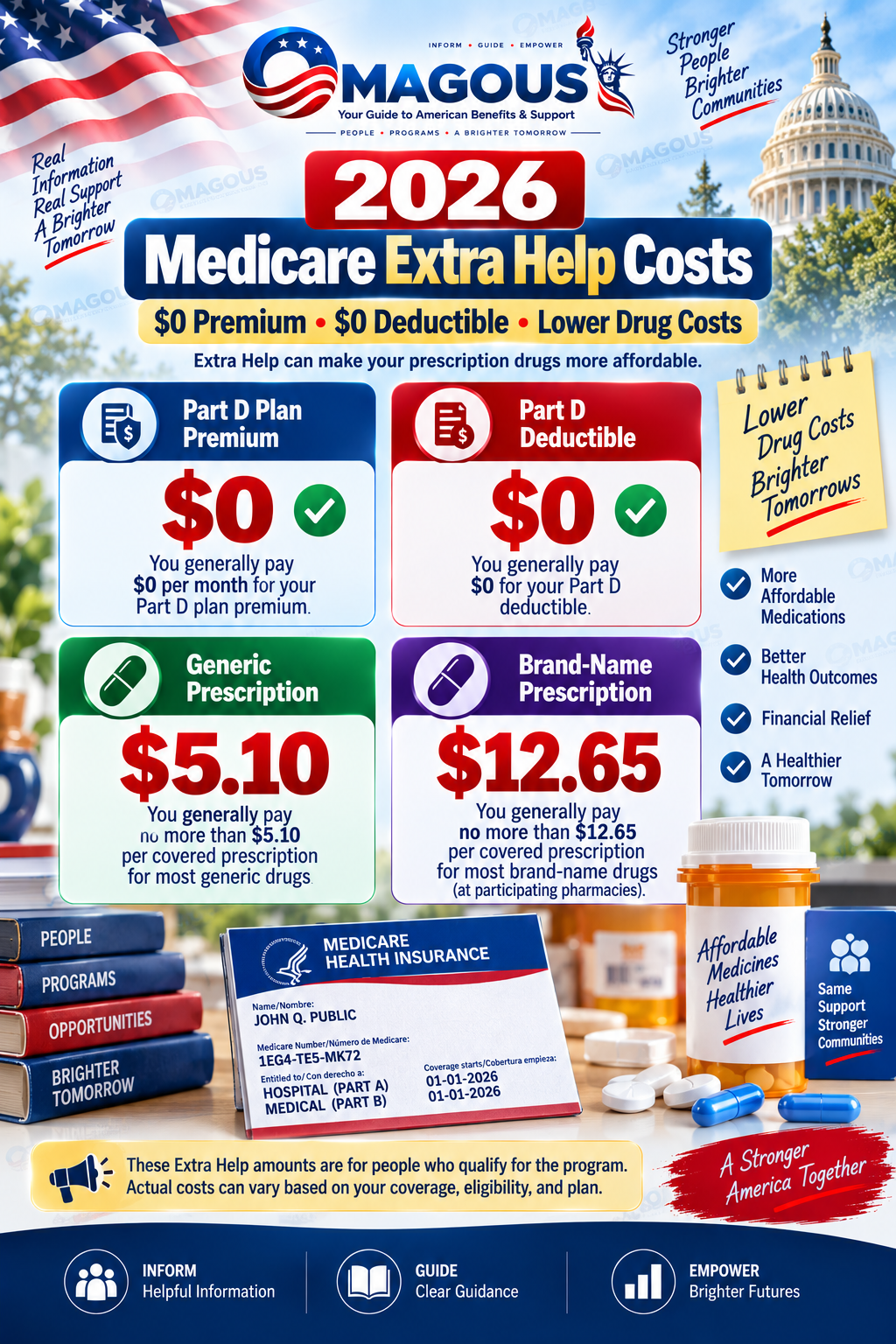
| 2026 Extra Help cost | Amount |
|---|---|
| Medicare drug plan premium | $0 |
| Deductible | $0 |
| Generic prescription | Up to $5.10 |
| Brand-name prescription | Up to $12.65 |
The exact cost-sharing treatment can differ by eligibility category. CMS’s 2026 LIS cost-sharing information shows separate cost-sharing levels for different beneficiary categories, including some beneficiaries who receive full Medicaid or who are institutionalized.
Does Extra Help Cover Medicare Part B Costs?
No. Extra Help is intended for Medicare Part D prescription drug costs.
If you need assistance with Medicare Part A or Part B premiums, deductibles, coinsurance, or copayments, you may also qualify for a Medicare Savings Program. These programs are administered through the states. Learn more about Medicare Savings Programs.
[Internal Link: Medicare Savings Programs and Part B Premium Help | Insert Existing URL]
You can apply for Extra Help and a Medicare Savings Program at the same time. Medicare explains how Extra Help and Medicare Savings Programs can work together.
Does Extra Help Eliminate the Medicare Part D Late Enrollment Penalty?
Yes. You generally do not have to pay the Part D late enrollment penalty while you receive Extra Help.
Medicare explains that Extra Help is one of the situations that protects beneficiaries from the Part D late enrollment penalty. You can review the Medicare late enrollment penalty rules for the applicable requirements.
[Internal Link: Medicare Part D Late Enrollment Penalty Explained | Insert Existing URL]
What If Your Income Is Slightly Above the 2026 Limit?
A published income limit does not always tell the entire story.
SSA explains that some people can qualify in certain circumstances even when their income is above the standard amount. Examples include having earnings from work, supporting other family members, or living in Alaska or Hawaii. Social Security evaluates the application using the applicable rules. See the SSA Extra Help eligibility guidance for the relevant rules.
That is why an income figure should be used as a starting point rather than as a final eligibility decision.
Can You Get Medicare Extra Help and Medicaid at the Same Time?
Yes. People who have full-benefit Medicaid and Medicare automatically qualify for Extra Help.
Medicaid can also help with other health care costs that Extra Help does not cover. Extra Help is focused on Medicare Part D prescription drug costs, while Medicaid coverage depends on the rules of your state. Medicare provides additional information about Medicare and Medicaid.
Can You Get Medicare Extra Help and SSI at the Same Time?
Yes. If you receive SSI and have Medicare, you automatically qualify for Extra Help and do not need to submit a separate Extra Help application. You can review the Social Security SSI information for more information.
If you do not already have Medicare prescription drug coverage, Medicare may enroll you in a Part D plan so you can use the Extra Help assistance. See Medicare’s automatic enrollment guidance for details.
What Should You Do After Receiving an Extra Help Notice?
Read the notice carefully because it explains your Extra Help status and, when applicable, information about your Medicare drug plan.
If Medicare automatically enrolls you in a Part D plan, review the plan’s covered medications and participating pharmacies. Medicare explains through its Extra Help enrollment information that you can choose a different drug plan if you prefer another option.
If your prescription costs appear higher than expected, contact your Medicare drug plan or 1-800-MEDICARE for help.
What If You Are Denied Medicare Extra Help?
If Social Security determines that you do not qualify, review the decision and the information used to make the determination.
Medicare says that if your income or resources change, you can reapply for Extra Help. You can also look into Medicare Savings Programs for help with other Medicare costs. The Medicare Extra Help information explains these options.
[Internal Link: How to Apply for Medicare Savings Programs | Insert Existing URL]
Frequently Asked Questions
How do I apply for Medicare Extra Help with low income?
If you do not qualify automatically, you can apply through Social Security using the Extra Help application. Social Security allows you to apply online, by phone, or through an appointment. You will need to provide financial information about your income and resources. Start with the Social Security Extra Help application.
Do SSI recipients automatically qualify for Medicare Extra Help?
Yes. People who receive SSI benefits and have Medicare automatically qualify for Extra Help. They do not need to file a separate Extra Help application. If they do not have Part D coverage, Medicare may enroll them in a drug plan. See the automatic Extra Help rules.
What is the Medicare Extra Help income limit for 2026?
For 2026, Medicare lists an annual income limit of $23,940 for an individual and $32,460 for a married couple living together. The applicable resource limits are $18,090 and $36,100. Specific income and resource exclusions also apply. Check the 2026 Extra Help limits.
What is the Medicare Extra Help resource limit for 2026?
The 2026 resource limit is $18,090 for an individual and $36,100 for a married couple living together. Certain resources, including a home, personal items, one car, and qualifying burial resources, are excluded under the program rules. See the 2026 Extra Help publication.
How much will prescriptions cost with Extra Help in 2026?
For 2026, Medicare says Extra Help generally limits covered prescription costs to up to $5.10 for a generic drug and $12.65 for a brand-name drug, with a $0 premium and deductible under the applicable program rules. Some beneficiary categories have different cost-sharing treatment. See the 2026 prescription cost information.
Do I need Medicare Part D to use Extra Help?
Yes. You need Medicare drug coverage to use Extra Help. If you qualify automatically but do not have Part D coverage, Medicare may enroll you in a Medicare drug plan so you can receive the assistance. See the Extra Help program information.
Can I qualify for Extra Help if my income is above the 2026 limit?
Possibly. SSA says certain circumstances can allow someone to qualify even when income is above the standard figure. Examples include working, supporting other family members, or living in Alaska or Hawaii. Social Security makes the eligibility determination based on the applicable rules. See the SSA eligibility guidance.
Does Medicare Extra Help pay my Part B premium?
No. Extra Help is for Medicare Part D prescription drug costs. Assistance with certain Part A and Part B premiums and other Medicare costs is available through Medicare Savings Programs administered by the states. Learn about Medicare Savings Programs.
Key Takeaways
The first question is whether you already qualify automatically. If you receive SSI, full-benefit Medicaid, or qualifying Medicare Savings Program assistance and have Medicare, you generally do not need to submit a separate Extra Help application.
- The 2026 Extra Help income limit is $23,940 for an individual and $32,460 for a married couple living together.
- The 2026 resource limit is $18,090 for an individual and $36,100 for a married couple.
- If you are not automatically eligible, you can apply through Social Security using the Extra Help application.
- Extra Help is intended for Medicare Part D prescription drug costs.
- For 2026, qualifying beneficiaries generally pay up to $5.10 for generic drugs and $12.65 for brand-name drugs, subject to the applicable cost-sharing category. See Medicare’s 2026 Extra Help information.
Conclusion
Knowing how to apply for Medicare Extra Help with low income starts with checking whether you already qualify automatically. SSI recipients with Medicare, people with full-benefit Medicaid, and people receiving qualifying Medicare Savings Program assistance can qualify automatically. See the automatic qualification rules.
If you do not qualify automatically, you can apply through Social Security and provide the requested information about your income and resources. Your eligibility decision comes from Social Security, so the published income and resource figures should be used as guidance rather than as a substitute for an official determination.
For help with Medicare costs beyond Part D prescription drugs, you can also review available Medicare Savings Programs through your state.
Disclaimer: This article is for general informational purposes and is not an official determination of Medicare Extra Help eligibility. Income, resources, Medicare coverage, and individual circumstances can affect eligibility. Program rules and amounts may change, so verify your current situation with Social Security, Medicare, or your state Medicaid office before making decisions about Medicare coverage or prescription drug costs.