
If you receive Social Security and you're worried about healthcare costs, you might be asking: Can Social Security recipients qualify for Medicaid? The short answer is yes, but the rules are not one-size-fits-all. Your benefit type, income, assets, and state of residence all play a role.
Many people wrongly assume that any Social Security income automatically disqualifies them.
In our research, we found that as of 2026, the Federal Poverty Level for a single household sits near $15,000 in most states. That figure drives many Medicaid income limits. Millions of Social Security recipients fall below it, which means coverage is often within reach.
But you have to know which pathway applies to you. That's exactly what we'll walk through next.
Quick Answer
Yes, Social Security recipients can qualify for Medicaid. Your eligibility depends on your income and assets. It also depends on your state's rules.
SSI recipients often get automatic Medicaid. SSDI and retirement benefits do not automatically disqualify you.
Why This Question Matters: The High Stakes of Medicaid and Social Security
Medicaid is not just another health program. For many seniors and disabled adults, it is the only realistic way to afford long-term care. Medicare covers hospital stays and doctor visits, but it does not cover most nursing home care.
That gap can wipe out a lifetime of savings in months.
The stakes are huge. One wrong answer can mean losing coverage or paying thousands out of pocket. In our research, we've seen people give up before applying because they assumed Social Security blocked them.
That assumption is often wrong. But acting on bad information can also lead to denials, penalties, or estate recovery surprises.
Here's what makes this topic risky:
- Medicare vs. Medicaid confusion leads people to miss benefits they already qualify for.
- Asset transfer mistakes can trigger a five-year look-back penalty.
- Spend-down misunderstandings cause people to miss eligibility by a few dollars.
- State rule changes mean advice from a neighbor in another state may not apply to you.
This is why we treat this as an expert-level topic. A wrong move can cost you your home or your care. A right move can protect both.
The Core Rules: How Social Security Benefits Affect Medicaid Eligibility
Social Security income counts when Medicaid checks your eligibility. But not all Social Security is treated the same. The program you receive determines your starting point.
SSI is the most straightforward. In most states, if you get SSI, you automatically get Medicaid. That's because SSI itself is a low-income program.
SSDI and retirement benefits work differently. These benefits can be higher than the Medicaid income limit. But that does not mean you're automatically out.
Many states use Medically Needy rules or spend-down programs. You can qualify if your medical bills eat up the excess income. In our research, we found that these pathways are underused because people don't know they exist.
The table below shows the basic differences.
| Benefit Type | Automatic Medicaid? | Income Test? | Asset Test? |
|---|---|---|---|
| SSI | Yes, in most states | Yes (SSI limits) | Yes |
| SSDI | No | Yes (state rules) | Yes |
| Retirement | No | Yes (state rules) | Yes |
Your state decides the exact income and asset limits. Some states are more generous than others. For official rules, check the Social Security Administration and your state Medicaid agency.
SSDI vs. SSI vs. Retirement Benefits: Three Different Medicaid Pathways
Each Social Security benefit opens a different door to Medicaid. Knowing which door is yours saves time and frustration.
SSI is the fastest path. If you receive Supplemental Security Income, you typically get Medicaid automatically. You still need to meet SSI's income and asset limits.
But once you're on SSI, the Medicaid card usually follows. A few states called 209(b) states use stricter rules. In those states, you may need a separate Medicaid application.
SSDI is for disabled workers. After 24 months on SSDI, you get Medicare. But Medicare has premiums, copays, and no long-term care coverage.
If your SSDI check is low, you may still qualify for Medicaid. You would become a dual eligible beneficiary. That means Medicare pays first, and Medicaid fills the gaps.
Retirement benefits start as early as age 62. At 65, you get Medicare. But again, Medicare is not free.
If your retirement check is modest, you can apply for Medicaid through your state's aged, blind, and disabled program. Many states allow a spend-down where you pay excess medical bills to qualify.
Here's the bottom line. SSI almost always leads to Medicaid. SSDI and retirement benefits require a separate application.
But they do not block you. They just change the paperwork.
Income, Assets, and Spend-Down: The Numbers That Decide Your Case
Medicaid looks at two things: income and assets. Income is your monthly money. That includes your Social Security check, pensions, and wages.
Assets are things you own, like bank accounts, stocks, and sometimes your home. The limits are strict. In many states, an individual can keep only $2,000 in countable assets.
A couple can keep around $3,000. Some states are more generous.
Income limits vary by state and program. For aged, blind, and disabled Medicaid, many states set the limit at 100% of the Federal Poverty Level. As of 2026, that's roughly $1,255 per month for an individual.
If your Social Security check is higher, you might still qualify through spend-down. Spend-down works like a deductible. You pay medical bills until your remaining income hits the limit.
Then Medicaid kicks in.
Here's a simple example. Suppose your Social Security is $1,400 per month. The state limit is $1,255.
You have a $145 spend-down. You submit $145 in medical receipts each month. After that, Medicaid covers the rest.
Assets also have exceptions. Your primary home may be exempt if you or your spouse lives there. One car is usually exempt.
Burial plots and some life insurance may be exempt. But cash and investments count. If you give away assets within five years of applying, you face a penalty period.
That's why expert advice matters before you move money.
State-by-State Differences: Why 209(b), 1634, and Expansion States Change Everything
Your zip code decides more than you think. Medicaid is a federal-state partnership. Washington sets broad rules, but states fill in the details.
That's why two people with identical Social Security checks can get different answers.
There are three main state categories for SSI-linked Medicaid.
- 1634 states automatically enroll SSI recipients in Medicaid. No separate application. Most states fall here.
- 209(b) states use their own stricter rules. You may need to apply separately and meet different income or asset limits. Examples include Illinois, Ohio, and Virginia.
- SSI criteria states require a separate Medicaid application but use the same rules as SSI. Examples include Alaska and Idaho.
Then there's Medicaid expansion. Under the Affordable Care Act, many states expanded Medicaid to adults under 65 with incomes up to 138% of the Federal Poverty Level. But expansion mostly helps non-disabled adults.
For seniors and disabled people on Social Security, the older non-MAGI rules still apply. So expansion does not automatically help you if you're on SSDI or retirement.
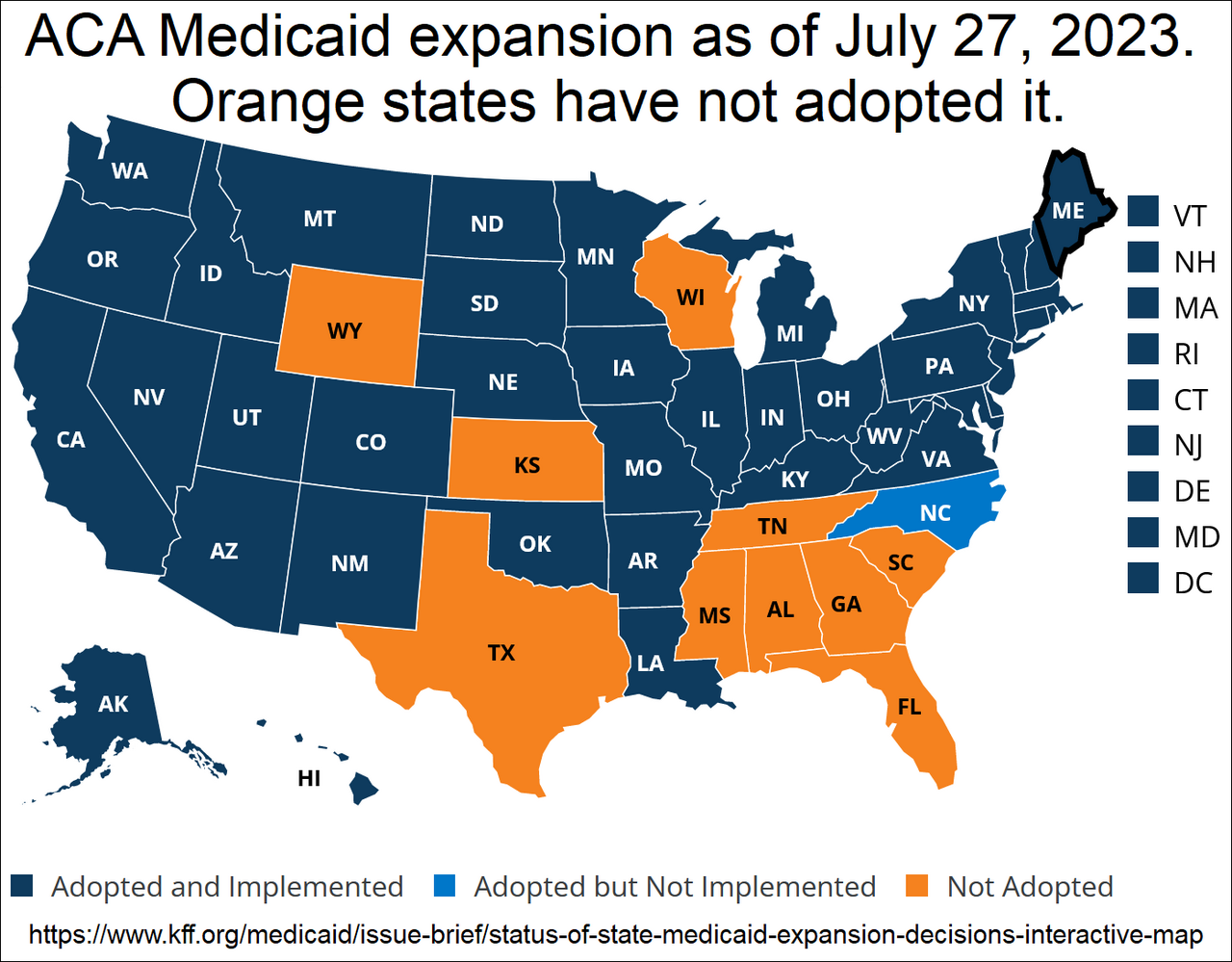
Image source: Wikimedia Commons / KFF. Text and border added later with freeware IrfanView or other image editor. Please add the source article date to the map. This eliminates the need for the date to be in the captions under the map in the many articles using this map on Wikipedia and elsewhere. Larger text for: "Orange states have not adopted it." This makes the map useful even at smaller thumbnail sizes. Copy and paste in image editor: ACA Medicaid expansion as of July 27, 2023. Orange states have not adopted it. Check article date. It is updated at times.
To find your state's rules, start with Medicaid.gov. Then contact your state Medicaid agency. They can tell you exactly which pathway fits your Social Security benefit.
Medicare Savings Programs, Dual Eligibility, and Long-Term Care: Bridges and Barriers
If you have Medicare but struggle with premiums and copays, Medicare Savings Programs (MSPs) can help. These programs are run by state Medicaid agencies. They pay your Medicare Part B premium and sometimes other costs.
In our research, we found that many Social Security recipients miss these benefits. They assume they earn too much. But the income limits are higher than full Medicaid.
There are four main MSPs.
| Program | What It Pays | Income Limit (2026, individual) |
|---|---|---|
| QMB | Part A and B premiums, deductibles, coinsurance | 100% FPL |
| SLMB | Part B premium | 120% FPL |
| QI | Part B premium | 135% FPL |
| QDWI | Part A premium (for working disabled) | 200% FPL |
If you qualify for QMB, you become a dual eligible beneficiary. That means Medicare pays first and Medicaid pays second. You may also get Extra Help with Part D drug costs.
Dual eligible beneficiaries often enroll in a Dual Eligible Special Needs Plan (D-SNP). These plans coordinate both programs.
Long-term care is a different beast. Medicare does not cover nursing home care beyond 100 days. Medicaid does, but the rules are strict.
You must meet a functional need for care. You also face a lower asset limit. In many states, the community spouse can keep a portion of assets.
That's called the Community Spouse Resource Allowance (CSRA). As of 2026, the maximum CSRA is about $154,140. The spouse can also keep a monthly income up to the Maximum Monthly Maintenance Needs Allowance (MMMNA).
Home and Community-Based Services (HCBS) waivers let you get care at home. PACE programs serve frail seniors in some states. Both have waiting lists.
Estate recovery can later claim your home. That's why planning ahead matters.
If you need nursing home care, apply early. If you want to stay home, ask about HCBS waivers. If you just need premium help, start with an MSP application.
Common Mistakes, Expert Tips, and When to Seek Help
Mistakes happen. But some can cost you coverage or money. Here are the ones we see most often.
- Assuming Social Security disqualifies you. Many recipients qualify through spend-down or MSPs.
- Transferring assets too late. The five-year look-back can trigger a penalty period.
- Forgetting to report changes. Report income or address changes within 10 days.
- Missing renewal deadlines. A missed form can end your coverage.
- Not appealing a denial. You have the right to a fair hearing. Deadlines are short.
- Ignoring estate recovery. Your state may claim your home after you die.
Expert tips can save you time and stress.
- Keep a paper trail. Save every letter and receipt.
- Use SHIP counselors. They offer free help. Find them through your state.
- Consult an elder law attorney. If your assets are complex, this is worth it.
- Set up a Miller trust. If your income is over the limit, a Qualified Income Trust can help.
- Consider an ABLE account. For disabled individuals, this protects savings.
- Apply for Extra Help. It lowers Part D drug costs.
You can check your MSP eligibility on the official Medicare.gov site. It has a free tool. But always confirm with your state Medicaid agency.
When should you seek help? If you've been denied, if you need nursing home care, if you have a disabled child, or if you've transferred assets in the last five years. Also, if you're not sure which program fits.
A SHIP counselor or legal aid office can guide you. Don't guess. A wrong move can cost you.
Step-by-Step: How to Apply, Renew, and Appeal a Medicaid Decision
Applying for Medicaid is a process. Here's how to do it right.
- Identify your pathway. Are you on SSI? You may be auto-enrolled. Are you on SSDI or retirement? You need to apply.
- Check your state's rules. Income and asset limits vary. Use your state Medicaid website.
- Gather documents. You'll need your Social Security award letter, Medicare card, bank statements, proof of residency, and immigration papers if applicable.
- Complete the application. You can apply online, by mail, or in person. Some states use healthcare.gov.
- Attend the interview. If requested, do it. Missing it can delay your case.
- Submit verifications. Respond to every request. Keep copies.
- Get your decision. It can take 45 to 90 days. If approved, you'll get a card.
- Complete spend-down if needed. Submit medical receipts each month.
You can apply for MSPs at any time. There's no open enrollment window. You can also have someone apply on your behalf.
A power of attorney or authorized representative form works.
Renewal is not automatic for everyone. Many states now use ex parte renewal. That means they check data sources first.
If they can't verify, they send you a form. You must return it by the deadline. Report any changes within 10 days.
Changes include new income, a move, or a new household member.
If you're denied, you have appeal rights. The notice will tell you how long you have. Usually it's 30 to 60 days.
You can request a fair hearing. You can represent yourself or bring someone. Many denials are overturned.
Don't skip this step. If you lose coverage during renewal, you can also appeal. Act fast.
Deadlines are strict.
Frequently Asked Questions
Can I get Medicaid if I receive Social Security retirement benefits?
Yes, you can. Your retirement check counts as income. But if it's below your state's limit, you qualify.
If it's over, you may still qualify through spend-down. You can also apply for Medicare Savings Programs to get help with premiums.
Does SSDI automatically qualify me for Medicaid?
No, SSDI does not automatically qualify you. Unlike SSI, SSDI is not a low-income program. You must apply separately.
Your state will check your income and assets. If you're below the limit, you qualify. If not, ask about spend-down or MSPs.
What if my Social Security income is over the Medicaid limit?
You still have options. Most states offer a spend-down program. You pay medical bills until your income drops to the limit.
Then Medicaid starts. You can also set up a Miller trust if your income is only slightly over. An elder law attorney can help.
Will Medicaid take my house after I die?
Possibly. States must try to recover costs from estates. But there are exceptions.
Your home is safe while you or your spouse lives there. A disabled child or sibling may also protect it. Some states don't recover at all.
Check your state's estate recovery rules.
Can I get Medicaid if I own a car and a home?
Yes, usually. Your primary home is exempt if you or your spouse lives there. One car is also exempt.
But other assets count. Bank accounts, stocks, and second homes are countable. The limit is often $2,000 for an individual.
Check your state's exact rules.
How long does it take to get a Medicaid decision?
It varies. Most states take 45 to 90 days. Some take longer if you need a disability determination.
You can speed things up by submitting all documents quickly. If you have an urgent medical need, tell your caseworker. You may get expedited processing.
Final Decision Guide: Is Medicaid Within Reach for You?
So, can Social Security recipients qualify for Medicaid? The answer is often yes. But it depends on your situation.
Use this quick guide to see where you stand.
- If you receive SSI: You likely qualify automatically in most states. Check if you live in a 209(b) state. If so, you may need a separate application.
- If you receive SSDI: Check your income and assets. If you're below the limit, apply. If not, ask about spend-down or Medicare Savings Programs.
- If you receive retirement benefits: Same as SSDI. Also look into long-term care planning if you may need nursing home care.
- If your income is over the limit: A Miller trust or spend-down can help. Don't give up yet.
- If your assets are over the limit: Consult an elder law attorney. A Special Needs Trust or ABLE account may protect some funds.
- If you need long-term care: Apply early. Ask about HCBS waivers and spousal impoverishment protections.
The rules are complex. But you don't have to figure them out alone. Free help exists.
Contact your state Medicaid agency. Reach out to your local SHIP office. Call Legal Aid if you've been denied.
These services are free and confidential.
Take the first step today. Check your state's Medicaid website. Or call your local SHIP office.
Coverage may be closer than you think.