
The most common Social Security retirement application denied reasons are simpler than you think. Insufficient work credits, missing documents, and filing errors top the list. You can fix most of them, but you have to act fast.
The SSA doesn't deny applications for fun. Every denial has a specific reason.
You need 40 work credits to qualify for retirement benefits. In 2026, you earn one credit for every $1,810 in wages, up to four credits per year. That means you need $7,240 in annual earnings to max out your credits.
Part-time and self-employed workers often fall short. Here's the quick answer on why denials happen and what to do next.
Quick Answer
Social Security retirement application denied reasons usually fall into five buckets. You might lack enough work credits. Your documents might not match SSA records.
A non-covered pension or earnings test can also trigger a denial. Check your denial notice for the exact reason.
The Core Rules Behind Retirement Eligibility: Work Credits, Insured Status, and Full Retirement Age
Social Security retirement benefits aren't automatic. You have to meet specific rules. The SSA checks your work history, your age, and your filing date.
Miss any one of those, and your application gets denied.
How Many Work Credits You Actually Need — and Why Part-Time or Self-Employed Work Can Fall Short
You need 40 work credits to qualify for retirement benefits. You earn up to four credits per year. In 2026, each credit requires $1,810 in earned income.
That means you need $7,240 in annual earnings to max out your credits. Part-time workers often fall short. Self-employed workers sometimes forget to report income.
Both can leave you without enough credits.
You can check your work credits online through your My Social Security account. If you see missing years, that's a red flag. You can earn credits after you apply.
But you must meet the requirement at the time of filing.
| Requirement | Number |
|---|---|
| Credits needed for retirement | 40 |
| Maximum credits per year | 4 |
| Earnings per credit | $1,810 |
| Earnings to max out credits | $7,240 |
If you're short on credits, you might still qualify through a spouse or ex-spouse. But that's a different application. For your own record, you need those 40 credits.
The Social Security Administration explains how credits work in detail.
Fully Insured vs Currently Insured: What SSA Means and Why It Changes Your Options
Fully insured means you have enough credits for retirement benefits. Currently insured means you have fewer credits, usually enough for survivor benefits only. The SSA uses these terms in denial notices.
If you're not fully insured, your retirement application fails. You might need to work longer or qualify under someone else's record. Currently insured status only helps survivors, not retirees.
Full Retirement Age, Early Filing Reductions, and Delayed Credits: The Math That Triggers Denials
Your Full Retirement Age (FRA) depends on your birth year. For most people born in 1960 or later, FRA is 67. Filing at 62 reduces your benefit by up to 30%.
The reduction is 5/9 of 1% per month for the first 36 months. Then it's 5/12 of 1% for each additional month. Filing after FRA earns delayed credits of 8% per year up to age 70.
SSA denies any application submitted before age 62. That's a hard rule. No exceptions.

Image source: Wikimedia Commons / Rcragun (CC BY)
Knowing these rules helps you spot the denial reason fast. If your notice says "not fully insured," you know it's a credit problem. If it says "application filed before age 62," you know it's a timing issue.
Match the notice language to the rule above. That's your first step toward fixing it. The SSA doesn't deny applications for fun.
Every denial ties back to a specific rule. Learn the rule, and you're halfway to an appeal.
The 12 Most Common Denial Reasons and What Each One Really Means
SSA denial notices use specific language. Each reason points to a different fix. Here are the most common ones, grouped by what you need to do next.
Work Credit and Insured Status Denials
You don't have 40 credits. Or you're not fully insured. This is the most common denial for part-time and self-employed workers.
Check your earnings record first. If credits are missing, you can correct your record. If you truly lack credits, you might qualify on a spouse's record.
You can earn credits after you apply. But you must meet the requirement at the time of filing.
Documentation and Identity Denials
Your name, SSN, or birth date doesn't match SSA records. You might have married and changed your name without telling SSA. You might lack a birth certificate or citizenship proof.
These denials are fixable. Send certified copies of the missing documents. SSA might accept a delayed birth certificate or a signed statement from a doctor.
Filing Date and Age Denials
You applied before age 62. Or you applied after FRA but SSA processed it as early. The SSA denies any application filed before your 62nd birthday.
If you filed too early, you can withdraw and refile. If SSA made a date error, request a correction. If you file at 62, your benefit is reduced.
If you file at 70, you get the maximum.
Pension and Earnings Denials
A non-covered pension can reduce or deny your benefit under WEP or GPO. The Social Security Fairness Act repealed WEP and GPO for benefits payable after December 2023. If you're still working, the retirement earnings test can suspend benefits.
Report your pension and earnings accurately. The earnings test exempt amount changes each year. It's set annually by SSA.
Administrative and Residency Denials
You're already receiving benefits on the same record. You withdrew your application. You filed under the wrong program.
Or you live abroad and don't meet residency rules. Noncitizens face extra restrictions. Totalization agreements can combine foreign work credits.
If you moved, update your address with SSA immediately.
| Denial Reason | First Step |
|---|---|
| Not enough credits | Check earnings record |
| Name or date mismatch | Send certified documents |
| Filed before 62 | Withdraw and refile later |
| Non-covered pension | Verify WEP or GPO rules |
| Already entitled | Confirm current benefit status |
Don't panic. Most denials are fixable. The key is matching the reason on your notice to the right action.
The next section shows you how to read that notice.
How to Read Your SSA Denial Notice and Identify the Exact Reason
Your denial notice is not a dead end. It's a roadmap. Every notice includes a reason code and appeal instructions.
Read it carefully before you do anything else.
The Notice of Disapproved Claim: Lines That Matter Most
Look for the "Reason for Denial" section. It cites a specific regulation or program rule. Common codes mention work credits, age, or missing evidence.
The notice also states your appeal deadline. That deadline is usually 60 days from the date you receive the letter. The notice also tells you what evidence is missing.
Matching the Denial Code to Your Next Step
If the code says "not fully insured," you need more credits or a different benefit. If it says "insufficient evidence," you need documents. If it says "filed before age 62," you need to refile later.
Match the code to the fix. Don't appeal without addressing the root cause. If you disagree with the reason, you can still appeal.
Correcting Your Earnings Record with W-2s, Schedule SE, and SSA-1099
Your earnings record drives your benefit amount and eligibility. If SSA missed your income, gather your W-2s, Schedule SE, and SSA-1099 forms. Submit them to SSA with a request for correction.
SSA will update your record and recalculate your credits. This can turn a denial into an approval. You can request a correction at any time, even after you apply.
Proving Age, Identity, Citizenship, and Marriage: Document-by-Document Guide
You need original or certified copies. For age, use a birth certificate or passport. For identity, use a driver's license or state ID.
For citizenship, use a passport or naturalization certificate. For marriage or divorce, use the certificate or decree. Send copies, not originals, unless SSA asks.
Never send original documents unless SSA specifically asks.
| What to Prove | Acceptable Documents |
|---|---|
| Age | Birth certificate, passport |
| Identity | Driver's license, state ID |
| Citizenship | Passport, naturalization certificate |
| Marriage | Marriage certificate |
| Divorce | Divorce decree |
Gather everything before you appeal. Missing documents are the top reason appeals fail. Make a checklist.
Then submit your appeal with all evidence attached. That gives you the best shot at a reversal. If you can't find a document, ask SSA for help.
They can sometimes accept alternative proof. But don't wait until the deadline. Start now.
Your Appeal Options After a Denial: Reconsideration, ALJ Hearing, Appeals Council, and Federal Court
You have four levels of appeal. Each level has its own form and deadline. Most people win at the hearing level.
But you have to start with reconsideration.
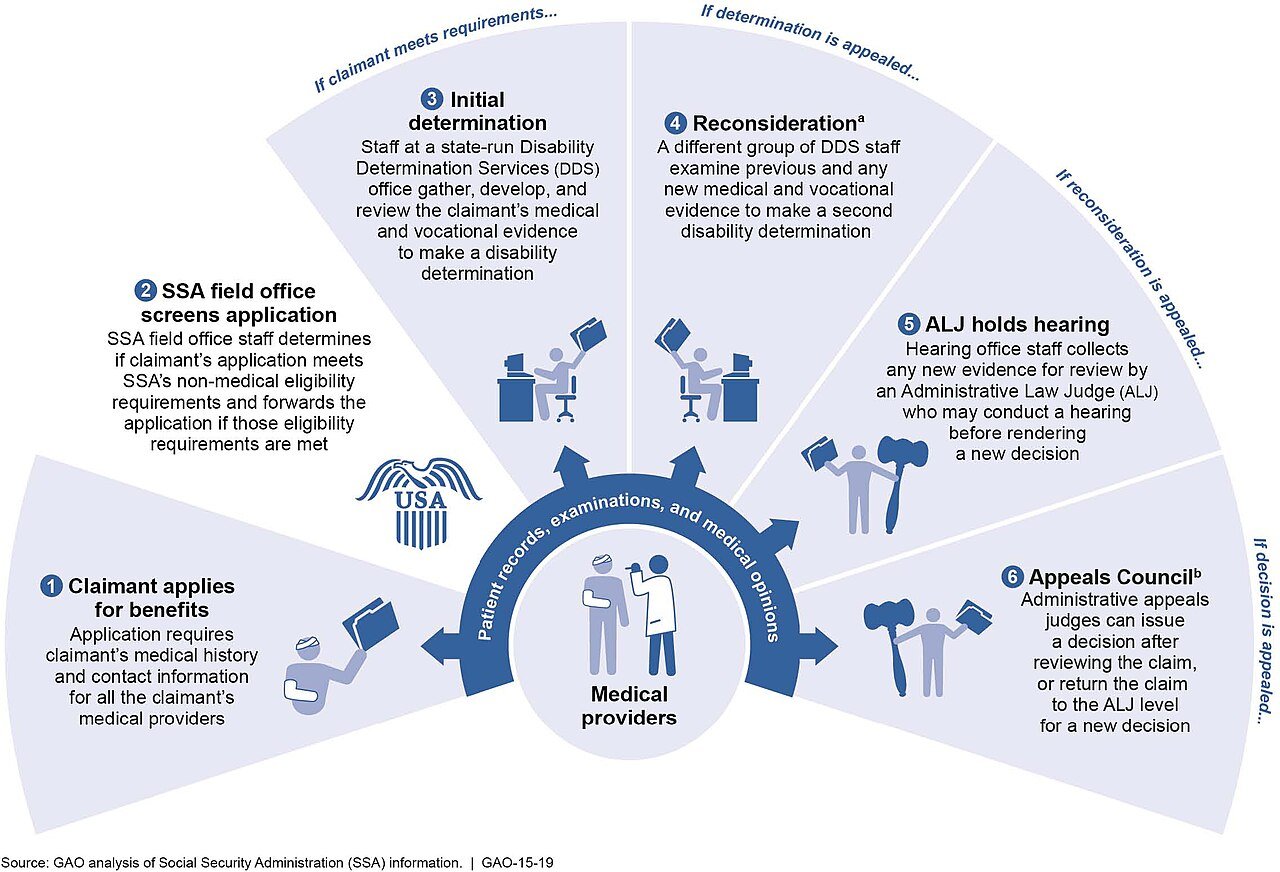
Image source: Wikimedia Commons / U.S. Government Accountability Office from Washington, DC, United States
Reconsideration (Form SSA-561): The First and Fastest Appeal Level
File Form SSA-561 within 60 days of your denial notice. A different SSA reviewer looks at your case. You can submit new evidence.
Reconsideration is your first chance to fix simple errors. Approval rates are low, but it's a required step. You can file online, by mail, or in person.
Administrative Law Judge Hearing (Form HA-501): Where Most Reversals Happen
If reconsideration fails, request a hearing with Form HA-501. An Administrative Law Judge (ALJ) reviews your case. You can appear in person, by video, or by phone.
You can bring a representative. Most successful appeals happen here. The wait for a hearing can be over a year.
Appeals Council Review (Form HA-520): When the ALJ Says No
If the ALJ denies you, request Appeals Council review with Form HA-520. The Council can deny, remand, or reverse. It mostly reviews the ALJ's decision for errors.
Very few cases win at this level. But it's a necessary step before federal court. You can submit new evidence to the Council in some cases.
Federal District Court: The Final Step and What It Requires
You can file a civil action in federal district court. You must exhaust all SSA appeals first. The court reviews the administrative record.
You need a strong legal argument. This step is rare and expensive. Most people stop at the ALJ level.
You need to file within 60 days of the Appeals Council decision. Learn more about the process at SSA's appeals page.
Appeal Deadlines: The 60-Day Rule, the 5-Day Mail Rule, and Good Cause Extensions
You have 60 days from receiving a notice to appeal. SSA adds 5 days if you receive the notice by mail. If you miss the deadline, you can request an extension for good cause.
Good cause includes illness, death in the family, or not receiving the notice. File as soon as possible. Keep proof of when you received each notice.
Pick your appeal level based on your denial reason. If you have new evidence, reconsideration might work. If the issue is legal, go straight to a hearing.
Track every deadline. Missing one can cost you thousands in retroactive benefits. You can hire a representative at any level.
Many work on contingency. They only get paid if you win. That reduces your risk.
Mistakes That Sink Appeals — And How to Avoid Them
Most denied applicants lose their appeal for one reason: they don't fix the problem that caused the denial. SSA reviews the same facts and reaches the same conclusion. Avoid these common errors and your odds improve dramatically.
Missing the Deadline Because You Mailed Instead of Filed Online
The 60-day clock starts when you receive the notice. SSA adds five days for mail delivery. But mailing your appeal adds risk.
If it gets lost, you have no proof. File online through your My Social Security account. You get an instant receipt.
If you must mail, use certified mail with return receipt. Keep a copy of everything you send.
Submitting the Same Evidence Without Addressing the Denial Reason
If SSA denied you for missing work credits, sending the same W-2s won't help. You need to show why those W-2s prove you have enough credits. Write a short cover letter.
Explain exactly which denial reason you're addressing. Point to the specific document that fixes it. Reviewers are busy.
Make their job easy.
Skipping Reconsideration and Going Straight to a Hearing
You cannot skip reconsideration for most retirement denials. SSA requires you to complete that step first. If you file for a hearing too early, SSA dismisses your request.
You lose time. Follow the order: reconsideration, then hearing, then Appeals Council, then federal court.
Failing to Correct Your Earnings Record Before You Appeal
An incorrect earnings record can cause a denial. It can also lower your benefit amount. Fix the record first.
Submit W-2s, Schedule SE forms, or pay stubs. Ask SSA to update your credits. Then file your appeal with the corrected record.
This turns a weak appeal into a strong one.
Not Disclosing a Non-Covered Pension or Foreign Work History
SSA checks for non-covered pensions. If you don't report one, SSA may deny or reduce your benefit later. That can trigger an overpayment.
Report all pensions, foreign work, and government employment. Totalization agreements can help you combine foreign credits. But you must disclose them upfront.
Representing Yourself When the Issue Is Legal, Not Factual
Some denials are simple fixes. Others involve complex rules like WEP, GPO, or totalization. If your denial cites a regulation, get help.
A trained representative knows the appeals process. They can spot errors in SSA's decision. They can also present your case to an ALJ.
Most work on contingency. You pay nothing unless you win.
Legal and Compliance Rules You Can't Ignore: Deadlines, Representation, and Fraud
Social Security is a federal program with strict rules. Ignoring them can cost you benefits or lead to penalties. Know your rights and responsibilities before you appeal.
Your Due Process Rights Under the Social Security Act and 20 CFR Part 404
You have the right to a fair hearing. You have the right to see the evidence SSA used. You have the right to submit new evidence.
You have the right to be represented. These rights come from the Social Security Act and federal regulations. SSA must follow them.
If SSA violates your rights, the Appeals Council or a federal court can remand your case.
Hiring a Representative: Fee Agreements, Withholding, and SSA-1696
You can hire an attorney or a non-attorney representative. They must be accredited by SSA. You file Form SSA-1696 to appoint them.
Most representatives charge a contingency fee. The fee is capped by law. SSA withholds the fee from your retroactive benefits.
You don't pay upfront. Always sign a written fee agreement. Keep a copy for your records.
Fraud, Identity Theft, and Overpayment Recovery: What Triggers Penalties
Never give false information to SSA. Never hide earnings or pensions. SSA can impose civil and criminal penalties.
Identity theft is a growing problem. Someone might file a claim using your SSN. Check your earnings record every year.
If you see unexpected income, report it. Overpayments happen. SSA will demand repayment.
You can request a waiver if you can't afford it and the overpayment wasn't your fault.
Noncitizen Eligibility, Totalization Agreements, and Foreign Enforcement Rules
Noncitizens face extra rules. You generally need lawful permanent resident status to qualify. Some exceptions exist for certain visa holders.
If you worked in another country, a totalization agreement might help. The U.S. has agreements with over 30 countries. These agreements combine work credits from both countries.
If you live abroad, SSA may restrict payments. Check the rules before you move.
SSA Scams Targeting Denied Applicants: How to Verify Every Notice
Scammers target people who just got a denial notice. They call or email pretending to be SSA. They ask for personal information or payment.
SSA never calls to demand immediate payment. SSA never asks for gift cards or wire transfers. If you get a suspicious call, hang up.
Call SSA directly at 1-800-772-1213. Verify every notice through your My Social Security account.
When to Get Expert Help — and When You Can Handle It Yourself
Not every denial needs a lawyer. Some fixes are simple. Others require legal expertise.
Use this guide to decide.
DIY Situations: Simple Earnings Record Fixes and Missing Documents
You can handle your appeal if the denial is about missing documents. If SSA says your birth certificate is missing, send it. If your earnings record is wrong, submit your W-2s.
These are factual fixes. You don't need a representative. File your appeal on time.
Include the missing evidence. Then wait for the decision.
When to Hire an Attorney or Non-Attorney Representative
Hire help if your denial involves legal rules. Examples include WEP, GPO, totalization agreements, or noncitizen eligibility. Hire help if you've already lost at reconsideration.
Hire help if you have a hearing scheduled. An ALJ hearing is formal. A representative can cross-examine witnesses and present legal arguments.
They can also handle the paperwork and deadlines.
How to Vet a Representative: Experience, Fees, and SSA Accreditation
Check SSA's list of accredited representatives. Ask about their experience with retirement denials. Ask how many hearings they've handled.
Ask about their fee structure. Most charge 25% of retroactive benefits, capped at $7,200 as of 2026. Get everything in writing.
Avoid anyone who promises a guaranteed win. No one can guarantee that.
Free and Low-Cost Help: Legal Aid, SSA Field Offices, and Federal Benefits Units
You might qualify for free legal aid. Legal aid organizations help low-income applicants. SSA field offices can answer basic questions.
They cannot represent you. If you live abroad, contact the Federal Benefits Unit at a U.S. embassy or consulate. They can help with foreign claims and appeals.
Frequently Asked Questions
How long do I have to appeal a Social Security retirement denial?
You have 60 days from the date you receive the denial notice. SSA adds five days if the notice comes by mail. If you miss the deadline, you can request an extension for good cause.
Good cause includes illness, family death, or not receiving the notice. File as soon as possible.
Can I reapply instead of appealing a denial?
Yes, in some cases. If your situation has changed, a new application might work. For example, you might have earned more work credits since the denial.
But reapplying doesn't preserve your original filing date. You could lose retroactive benefits. Appeal first if you disagree with the denial reason.
What happens if I miss the 60-day appeal deadline?
You lose your right to appeal that decision. You can request an extension for good cause. If SSA denies the extension, you must start over with a new application.
That means a new filing date. You could lose months of benefits. Never ignore a denial notice.
Will I lose Medicare if my retirement application is denied?
Not necessarily. Medicare eligibility depends on your work credits, not your retirement application. If you have 40 credits, you can enroll in Medicare at 65.
If you're denied retirement benefits, check your Medicare status separately. Contact SSA to confirm your enrollment.
Can I get retroactive benefits if my appeal is approved?
Yes. If you win your appeal, SSA pays retroactive benefits back to your original filing date. The amount depends on how long the appeal took.
SSA may pay a lump sum. It can also pay monthly benefits going forward. Keep your appeal moving to maximize retroactive pay.
Does a denied retirement application affect my spouse or survivor benefits?
A denial on your own record doesn't automatically affect spousal or survivor benefits. Those benefits depend on the other person's record. But if you're denied because you're not fully insured, your spouse might not qualify for spousal benefits on your record.
Check with SSA to understand your options.
How do I fix an incorrect earnings record before I appeal?
Gather your W-2s, Schedule SE forms, and pay stubs. Submit them to SSA with a written request for correction. SSA will review your record and update your credits.
This can take several weeks. Do it before you file your appeal. A corrected record strengthens your case.
What is the difference between WEP and GPO?
WEP stands for Windfall Elimination Provision. It reduced benefits for people with non-covered pensions. GPO stands for Government Pension Offset.
It reduced spousal and survivor benefits for government workers. The Social Security Fairness Act repealed both for benefits payable after December 2023. If you were affected, your benefit may increase.
Can noncitizens appeal a Social Security retirement denial?
Yes. Noncitizens have the same appeal rights as citizens. You must meet eligibility rules for noncitizens.
These include lawful permanent resident status or a specific visa. If you worked in another country, a totalization agreement might help. File your appeal within 60 days.
How long does a Social Security appeal take in 2026?
Reconsideration takes several months. An ALJ hearing can take over a year. Appeals Council review adds more time.
Federal court takes the longest. The exact timeline depends on your hearing office. Check your My Social Security account for updates.
File promptly to avoid extra delays.
Final Decision Guide: Fixing Your Denial and Protecting Your Benefits
You got a denial. Now what? Follow these five steps.
They work for almost every retirement denial.
Step 1: Identify the Exact Denial Reason from Your Notice
Read your denial notice carefully. Find the "Reason for Denial" section. Write down the exact reason.
If it says "not fully insured," you have a credit problem. If it says "insufficient evidence," you need documents. If it cites a regulation, you have a legal issue.
Knowing the reason tells you what to fix.
Step 2: Choose Reconsideration, New Application, or Withdrawal
If you disagree with the denial, file for reconsideration. Use Form SSA-561. If your situation has changed, a new application might be faster.
If you filed too early, withdraw and refile later. Don't withdraw unless you're sure. Withdrawal can affect your filing date.
Talk to SSA or a representative if you're unsure.
Step 3: Gather the Right Evidence Before the Deadline
Collect every document that addresses the denial reason. If credits are missing, get W-2s or Schedule SE forms. If identity is the issue, get a certified birth certificate or passport.
If marriage is the issue, get a marriage certificate. Send copies, not originals. Keep a record of what you sent and when.
Step 4: File Correctly and Track Your Appeal
File your appeal online through My Social Security. If you mail it, use certified mail. Keep the receipt.
Check your appeal status online every few weeks. Respond immediately to any SSA request for more information. Missing a request can delay or deny your appeal.
Step 5: Prepare for a Hearing If Reconsideration Fails
If reconsideration denies you, request an ALJ hearing. File Form HA-501 within 60 days. Gather your evidence again.
Write a clear statement explaining why you qualify. Consider hiring a representative. They can present your case and cross-examine SSA's witnesses.
Most successful appeals happen at this level.
Verified Summary: What to Do in the First 30 Days After a Denial
Day 1 to 5: Read your notice. Identify the denial reason. Day 6 to 10: Gather missing documents.
Request an earnings record correction if needed. Day 11 to 15: File your reconsideration appeal. Use Form SSA-561.
Day 16 to 20: Confirm SSA received your appeal. Day 21 to 30: Respond to any SSA requests. Keep copies of everything.
Mark your calendar for the 60-day deadline. Missing it costs you benefits.
Appeal Success Rates and What They Tell You About Your Case
Most people treat a denial as the end of the road. The data says otherwise. Reconsideration approval rates sit around 10 to 13 percent.
ALJ hearings flip that number. Roughly half of all cases that reach a hearing get approved.
That changes how you plan your appeal. If you have new evidence, reconsideration is worth filing. If your case turns on a legal rule, expect to go to the hearing level.
What the Numbers Look Like at Each Appeal Level
Here's how SSA's own published data breaks down, based on aggregate approval trends.
- Initial retirement application: roughly 4 in 10 approved
- Reconsideration: about 1 in 10 approved
- ALJ hearing: roughly 5 in 10 approved
- Appeals Council: fewer than 2 in 100 reversed
- Federal district court: rare, but remands do happen
These are trends, not promises. Your odds depend on your denial reason. A missing document case behaves very differently from a totalization agreement case.
Why the Hearing Level Matters Most
An ALJ can review both facts and law. A reconsideration reviewer usually can't. That's why most reversals happen at the hearing stage.
If you've been denied twice, don't walk away. File Form HA-501 within 60 days of the reconsideration notice.
How Long You'll Wait in 2026
Reconsideration takes three to six months on average. An ALJ hearing can take twelve to eighteen months. Wait times vary by hearing office.
Check your case status through your My Social Security account every few weeks.
What to Do While Your Appeal Is Pending
Keep your address updated with SSA. Respond to every request for information before the deadline. Gather medical, work, and pension records as you go.
If your health, work, or marital situation changes, tell SSA right away.
One last thing. A denial is a delay, not a verdict. The applicants who win are the ones who read the notice, fix the actual problem, and file on time.
Do those three things, and you give yourself the best shot at the benefits you earned.