
If you're on Medicare and money is tight, the Medicare Savings Program income limits decide whether you get help paying premiums. These limits aren't one number. They change by program, household size, and state.
Miss them, and you could pay thousands you don't owe.
As of 2026, the Federal Poverty Guidelines set the baseline. For a single person, 100% of the FPL is about $15,650 per year in most states. But many states raise that.
Here's the short answer first.
Quick Answer
Medicare Savings Program income limits vary by program and state. QMB uses 100% of the Federal Poverty Level. SLMB uses 120%.
QI uses 135%. QDWI uses 200%. Most states follow these minimums.
Some states set higher limits. Asset limits also apply in many states.
Why Medicare Savings Program Income Limits Matter More Than You Think
If you get the income limits wrong, you could lose hundreds of dollars every month. That's not an exaggeration. The Medicare Savings Programs pay your Part B premium.
That's $185 per month in 2026 for most people. They can also cover deductibles and copays.
But here's the catch. Each program has its own limit. And those limits shift every year.
A small Social Security cost-of-living adjustment can push you over the line. Then you lose help you were counting on.
The stakes are real. A denied application means you pay full price. That's $2,220 per year just for Part B.
Add hospital deductibles, and the number climbs fast.
In our research, we found three common traps:
- Using last year's income limits.
- Forgetting that some states count assets.
- Assuming all states use the same numbers.
This isn't just about paperwork. It's about keeping your health care affordable. When money is tight, every dollar counts.
The programs for older adults can fill gaps, but only if you qualify.
The good news? The limits are public. You just need to know where to look.
And you need to check them every year.
One more thing. The Centers for Medicare & Medicaid Services (CMS) runs the federal baseline. But states run their own Medicaid offices.
That's why your ZIP code matters so much.
If you're working past 65, your income might already be too high. But some states have higher limits. Learn about earning while retired to see how work affects your benefits.
The Federal Poverty Level (FPL) is the starting point. For 2026, the FPL for a single person is $15,650. For a couple, it's $21,150.
Those numbers are the floor, not the ceiling.
Bottom line: these limits decide real money. Get them right.
The Four Medicare Savings Programs: QMB, SLMB, QI, and QDWI Income Limits
Not all Medicare Savings Programs are the same. Each one helps with different costs. And each one has a different income limit.
Here's the breakdown.
QMB Income Limits: 100% of the Federal Poverty Level
QMB stands for Qualified Medicare Beneficiary. It's the most comprehensive program. If you qualify, you pay no Part A or Part B premiums.
You also pay no deductibles, coinsurance, or copays for Medicare-covered services.
The income limit is 100% of the FPL. For a single person in 2026, that's about $15,650 per year. For a couple, it's about $21,150.
Some states raise these limits. California, for example, goes higher.
SLMB Income Limits: 120% of the Federal Poverty Level
SLMB stands for Specified Low-Income Medicare Beneficiary. This program pays your Part B premium only. It doesn't cover deductibles or copays.
The income limit is 120% of the FPL. For a single person, that's roughly $18,780 per year. For a couple, about $25,380.
Again, states can set higher limits.
QI Income Limits: 135% of the Federal Poverty Level
QI stands for Qualifying Individual. It also pays your Part B premium. But QI is funded by a federal block grant.
That means money can run out. Some states have waiting lists.
The income limit is 135% of the FPL. For a single person, that's about $21,128 per year. For a couple, about $28,553.
QI is first-come, first-served. Apply early.
QDWI Income Limits: 200% of the Federal Poverty Level
QDWI stands for Qualified Disabled and Working Individuals. This program helps people under 65 who lost Part A because they returned to work. It pays the Part A premium.
The income limit is 200% of the FPL. For a single person, that's about $31,300 per year. For a couple, about $42,300.
Not all states offer QDWI.
How 2026 Federal Poverty Guidelines Set Medicare Savings Program Income Limits
The Federal Poverty Guidelines (FPG) are the backbone of MSP eligibility. The U.S. Department of Health and Human Services (HHS) updates them every year.
They adjust for inflation. That's why the limits change.
As of 2026, here are the base FPG numbers for the 48 contiguous states and DC:
| Household Size | 100% FPL | 120% FPL | 135% FPL | 200% FPL |
|---|---|---|---|---|
| 1 | $15,650 | $18,780 | $21,128 | $31,300 |
| 2 | $21,150 | $25,380 | $28,553 | $42,300 |
| 3 | $26,650 | $31,980 | $35,978 | $53,300 |
| 4 | $32,150 | $38,580 | $43,403 | $64,300 |
Alaska and Hawaii have higher numbers. So do some territories.
2026 Federal Poverty Guidelines for Household Sizes 1 to 4+
The table above covers the most common household sizes. For larger households, add about $5,500 per person for 100% FPL. The same percentage multipliers apply.
Monthly vs Annual Income Limits
Most states look at monthly income. But some look at annual. Don't mix them up.
If your monthly income is $1,500, that's $18,000 per year. That could put you over the QMB limit but under SLMB.
Why the Annual Update Changes Your Eligibility
Every January, the FPG changes. Sometimes the limits go up. Sometimes they stay flat.
But your income might also change. A Social Security COLA can push you over. Always recheck after the new numbers come out.
You can find the official numbers on Medicaid.gov. The site lists state-specific limits. It's updated every year.
Don't guess. Use the official numbers. A difference of $50 per month can change your program.
That's $600 per year. Small amounts matter.
Income Counting, Household Size, and Asset Tests for MSP Eligibility
Your gross income isn't always what counts. States use "countable income" for MSP. That means some income is excluded.
Knowing what counts can make or break your application.
Countable Income Sources
Most states count:
- Social Security benefits (after Medicare premium deductions)
- Pensions
- Wages
- Self-employment income
- Rental income
- Interest and dividends
They generally don't count:
- Food stamps (SNAP)
- Housing subsidies
- Energy assistance
- Some veterans benefits
Check your state's rules. They vary.
Household Size Rules
Who counts as part of your household? It's not always who lives with you. For MSP, your household usually includes:
- You
- Your spouse (if living together)
- Anyone you claim as a dependent
It doesn't include roommates or adult children who file their own taxes. But some states have different rules. If you're married but living apart, that gets tricky.
Learn about marriage and benefit changes to avoid surprises.
Asset Limits for Individuals and Couples
Many states have asset limits for QMB, SLMB, and QI. As of 2026, the federal limits are:
| Program | Individual Asset Limit | Couple Asset Limit |
|---|---|---|
| QMB | $9,430 | $14,130 |
| SLMB | $9,430 | $14,130 |
| QI | $9,430 | $14,130 |
| QDWI | $4,000 | $6,000 |
These limits exclude your home, one car, and personal belongings. But they count bank accounts, stocks, and bonds. Check savings account rules for more detail.
States With No Asset Test
Some states have eliminated the asset test for MSP. That means you can have more savings and still qualify. Examples include Alabama, Arizona, and New York.
Check your state's Medicaid website.
A small savings account can disqualify you. That's harsh. But it's the rule in many states.
If you have extra money, talk to a SHIP counselor before applying. Gather your paperwork for aid programs early.
State-by-State Medicare Savings Program Income Limits: Why Your ZIP Code Changes the Answer
The federal government sets a floor. States can go higher. That's why two people with the same income can get different answers.
Your state's Medicaid agency makes the final call.
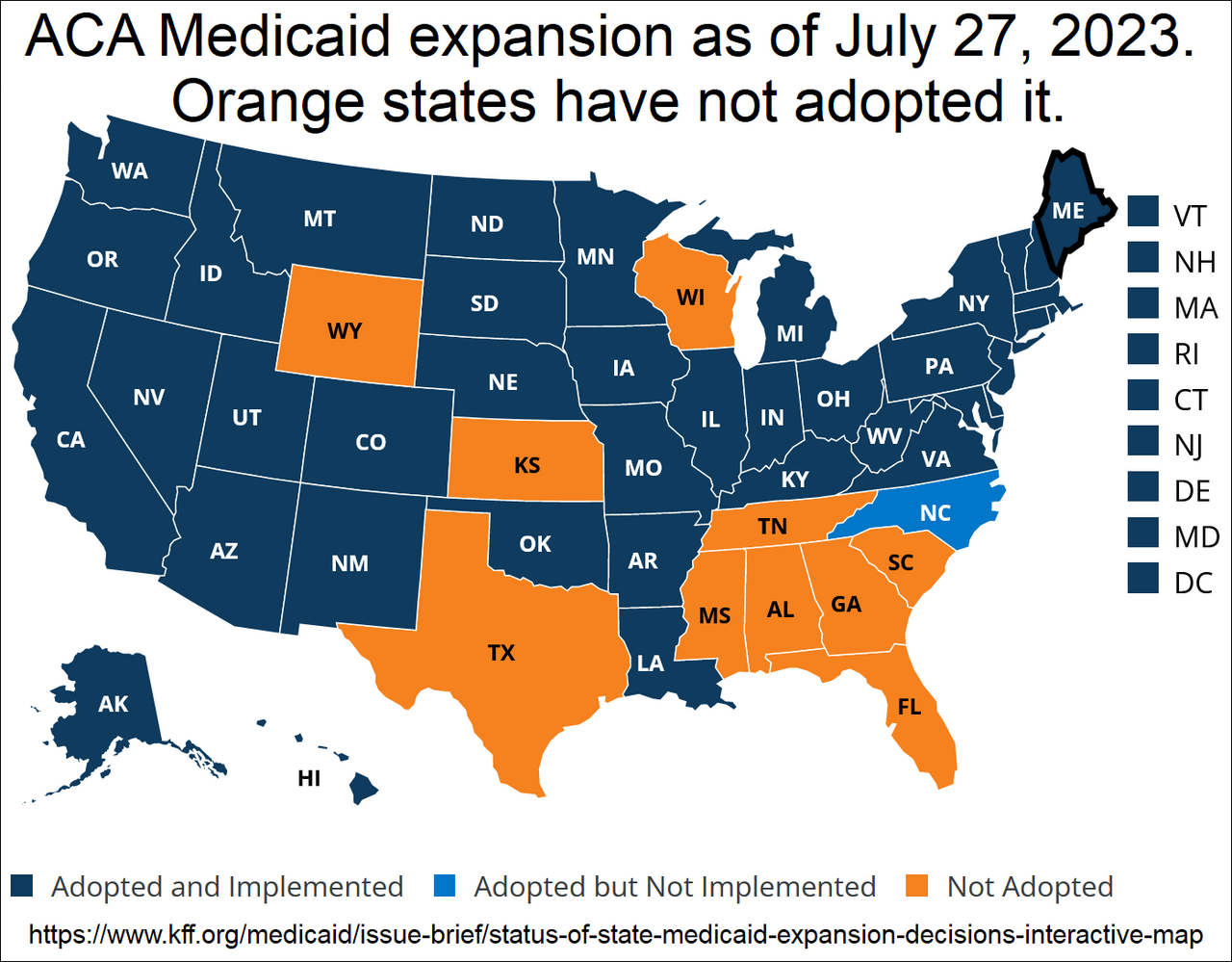
Image source: Wikimedia Commons / KFF. Text and border added later with freeware IrfanView or other image editor. Please add the source article date to the map. This eliminates the need for the date to be in the captions under the map in the many articles using this map on Wikipedia and elsewhere. Larger text for: "Orange states have not adopted it." This makes the map useful even at smaller thumbnail sizes. Copy and paste in image editor: ACA Medicaid expansion as of July 27, 2023. Orange states have not adopted it. Check article date. It is updated at times.
States That Raise MSP Income Limits Above Federal Minimums
Some states are more generous. California, for example, uses higher limits for QMB and SLMB. New York does too.
Maine and Massachusetts also go beyond the minimums. If you live in one of these states, you might qualify even if your income is higher.
States With QI Waiting Lists
QI is funded by a limited federal block grant. When the money runs out, states stop accepting applications. Some states have waiting lists.
Others close enrollment entirely. Apply as early in the year as you can.
States That Offer QDWI
QDWI is optional for states. Not all offer it. Check your state's Medicaid website.
If your state doesn't offer it, you might still qualify for QMB or SLMB.
How to Find Your State Medicaid Income Limits
Go to Medicare.gov or your state Medicaid site. Look for the "Medicare Savings Programs" page. It lists current income and asset limits.
If you can't find it, call your State Health Insurance Assistance Program (SHIP). They offer free help.
For people with a limited work history, other programs might help. Learn about benefits without a full work record.
Don't rely on national articles. They often use old numbers. Always check your state's official page.
The rules change every year.
Step-by-Step: How to Apply for Medicare Savings Program Income Limits Help
Applying isn't hard once you know the steps. The process is mostly paperwork and one interview. Here's how it works, start to finish.
Documents You Need
Gather these before you apply:
- Proof of identity (driver's license or state ID)
- Social Security card or number
- Proof of all income (Social Security award letter, pension statements, pay stubs)
- Bank statements for the last three months
- Proof of any assets (stocks, bonds, retirement accounts)
- Medicare card
- Proof of address
Missing documents cause delays. Get them together first. If you've lost track of some, a payee or income record request can help you pull what you need.
Apply Through Medicaid or SSA
Most states handle MSP applications through their Medicaid office. You can apply online, by mail, or in person. Some states let you apply through the Social Security Administration (SSA).
Call your state Medicaid office or visit its website to find the right path.
If you're married, both spouses must apply separately. Each person has their own income limit. That catches people off guard.
Phone Interview and Determination
Some states require a phone interview. Others don't. If yours does, expect questions about your income, assets, and household.
Answer honestly. The caseworker will verify your answers with SSA and other agencies.
Most decisions come back within 30 to 90 days. If approved, your state Medicaid office pays your Part B premium through the Medicare Buy-In. You don't have to do anything else.
Annual Redetermination and Reporting Changes
Approval isn't forever. Every year, you'll get a redetermination notice. You must respond by the deadline.
If you ignore it, your benefits stop.
Report changes within 10 days. That includes a new job, a raise, marriage, divorce, or a move. If you have trouble with mail delivery, read about getting mail without a fixed address.
Common Mistakes That Cause MSP Denials and Cost You Premium Help
Denials are common. Most are avoidable. Here are the four mistakes we see most often.
Using Outdated Income Limits
The Federal Poverty Guidelines change every year. If you use last year's numbers, you might think you don't qualify. Or you might apply for the wrong program.
Always check the current year's limits before you apply.
Forgetting Social Security COLA
Every January, Social Security benefits get a cost-of-living adjustment. That small raise can push you over the limit. If your COLA bumps you up a bracket, you might drop from QMB to SLMB.
Or from SLMB to QI. Plan for it each year.
Miscounting Household Size
Count the right people. Your spouse counts. A dependent child counts.
A roommate usually doesn't. If you're married but living apart, rules vary by state. Report your household accurately.
Missing Recertification Deadlines
This one hurts the most. You qualify, you get approved, and then you forget to return the recertification form. Benefits stop.
You can lose months of premium help before you fix it. Mark the deadline on your calendar. Respond early.
If you're denied, don't give up. You have the right to appeal. Learn how to track an appeal decision online so you don't miss a step.
Medicare Savings Program vs Extra Help vs Medicaid: What Each One Covers
These three programs sound similar. They're not. Each covers different costs.
Here's how they compare.
Medicare Savings Program vs Extra Help
The Medicare Savings Programs pay your Part B premium. Some also cover deductibles and copays. Extra Help, also called the Low-Income Subsidy, pays for Part D prescription drug costs.
You can qualify for both at the same time.
If you get QMB, SLMB, or QI, you're automatically deemed eligible for Extra Help in most cases. That's a big win.
MSP vs Full Medicaid
Full Medicaid covers far more. It pays for long-term care, doctor visits, hospital stays, and other services. MSP only helps with Medicare costs.
You can have both. In fact, many people on MSP also qualify for full Medicaid.
QMB vs SLMB vs QI vs QDWI
Here's the quick comparison:
| Program | Pays Part B Premium | Pays Deductibles/Copays | Pays Part A Premium |
|---|---|---|---|
| QMB | Yes | Yes | Yes |
| SLMB | Yes | No | No |
| QI | Yes | No | No |
| QDWI | No | No | Yes |
If you want the most coverage, aim for QMB. If your income is too high, SLMB or QI still helps with the Part B premium. For working disabled individuals, QDWI covers Part A.
If you live in a care facility, other benefits apply. Read about benefits for nursing home residents.
Verified Next Steps and When to Seek Free Expert Help
You don't have to figure this out alone. Free help exists. Here's what to do next.
Check Your Current Income Against 2026 Limits
Add up your monthly income. Compare it to the 2026 limits in the tables above. Add your household size.
Then check your state's official MSP page. That tells you which program fits. Do this every January.
Contact SHIP or State Medicaid
The State Health Insurance Assistance Program (SHIP) offers free, unbiased counseling. Counselors know your state's rules. They'll walk you through the application.
Find your local SHIP through Medicare.gov or your state's insurance department.
Your state Medicaid office can also help. Call them with specific questions about your case. They have the final say on eligibility.
Appeal a Denial Safely
If you're denied, read the notice carefully. It tells you why and how to appeal. You usually have 60 days.
Don't wait. Submit the appeal in writing. Include any documents that support your case.
Many denials come from simple errors. A missing pay stub or a misread income figure. Fixing it can flip the decision.
If the first appeal fails, you may have another level of review.
Medicare Savings Program Income Limits FAQs
What are the Medicare Savings Program income limits for 2026?
For 2026, QMB uses 100% of the Federal Poverty Level, around $15,650 for a single person. SLMB uses 120%, about $18,780. QI uses 135%, about $21,128.
QDWI uses 200%, about $31,300. Many states set higher limits.
Do all states use the same MSP income limits?
No. The federal government sets minimums. States can raise them.
California, New York, Maine, and Massachusetts often use higher limits. Always check your state Medicaid website for the exact numbers.
Is there an asset limit for QMB?
Yes, in most states. As of 2026, the QMB asset limit is $9,430 for an individual and $14,130 for a couple. Your home, one car, and personal items don't count.
Some states have removed the asset test entirely.
Can I qualify for QMB if I only have Social Security?
Yes, in many cases. If Social Security is your only income and it falls under 100% of the FPL, you can qualify. The average Social Security check is around $1,900 per month, which may be too high in some states.
Check your state's limit.
What happens if my income goes up?
You must report the change within 10 days. Your state will redetermine your eligibility. You might move to a different program, like SLMB or QI.
Or you might lose benefits entirely. Act fast to avoid overpayments.
Does QI have a waiting list?
Sometimes. QI is funded by a limited federal block grant. When funds run out, states stop accepting applications or create waiting lists.
Apply early in the year for the best chance.
How often do I need to recertify?
Once a year. Your state will send a redetermination notice. You must respond by the deadline with updated income and asset information.
Missing it means losing benefits.
Can I get MSP if I have Medicare Advantage?
Yes. MSP works with Medicare Advantage. Your state still pays your Part B premium.
Some MSP programs also cover cost-sharing. Check with your plan and state Medicaid office.
Does MSP pay for Part A?
Only QMB and QDWI pay the Part A premium. Most people get Part A for free based on work history. If you don't, QMB or QDWI can help.
If you have a limited work record, other options exist.
What if I was denied but my income is low?
Appeal the decision. Many denials come from missing documents or miscounted income. You have 60 days to appeal.
Contact SHIP for free help. If your situation changed, you can also reapply.